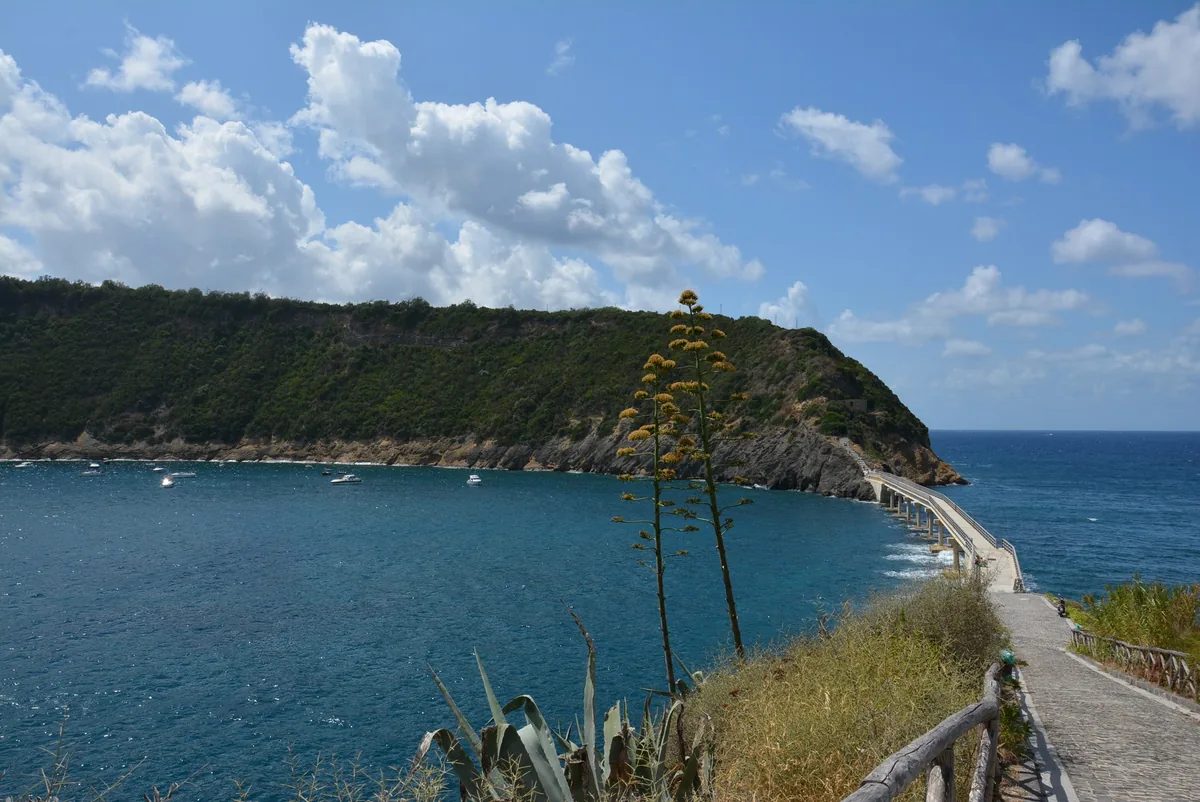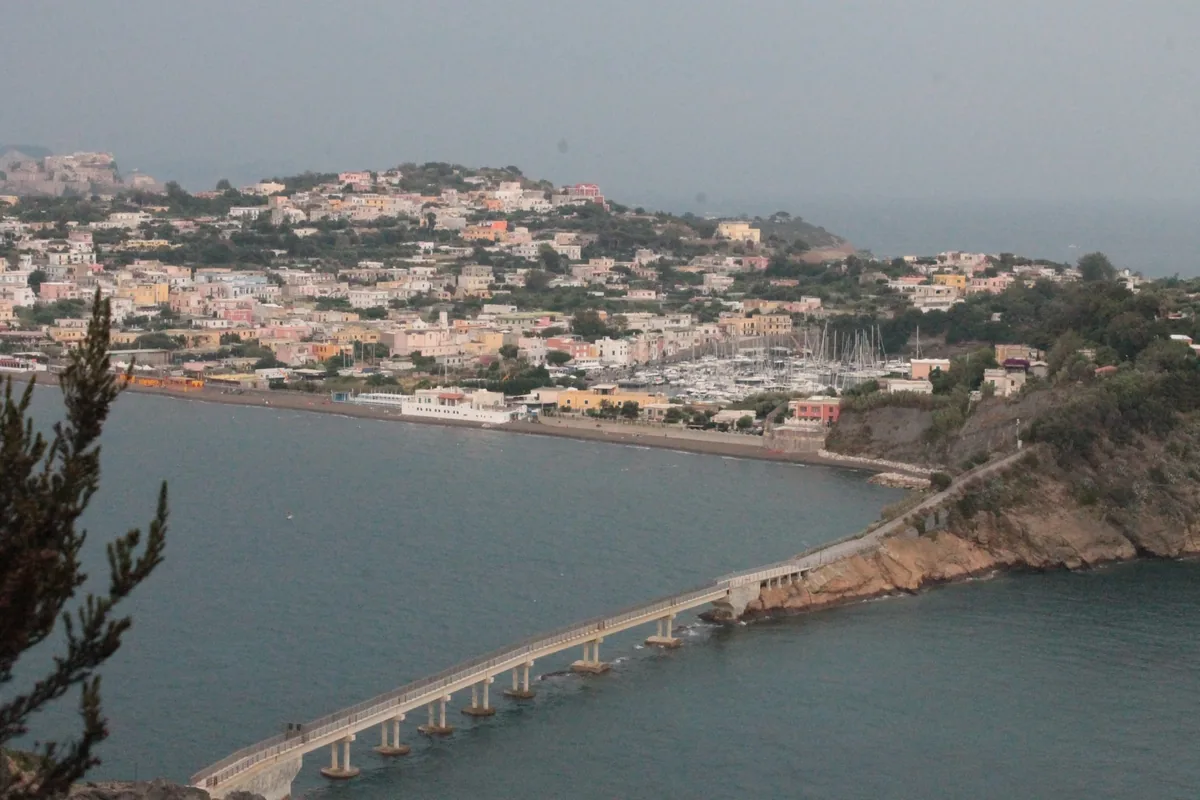
The bridge is narrow, made of iron, and a water main runs under your feet. You walk a few dozen metres above the water, go through the gate, and in ten paces the noise of the Chiaiolella disappears. From here on there are only trees, a path and the guide’s voice. Nobody lives on Vivara, and you notice it straight away.
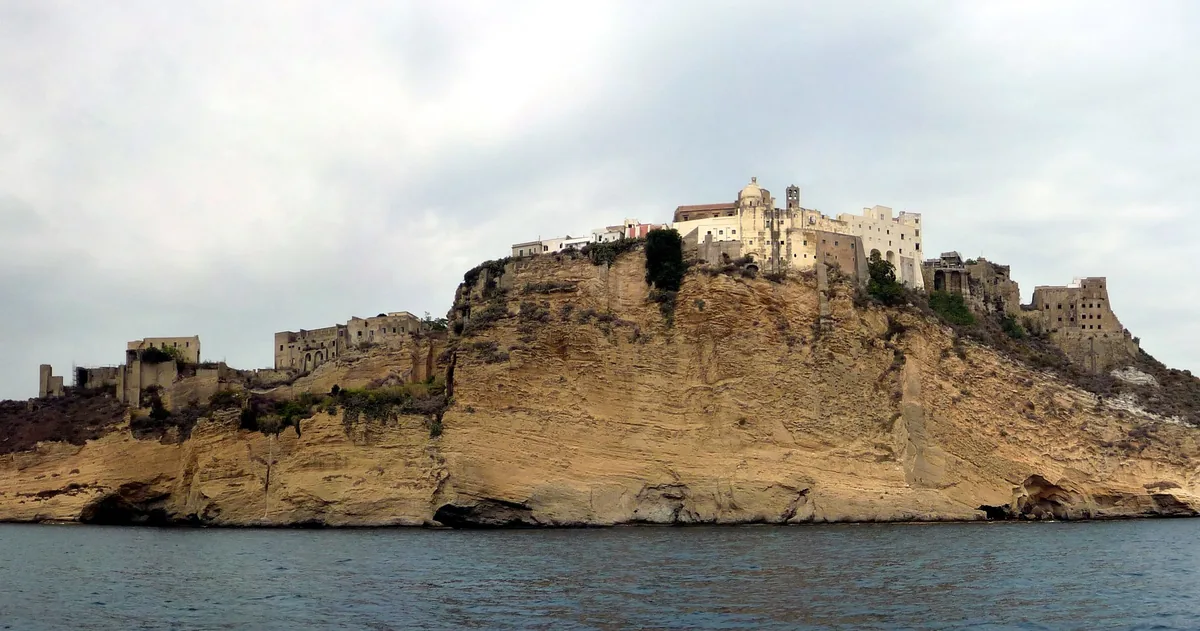
It is a State Nature Reserve, established by ministerial decree on 24 June 2002, of about 36 hectares: a crescent-shaped volcanic islet, privately owned, linked to Procida by a footbridge. It is not a park you walk into and stroll around. It is the only place on the island where getting in means booking, paying and putting the right shoes on, and it is worth understanding why before you reach the gate.
The rules that matter
Guided visits only, and only with an online booking. There is no ticket office at the bridge. Monday is closed. Flip-flops and unsuitable footwear are forbidden: you need walking boots, and anyone who turns up without them does not get in. This is not a polite form of words.
The slots have a fixed capacity: a maximum of 25 visitors at a time, lasting 2 hours 30 on average. It means that in the full months the places run out, and that turning up at the bridge hoping for a free place is the surest way to lose your morning.
The ticket office is online, at liveticket.it/vivararns. There is no published telephone number: the only contact is the address [email protected]. If you need a confirmation, write a few days in advance.
2026 opening hours
The official calendar for the 2026 season is published up to 1 November and changes three times in the space of two months, so read it carefully.
- From 28 August to 10 September: departures at 09:30 and 16:30.
- From 11 September: departures at 09:30 and 16:00.
- From 25 September: Friday to Sunday only, with a single slot at 09:30.
On Monday the reserve is closed in every period. That change on 25 September is the point where almost everybody gets it wrong: people who arrive at the end of September or in October expecting two slots a day find themselves with three usable days a week and a single departure time. If Vivara is the reason for your trip, build the dates around this, not the other way round.
What it costs
The 2026 prices are published by the reserve and they are clear, which is not a given on Procida: adults 10.00 EUR, children from 8 to 12 years 3.00 EUR, Procida residents 5.00 EUR, groups over 25 people 6.00 EUR per person, school parties 3.00 EUR. Under 7 there is nothing to pay, and entry is free for people with disabilities.
For what you get — two and a half hours with a guide, in an area closed to the public the rest of the time — ten euros is money well spent. It is probably the best value entry ticket on the island.
What you see
Vivara is small: about 0.4 km² of surface, a perimeter of 3 kilometres and a highest point at 110 metres. The crescent shape is the surviving rim of a crater: on the age the sources do not agree — Wikipedia says about 55,000 years, other reference works about 40,000, while the figure of 4,000 years that often goes round refers to the prehistoric settlement, not to the volcano. Let us say tens of thousands of years and leave it there.
The archaeology is serious. There is a Bronze Age settlement here with imported Aegean pottery, datable to between the 17th and the 14th century BC, identified in the 1930s by the archaeologist Giorgio Buchner; systematic excavation began around 1975. It means that three thousand five hundred years ago this islet was a trading node in the Mediterranean.
What it is not should be said as well. You do not swim, there is no serviced beach, there is no bar and you do not wander about on your own: you stay with the group, on the path, for two and a half hours. Anyone after a day by the sea has the wrong place and would do better to stay on the Chiaiolella beach, two hundred metres away.
Anyone who comes for the nature and the silence, on the other hand, finds something rare in the bay of Naples: an island with no inhabitants, no roads and no houses, one bridge away from a marina. In an area as built up as this one, forty years of banned access have done what no landscape plan manages to do.
The coast falls within the Regno di Nettuno marine protected area, and the Mediterranean scrub, grown up without inhabitants, is dense. Do not expect continuous views: you often walk inside the vegetation, with sudden openings onto the sea and onto Procida.
The bridge
The footbridge starts from the Chiaiolella and is not open to vehicles. It also carries the water main that supplies Ischia: before being a way in for visitors it is a piece of infrastructure, and that explains why it is so unassuming.
Walking as far as the gate is free and worth the stroll, especially towards sunset, when the sun goes down behind the islet. But the gate is the point where you stop without a booking, and there is no arguing about it: there is nobody on the other side to persuade.
How to organise yourself
Book online before you set off, choose the 09:30 slot — in summer the afternoon one is much hotter — and pack real walking boots, not city trainers. Take water: it is two and a half hours on foot and there is nothing on the islet.
You reach the Chiaiolella on the L2 bus from the terminus at Marina Grande, or by car and scooter: road access is direct, and it is the easiest part of the island. The real timetables for the lines are in getting around Procida.
On the way back, the seafront at the little harbour is a few minutes away: Da Mariano is one of the addresses Procidans mention first, and the Chiaiolella beach is right next to it for a swim after the walk. The full route is in the Chiaiolella-Vivara walk, the details of the visit on the page for the guided visit to Vivara.