The answer is May, June or September, and it is not an original answer: it is the same one anyone who lives here would give you. What changes is the reason. You do not come in these months because the island is unliveable in summer — it is not — but because in May and September the sea is still good, the evening ferries are still running, and you can get a table on the quay without ringing three days ahead.
Then there is the question of the crowds, which needs cutting down to size with numbers. In the summer of 2026 Procida recorded 236,000 sea arrivals. Ischia had more than 860,000, Capri about 1,050,000. When you read that Procida is crowded, bear that in mind: the island takes little more than a fifth of Capri’s arrivals. Tourist pressure here is of another order of magnitude.
On the climate we are cautious: we do not publish temperature tables. We have no climate data for Procida from a reliable meteorological source, and we would rather say so than fill a table with invented numbers. What the local sources report is a qualitative description: mild all year, never muggy in summer, never harsh in winter. Here the difference between the months is made by the connections and the crowds far more than by the thermometer.
May, June, September
May is the month when the island gets going again. The tourist season starts at Easter and by May it is under way: the restaurants have reopened, the boat trips are running, the days are long. The sea is still cool for staying in the water any length of time, so it is a month for walks, villages and photography rather than for the beach. On 8 May there is the feast of San Michele, the patron saint. The whole month is in Procida in May.
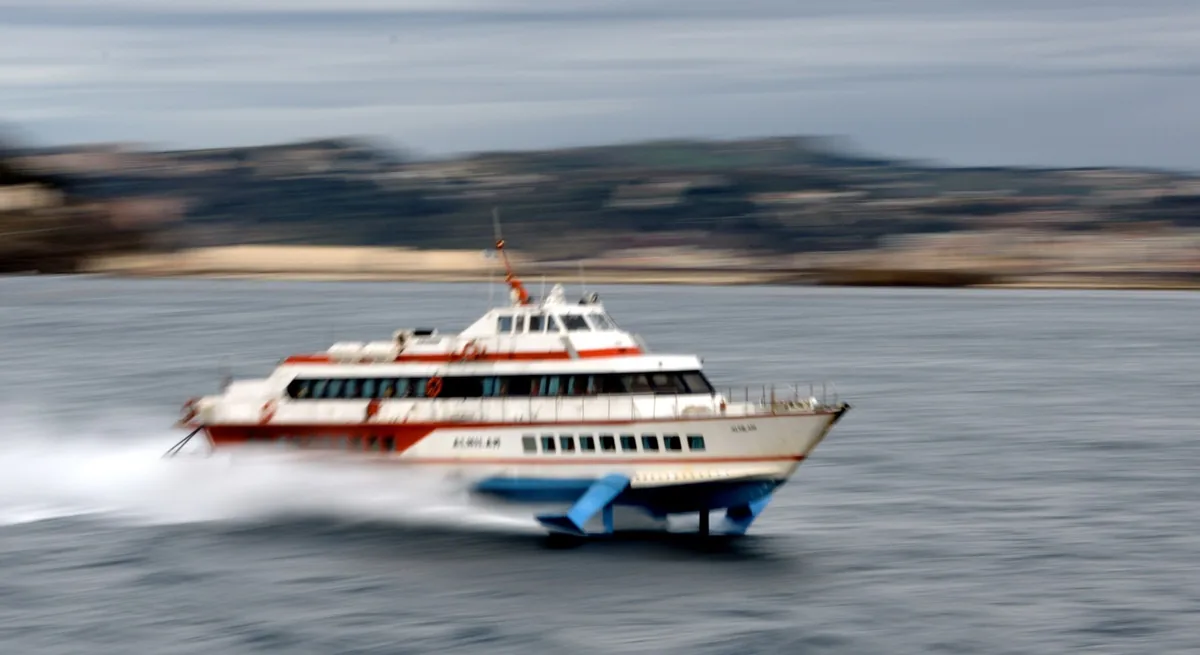
June is the best compromise for anyone who wants the sea. The water has come up to temperature, the evening ferry sailings are running — the 21:05 hydrofoil from Naples restarts on 1 June, the 20:05 from Procida on the 15th — and prices have not yet reached the August peak. Details in Procida in June.
September is the month I would recommend first. The sea stays warm all month, the day trippers thin out from the second week, and the light is the best of the year for photographing Corricella. On 29 September there is the second feast of San Michele, the one that matters more. One thing to watch: from 25 September visits to Vivara are cut back to Friday, Saturday and Sunday. It is all in Procida in September.
Outside those three, spring and autumn work well for weekends of two or three nights, when you do not need the beach but you do need the town to be open.
What “crowded” actually means here
It is worth looking at the numbers in a row, because they overturn the idea you form from reading the guides.
| Island | Arrivals, 1 Jun – 31 Aug 2026 | Area | Inhabitants |
|---|---|---|---|
| Procida | 236,000 (-1,000) | 3.7 km² | 10,034 |
| Ischia | more than 860,000 (+20,000) | 46.3 km² | about 70,000 |
| Capri | about 1,050,000 (-20,000) | about 10 km² | about 14,000 |
These are landing counts picked up by the local press on 03/09/2026, covering 1 June to 31 August 2026. They count passengers landed rather than visitors: someone arriving twice is counted twice, and private boats stay outside the figure. The most telling comparison is with Capri: 4.4 times Procida’s arrivals on an island only 2.7 times bigger, and with barely 5,500 beds a day. It means that on Capri almost everyone is a day tripper, arriving and leaving on the same day, concentrated into the same hours and the same two or three places.
Procida is built differently. About 90 places to stay and 53 restaurants on the whole island: it is not organised around mass tourism, and its numbers are accordingly stable, with a thousand fewer arrivals than the year before. Add that 10,034 residents on 3.7 km² make one of the highest population densities in Europe for an island: civic life here goes on in January too, and in August the Procidans are still the majority.
The honest conclusion: even in August, Procida is not Capri. What you feel in high season is the pressure on a few narrow points — the quay as the ferries come in, the Corricella waterfront at dinner time, the Chiaia stairway in mid-afternoon — not an island overrun. The full comparison between the three islands is in Procida, Ischia or Capri.
July and August: what you gain and what you lose
We are not going to demonise the summer, because it has concrete advantages. The connections are at their maximum: the L1 runs every fifteen minutes, with 110 services a day from 05:20 to 00:15, which stays the last service in high season too: there is no night bus on the island. The evening ferry sailings are running. The links from Ischia and the other islands increase. Every beach club, boat trip and restaurant is open. If you are travelling with teenagers and want the sea all day, summer is the right time and there is nothing to justify.
What you lose is the quiet in the middle of the day, and availability. The big beaches — Chiaiolella and Ciraccio, the only ones with direct road access — fill up; tables on the Corricella quay have to be booked; rooms cost more. The price bands recorded in May 2026 give 80-180 EUR for a double in a three-star or a B&B and 160-280 EUR for a sea-view four-star: the top of those ranges is the summer.
A hard figure for the exact peak of day trippers is something we do not publish, because we do not have it. What we can tell you is visible to the naked eye: the island fills up at the times the ferries dock and empties after the last sailing. If you sleep here, in the evening the island is yours again.
Winter: the real cost of coming out of season
Here we need to be precise, because "Procida is lovely in winter too" is true and incomplete at the same time. The true part: the climate stays mild, the island has ten thousand inhabitants and a life that does not stop, the villages do not close, and seeing Corricella with nobody in it is an experience that does not exist in August.
The part nobody writes:
- The buses finish around 21:00. From October to May the last service is at that time. If you eat a long way from the port, you have to organise the way back yourself.
- The evening ferry sailings disappear. The 21:05 hydrofoil from Naples runs from 1 June to 30 September; the 20:05 from Procida from 15 June to 15 September. Outside those windows, the last useful return is early.
- Seasonal businesses close. The boat trips, the beach clubs, some of the restaurants. Vivara has a calendar published as far as 1 November.
- The abbey of San Michele is open to visitors from Holy Week to All Saints’, 1 November. Outside that period the opening service is not guaranteed.
All that said, winter works for one particular kind of trip: two nights, few demands, walks, one restaurant open in the evening and waking up to an empty port. It does not work if you are after a holiday full of things to do.
One last note on dates to mark: Holy Week with the Processione dei Misteri is the year’s most defining event and it falls out of season, between late March and April. On those days the island is full, but full of Procidans, which is quite another thing.
How to decide, in two questions
Do you need the sea? If so, the useful window runs from June to September, with September at the head: water still warm and fewer people. If not, May and October give you the same island with half the people and lower prices.
How many nights have you got? With a single night, or even on a day trip, any month works: read Procida from Naples in a day. With two or three nights, spring and autumn are the period this island seems made for: look at a weekend in Procida.
There is one case where the island decides the date for you: if you want to see Vivara, check the calendar before booking the ferry. The reserve admits a maximum of 25 visitors per slot, guided visits only, with online booking, and from 25 September it cuts back the days. It is not the sort of thing you can sort out by turning up.