The first thing to say is also the most useful: nearly always you need none of it. Procida is 3.7 km² and you can cross the whole of it on foot in about forty minutes. From Marina Grande, where you land, you climb to Terra Murata in about ten minutes uphill and drop down to Corricella in about ten minutes downhill.
The bus is useful for three real things: the luggage on the day you arrive, the climbs when it is hot, and the evenings when you cannot face the stairway again. The rest of getting about on the island is micro-taxis, scooters and bicycles, with one detail worth knowing beforehand: from late March to mid-October non-residents cannot land vehicles, so your own car is not an option in high season.
Here you will find the EAV lines with their real routes, the fare we have checked, what hire costs, and one thing we do not tell you: how long the ticket is valid for, because the sources do not agree and we have no intention of inventing it.
The EAV lines, one by one
All the buses leave from the same place: the Marina Grande terminus, by the church of Santa Maria della Pietà, a few steps from the quay. There is no station: there is a square and some shelters.
- L1 — Porto / Chiaiolella / Porto. This is the island’s spine, the line you will use most. It links the port to the south-western marina, crossing the built-up area.
- L2 — Porto / Chiaiolella / Solchiaro / Porto. Like the L1 but with the detour towards Solchiaro. It is the line for the big beaches: Chiaiolella and Ciraccio.
- C1 — Porto / Pozzo Vecchio beach / Porto. The circular that goes to the Il Postino beach, below the cemetery.
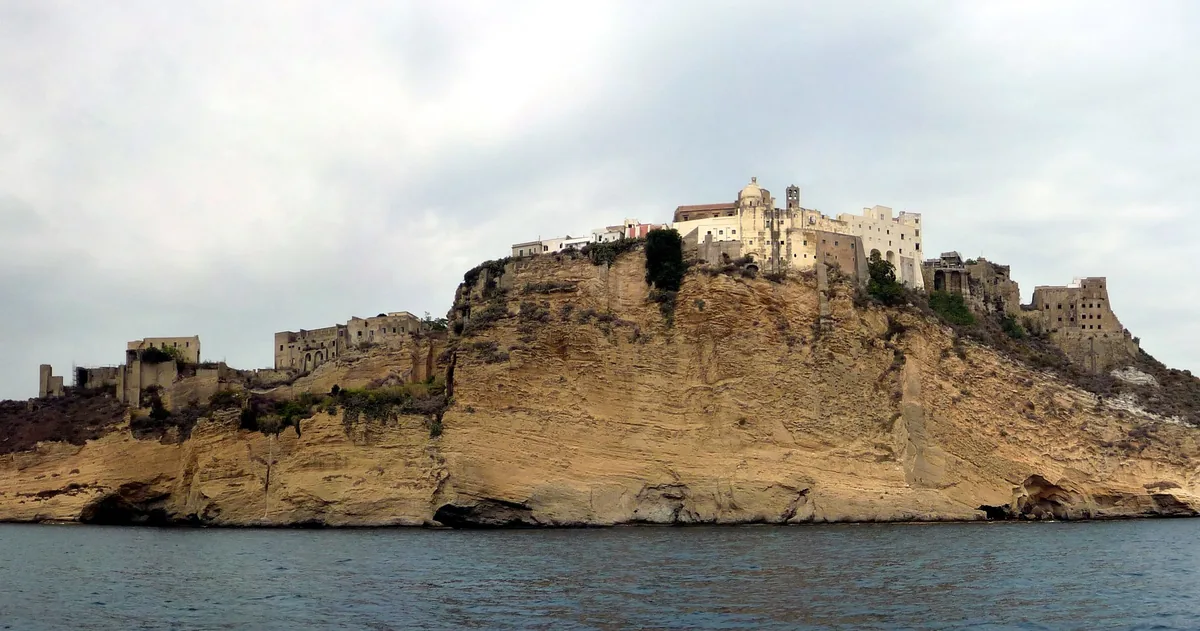
- C2 — Porto / Terra Murata / Corricella / Porto. This is the line for the two upper villages, the one that saves you the climb to the abbey and the belvedere. If you are going up to Terra Murata in the heat, or with someone who struggles, this is the one you want.
- L7 — link with the health centre. Ten services, from 07:50 to 14:05. It is not a tourist line.
An inconsistency about the lines. The official EAV description of the routes assigns Terra Murata and Corricella to the C2. Some tourist sources also list the C1 and the L1 for the climb to Terra Murata. If in doubt, ask the driver at the terminus: it is a single question and it is settled in ten seconds.
Tickets, frequencies and the thing we do not tell you
The ticket costs 1.20 EUR if you buy it ashore — in the bars, the tobacconists, the newsagents — and 1.40 EUR if you buy it on board. It is twenty cents, but the point is not the saving: it is that on board they do not always have any, and there are no machines at the stops. Buy three or four as soon as you land, in one of the bars on via Roma, and your day is sorted.
On how long the ticket is valid we do not publish a number. One source says 60 minutes, another 90. They are not the same thing and we have no way of establishing which is correct. If you need certainty — to make a return trip on one ticket, for instance — ask when you buy it, or call EAV on 081 810 1241.
The average frequency is about one service every thirty minutes. In summer it changes a great deal: the L1 gets up to one service every fifteen minutes, with 110 services a day, the first at 05:20 and the last at 00:15 (figures recorded on 06/07/2026). There is no night service even in high season: the EAV summer timetable, in force from 6 July 2026, counts 55 runs in each direction, every one marked «Ord» — that is, daily — with the last departure from the port at 00:15 and from Chiaiolella at 00:35.
Out of season, from October to May, the last service is around 21:00. That is the figure that genuinely changes a winter holiday: if you eat at Chiaiolella in November, the way back on foot or by taxi has to be allowed for before you sit down at the table. We go into it at length in when to visit Procida.
The micro-taxis, which here are ape cars
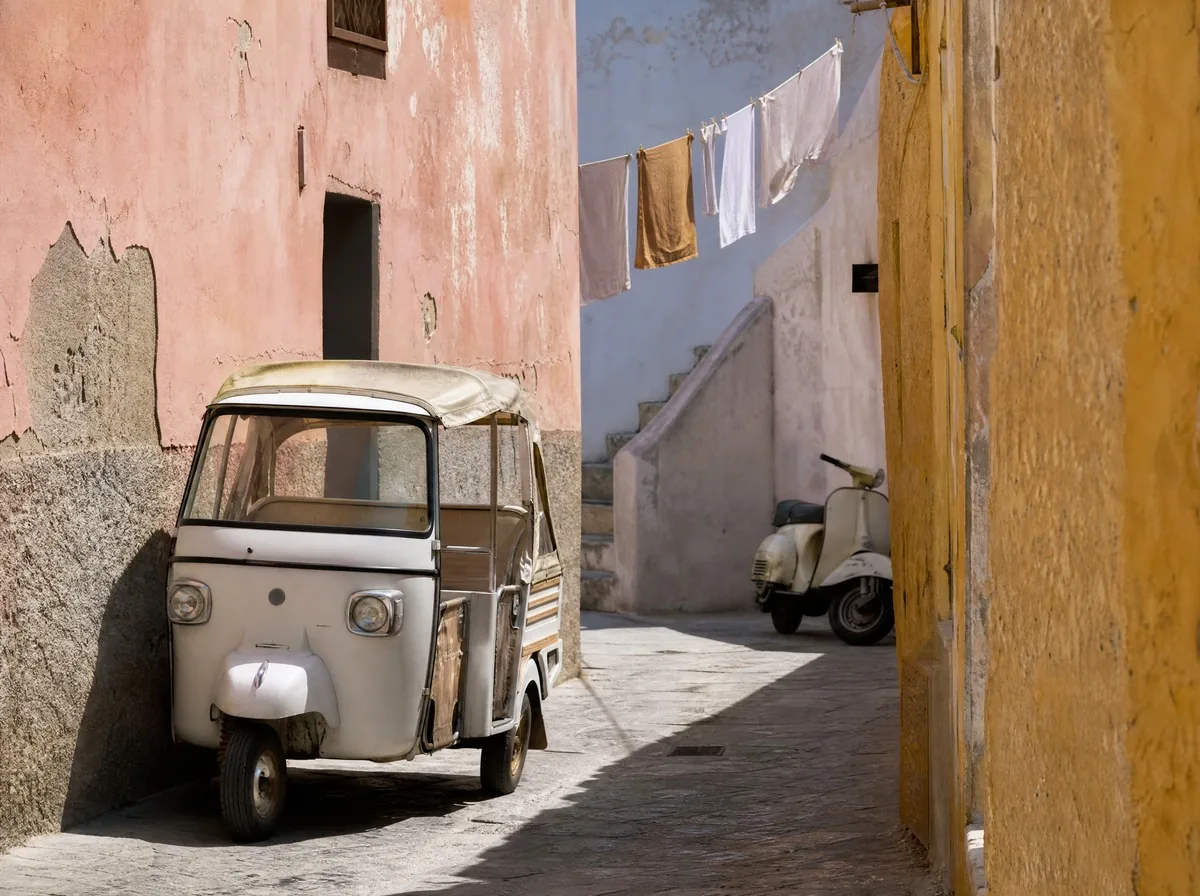
The Procida taxi is not a car. It is an ape car with a covered trap, four to six seats, narrow enough to get through the alleys and allowed into the restricted-traffic zones where cars do not go. Many of the drivers also do a guided tour of the island, and it is an honest way to see the perimeter in an hour if you are short of time or have difficulty walking.
On the price the sources do not agree, and we will tell you so plainly. One tourist portal gives a stated flat fare of 15 EUR per trip, with no meter. Other sources say only that the price is agreed with the driver and should be asked for before you get in. The two things can coexist — a reference fare and a negotiation — but there is only one practical rule: agree the figure before you set off, not at the end of the ride.
Bookings are on 081 896 8785. In high season, as the ferries come in, the micro-taxis are waiting on the quay: if you land with suitcases and are sleeping up the hill, it is the quickest way not to drag them uphill.
Scooters, bikes, cars: when they make sense
Indicative hire prices on the island are about 25 EUR a day for a scooter, about 10 EUR for a bicycle and about 50 EUR for a car. There are e-bikes at the port too, which on an island made of climbs are the most sensible of the three. There is also an electric car-sharing service.
Our advice is blunt: you do not need a hire car. The local sources say so too, and for two concrete reasons. The roads are narrow, often one-way and full of pedestrians; there are few parking spaces. On an island you cross on foot in forty minutes, a car is an expense that creates problems instead of solving them.
A scooter makes sense in one case only: if you are sleeping a long way from the port, have several days and want to move about at times when the buses do not run. Even then, remember that nothing on wheels reaches Corricella: the village is entirely pedestrian and you go down by stairway.
The bicycle is for those with legs and patience. The coastal perimeter is about 16 km, but the ground rises and falls constantly. With an e-bike the matter changes considerably.
On parking on the island we publish neither rates nor rules: no reliable source makes them known. That is consistent with the fact that for half the year non-residents do not land vehicles. If you arrive in low season with a car, ask your accommodation directly where to leave it.
On foot: what we know and what we do not
The measurement that counts: you cross the whole island on foot in about forty minutes. From Marina Grande it takes about ten minutes uphill to reach Terra Murata and about ten minutes downhill to drop to Corricella. Those are the three figures we have verified, and they are also the ones you will use most.
Two timings we do not give you. We do not publish how long it takes on foot from Marina Grande to Chiaiolella, nor from Corricella to Chiaiolella: no reliable source reports them and we have no intention of estimating them. For those two stretches use the L1 or the L2, which is exactly why they exist.
One warning that applies to everybody. The stairways here are not a picturesque detail: they are the infrastructure. You get down to the Chiaia beach by a long stairway — sources say 182 or 186 steps, so count on about a hundred and eighty — and you come back up the same one. At Corricella you go down by four different stairways. With a large wheeled case, a pushchair or a bad knee, these stretches have to be planned, not improvised.
Anyone with mobility problems has two real tools: the C2 line for the upper villages and the micro-taxi, which goes where cars do not. The full route between the upper village and the lower one, with the stairways in the right order, is in the Terra Murata-Corricella walk.
The other network: the sea
The most Procidan way of getting about is not by road. A boat service links Corricella to the Chiaia beach, and it is the alternative to the hundred and eighty steps: it costs something, but it saves you the climb back at the worst hour of the afternoon.
To see the island from the water there are boat trips from the little harbour: the full circuit, the swim stops, hire without a licence. They are gathered under experiences, with prices and durations. It is worth doing one for a practical reason alone: you only really understand Corricella from the sea, and that is where the coloured houses line up as they do in the photographs you have seen.
The footbridge to Vivara starts from Chiaiolella and is not open to vehicles: you cross it on foot, and only on a booked guided visit.