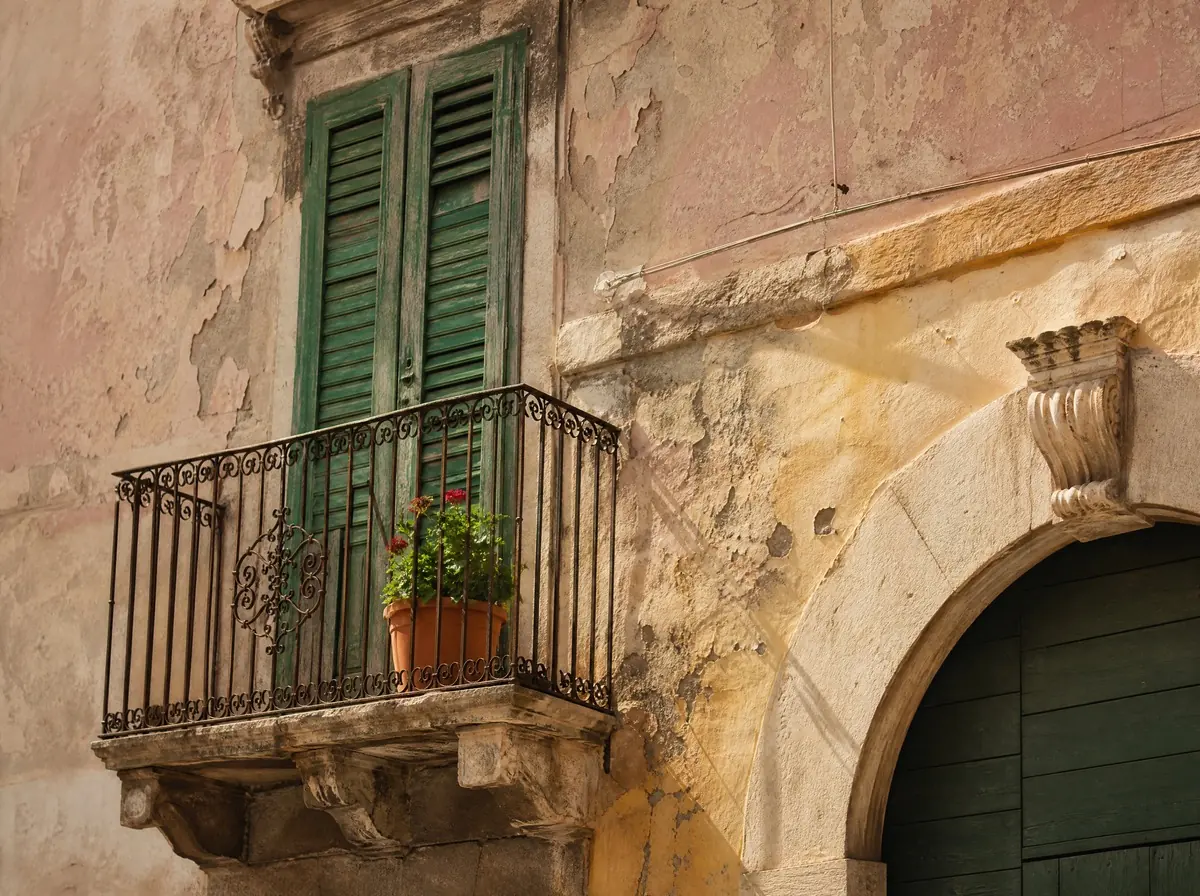
Procida really is small: 3.7 km², 10,034 inhabitants, a coastal perimeter of some sixteen kilometres and a highest point that stands at 91 metres. You can walk right across it in about forty minutes. That means two things. The first is that you do not need a military plan to see it. The second is that the real risk is not time, but arriving in front of a closed door: on the island the hours change with the season, an important monument can only be visited by booking, and the most interesting natural attraction will not let you in if you are wearing flip-flops.
This guide lines up everything worth seeing in the order it is worth seeing it, starting from the quay and climbing. Where there is a firm figure you will find it written down; where the sources disagree we say so; where something is closed we put it first, not last. Let us begin with the note that saves the most disappointment: the underground levels of the Abbey of San Michele cannot be visited, even though a great many guides go on promoting them.
The first quarter of an hour: Marina Grande
You land at Marina Grande, the port that Procidans also call Sent’Co. In front of you is the harbour front of via Roma, with the bars, the restaurants and the bus terminus; on the square is the church of Santa Maria della Pietà, the first building you see arriving by sea. Its story begins in 1616, when the shipowners of the Pio Monte dei Marinai asked the viceroy for a chapel dedicated to the Madonna della Pietà: it was completed in 1619, enlarged at the end of the seventeenth century and then around 1760, when the original chapel ended up absorbed into the sacristy. Inside there are two canvases from 1722 by Antonio Fumo, a wooden pulpit from 1744-45 and a high altar from around 1766; outside, a baroque bell tower with a four-faced clock. Entry is free; the hours that circulate (9:00-20:00) do not come from the parish, so treat them as indicative and expect closures during services.
All the EAV buses leave from here. You will need two or three lines in all: the C2 climbs to Terra Murata and Corricella, the L2 goes to the Chiaiolella and the Ciraccio, the C1 goes to the Pozzo Vecchio beach. A ticket costs 1.20 EUR bought on land, 1.40 EUR on board. In summer the service is dense, with the L1 trunk line running every fifteen minutes; from October to May the last departure is around 21:00, and that shapes your evenings. Everything else is in how to get around Procida.
If you have two hours and no more, the Silurenza is five minutes on foot from the quay: it is the beach that solves a wait.
Terra Murata: the most important piece of the island
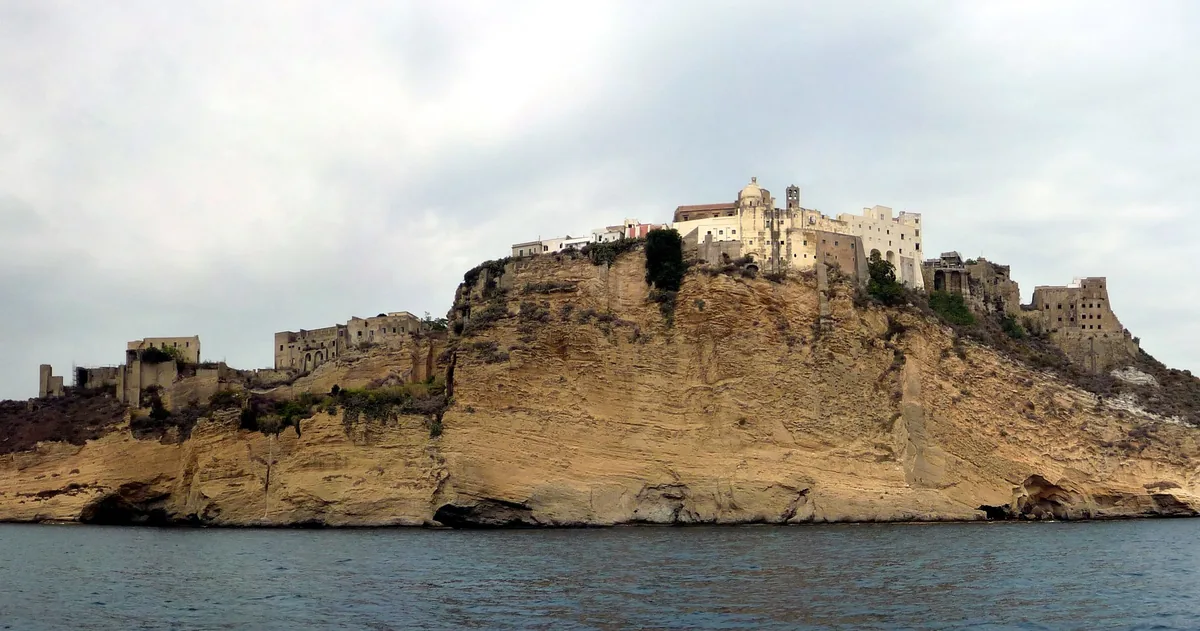
If you have to choose one thing only, choose this. Terra Murata is the fortified village at the top of the island, the acropolis, the highest inhabited point and the place from which you understand the geography of everything else. It became a fief of the d’Avalos family in 1529, and the system of walls and towers is attributed to Cardinal Innico d’Avalos d’Aragona; two historic gates remain, Porta di Ferro and Porta di Mezz’Omo. At the Belvedere dei Cannoni there are two long-range cannons of the Neapolitan Republic of 1799, and close by is the permanent museum of the best Misteri from the Good Friday procession.
You climb up on foot from Corricella, on a steep slope that you feel in summer, or with the C1 and L1 buses. It is not a route suited to wheelchairs. Access to the village is free: there are no hours and no tickets, it is a public open space.
Abbey of San Michele Arcangelo
The abbey is the island’s symbolic monument and, in 2026, it celebrates its millennium: the monastic presence is documented from 1026, while the architecture you see is sixteenth-century. Entry is free, with a voluntary offering to the parish, and the guided explanation is free too, run by the Associazione culturale Millennium. The official 2026 hours: Monday 10:00-13:00, Tuesday to Friday 10:00-13:00 and 16:00-18:00, Saturday 10:00-13:00, Sunday 11:00-13:00, with the feast-day mass at 09:30 and no visits during the liturgy. The opening service runs from Holy Week to All Saints. Note: the official site warns that in the Millennium Year the calendar may change or be suspended without notice, so check again before you climb.
Inside you will find the 1770 bellows organ by Domenico Antonio Rossi, in carved and gilded wood, and the statue of San Michele donated in 1811. Below there are three underground levels with the eighteenth-century Neapolitan nativity scene, the chapel of San Michele with eighteenth-century frescoes restored in 1907, a library of about 8,000 volumes with sixteenth-century parchment choir books and an atlas from 1570, and the room called "La Segreta", which holds a Deposition of Christ from 1746 by Domenico Guarino. None of this can be visited. The official site states that at present the underground levels cannot be visited: if a guide sells them to you, they are selling you something that is not there.
Palazzo d’Avalos
Palazzo d’Avalos is the island’s strongest story and the visit that is hardest to organise. Built in the sixteenth century by the d’Avalos, governors of Procida until the eighteenth century, it was turned by the Bourbons into a military school and then into a prison of the kingdom: penitentiary function from 1830, definitive closure in 1988. It is not a building but a complex: palace, courtyard, guards’ barracks, wing of single cells, veterans’ quarters, infirmary, governor’s house, farmland. Inside there remain cells with rusted iron beds, prisoners’ personal effects and a surgical room. The State acquired the complex in 2013 and guided visits began in 2016; in June 2025 it reopened with the permanent installation "Non ho aspettato altro che il giorno pieno" and a video room showing the documentary Terra Murata by Domenico Palma. A hundred and forty years of prison left a domestic mark: almost every Procidan family keeps an object made in there.
The practical part, plainly: you get in only on a guided visit, booked two days in advance, minimum two and maximum twenty people, lasting about an hour, ticket 13.00 EUR a person, free under 6. And above all: the hours are not verified. We found three different calendars on three different sources and we are not picking one at random. Write to whoever organises the visits before you climb, not after.
Santa Margherita Nuova and Casale Vascello
The church of Santa Margherita Nuova, with the former Dominican convent, sits on the ridge between Corricella and Terra Murata: it was built from the second half of the sixteenth century, when the Dominicans came up here from the Chiaiolella to escape the Saracen raids. After the collapses of the winter of 1956, the restoration of the church was completed in September 2012, while that of the convent is still under way; on the lower levels there is a remarkable system of cisterns. Today it hosts exhibitions and the hours that circulate (Monday to Friday 10:00-19:00, closed at the weekend) are tied to whatever is on show: check on the spot, and do not take access to the interior for granted. The terraces give one of the most classic views from above over the Corricella.
Just below, the Casale Vascello is a fortified courtyard settlement of the seventeenth century, the first residential nucleus outside the walls, with the coloured houses built up against each other to block an enemy’s passage and a large central courtyard. It has two entrances, on Via Principe Margherita and on Via Salita Castello, and it is not a given that both are open. Remember that it is an inhabited courtyard, not a monument: no hours, no tickets, and a little discretion.
Corricella, and the right way to get there
Marina Corricella is the oldest fishing village on the island; the port as you see it is seventeenth-century. It is the image that brought you here: arches, domes, stairs, loggias and multicoloured facades, with the vefi — the small covered balconies with an arched vault, Arab in influence — which are the most recognisable local element.
The thing to know before you go down: there is no vehicle access. The village is entirely pedestrian and you reach it only by four stairways — the Gradinata del Pennino from via San Rocco, the Gradinata Scura from via M. Scotti and two from the ends of the port — or by sea. With luggage or with mobility problems it is a real obstacle, not a picturesque detail. From Marina Grande it is about ten minutes downhill; the way back is uphill.
On the quay you eat and you watch: La Lampara, Caracalè, Il Pescatore and Fuego, which is the village’s budget bracket. The little square is called Piazzetta Massimo Troisi, and that brings us to the other reason people come here.
The best way to link the two upper villages is the Terra Murata–Corricella walk: you climb once only and come down looking at the bay, instead of doing the same ascent twice.
The cinema, and the year as capital of culture
In 1994 Il Postino was filmed here, with Massimo Troisi as Mario Ruoppolo and Philippe Noiret as Neruda: the Pozzo Vecchio beach is the most recognisable location, and ever since it has been called the Postino beach even by people born here. Which other corners are confirmed by the sources and which are island storytelling we have set out on the page about the locations of Il Postino.
Then there is the literature: Procida is the setting of L’isola di Arturo by Elsa Morante, and out of that novel comes a town prize founded in February 1986 and still running. The history and the few genuinely documented places are in the dedicated article.
In 2022 the island was Italian Capital of Culture, the first Italian island to receive the title, designated on 18 January 2021 with the slogan "Procida, la cultura non isola": 150 events in 330 days, 350 artists from 45 countries. The most concrete legacy is the restoration of Palazzo d’Avalos.
The beaches, in order of practicality
There are six and they are all free, of dark volcanic sand except one. The difference is made by access and wind, not by beauty. The full picture, with the reasoned ranking, is in the guide to the best beaches of Procida.
- Chiaiolella: the best served, with direct road access, the L2 bus, beach clubs and restaurants behind the sand. Shallow water, sun all day, a view of Vivara and Ischia.
- Chiaia: the most sheltered, with shallow water a long way out. No road reaches it: you go down a stairway of about 180 steps (sources say 182 or 186) or you arrive by boat from Corricella.
- Ciraccio: long, open, with a road and a bus, plenty of space and the maestrale that comes in during the afternoon.
- Silurenza: five minutes from the quay, convenient, small, with a rock the local kids dive off.
- Pozzo Vecchio: the Postino bay, below the cemetery, with a short but steep descent and almost no shade.
- Lingua: tiny, pebbly, next to the port, with a pink light at sunset that is the only reason to go down.
One rule for all of them: no beach club publishes its rates. You ask the price on the beach, and the free stretch stays free.
Chiaiolella and Vivara: the part you have to book
At the south-western end is the Chiaiolella, marina and marina harbour, with the widest beaches, the services and the seafront restaurants such as Da Mariano and Da Girone. The road reaches it and so does the L2 bus.
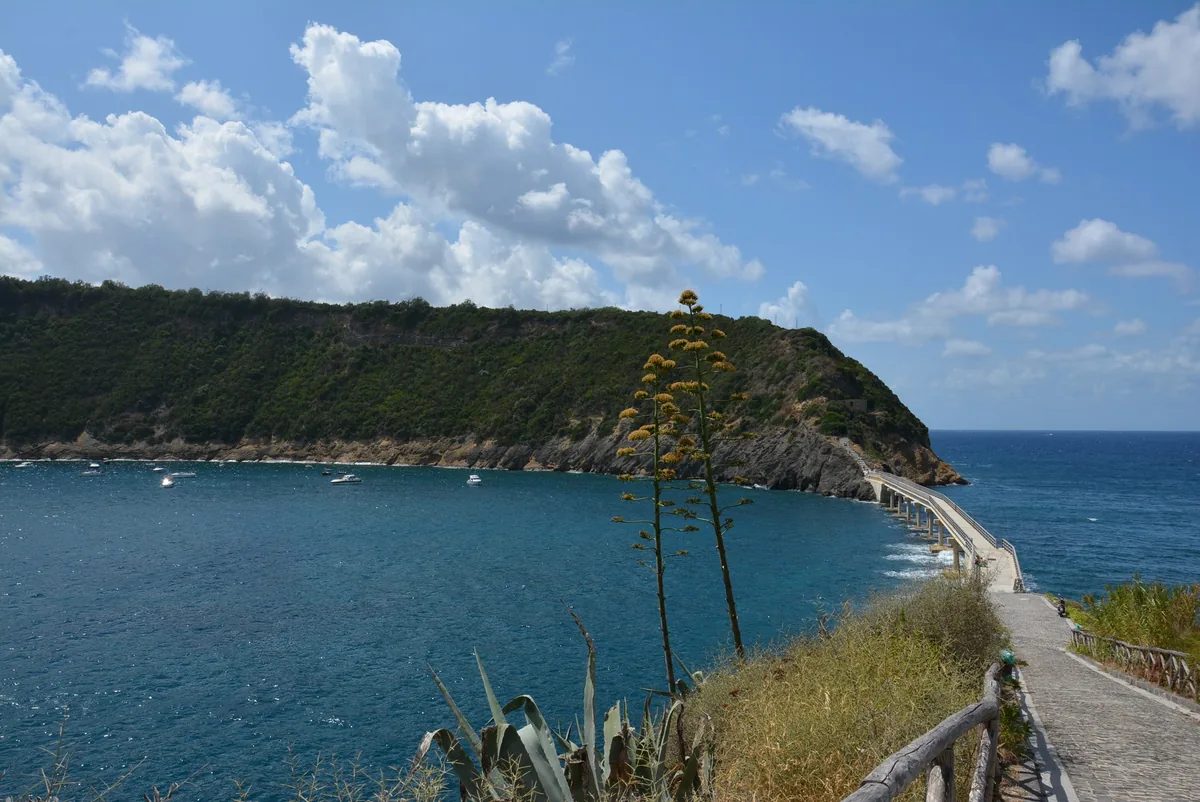
From here the pedestrian bridge leads to the island of Vivara, a State Nature Reserve by the decree of 24 June 2002: a crescent-shaped volcanic islet of about 36 hectares, uninhabited, highest point 110 metres, with a coastline that falls within the Regno di Nettuno marine protected area. There was a Bronze Age settlement here with imported Aegean pottery, datable between the seventeenth and fourteenth centuries BC, identified by the archaeologist Giorgio Buchner in the thirties. The bridge, which is not open to vehicles, also carries the water main that supplies Ischia.
The practical part is strict and has to be respected: you get in only on a guided visit with compulsory online booking on liveticket, maximum 25 visitors per slot, average duration 2 hours 30. In the 2026 season departures are at 09:30 and 16:00, and from 25 September only Friday to Sunday at 09:30; Monday is always closed. Tickets: 10.00 EUR for adults, 3.00 EUR for children between 8 and 12, free under 7 and for people with disabilities. One last thing, the one that sends people back: flip-flops and unsuitable footwear are forbidden, you need walking boots. The approach walk is described in the Chiaiolella–Vivara route.
The viewpoints, and one to take with a pinch of salt
The three views that count are free. The first is from the Belvedere dei Cannoni at Terra Murata, with Corricella below. The second is from the terraces of Santa Margherita Nuova, when the church is open. The third is from Punta Pizzaco, the headland that closes the Chiaia bay to the south and that you reach on foot from Piazza Olmo along Via Pizzaco.
On Punta Pizzaco we have to be more honest than usual: the height, the length of the path and whether a belvedere has been built do not appear in any official source. What we know is that it is a rocky headland reachable on foot and always accessible. The path is unsurfaced and steep: go in closed shoes, in daylight, and do not count on railings, lighting, shade or facilities.
How much time you need, and in what order
With a full day: the port, the climb to Terra Murata with the abbey, the descent to Corricella for lunch, an afternoon on the beach, the return. That is exactly the one-day itinerary, which also works for anyone coming from Naples for the day.
With two days you add Vivara early in the morning, the Chiaiolella, a proper beach and an unhurried dinner: the sequence is in Procida in two days and, with two nights, in the weekend.
The advice on order is always the same: monuments in the morning, beaches in the afternoon, viewpoints at golden hour. Not because it is poetic, but because the abbey closes at lunchtime, the climb to Terra Murata at two in the afternoon is unpleasant and the light on the Corricella arrives late.
The practical things that change the day
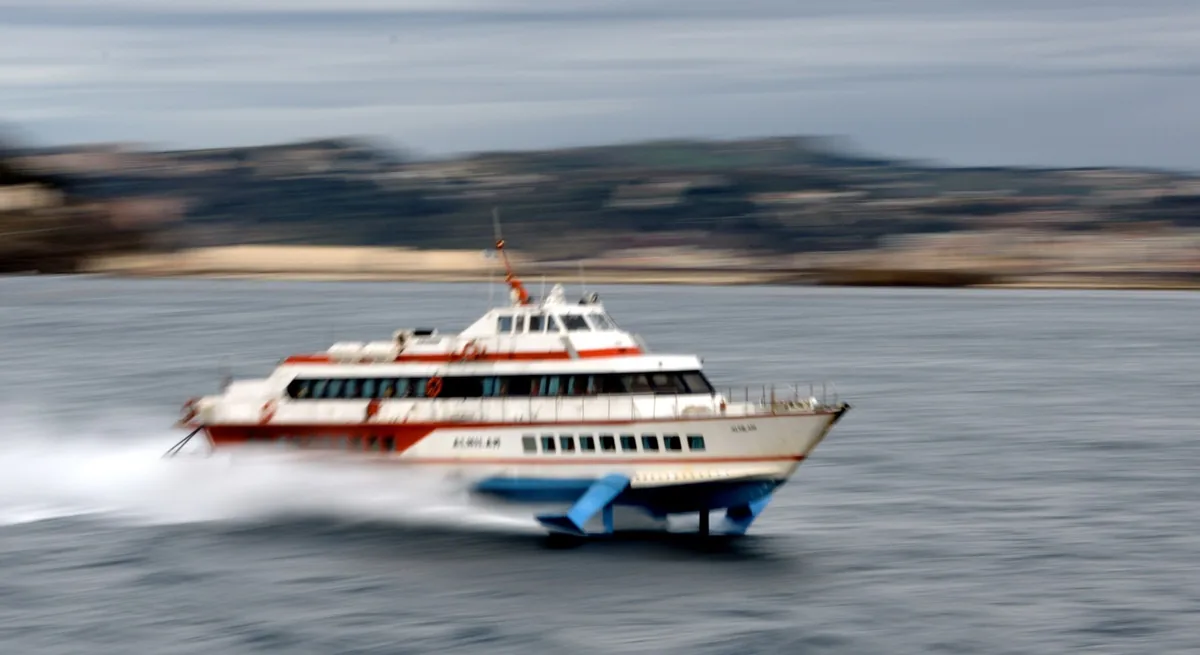
Getting here. From Naples you leave from two different quays: the Beverello for the hydrofoils, which are passengers only and take 40 minutes, Calata Porta di Massa for the ferries, which take vehicles and take about an hour. A foot passenger on the ferry costs 12.70 EUR at official Caremar rates, the hydrofoil 17.40 EUR; from Pozzuoli, which is the shortest and cheapest route, it drops to 9.50 EUR. Resale portals show higher figures: buying on the company’s own site costs less. The full picture is in ferries to Procida and getting there.
The car. From 30 March to 15 October 2026 non-residents’ vehicles may not land on or drive around the island, by regional decree, with fines from 430 to 1,731 EUR. The decree changes every year and has to be checked again in March, but the substance stays: in high season the car is no use and cannot be brought. It is better to leave it at Pozzuoli, where the car parks cost 10-15 EUR a day against the 20-28 at the Beverello.
When to come. May, June and September. The tourist season runs from Easter to the beginning of October; the climate is mild all year. See when to go, or the pages for May, June and September.
How many people there will be. In the summer of 2026 Procida counted 236,000 arrivals, against Ischia’s more than 860,000 and Capri’s well over a million. It is the figure that explains why the island stays liveable even in August: the reasoned comparison is in Procida, Ischia or Capri.
With children. Which beaches have a road, which have steps, which buses actually help: there is a page just for that on Procida with children.