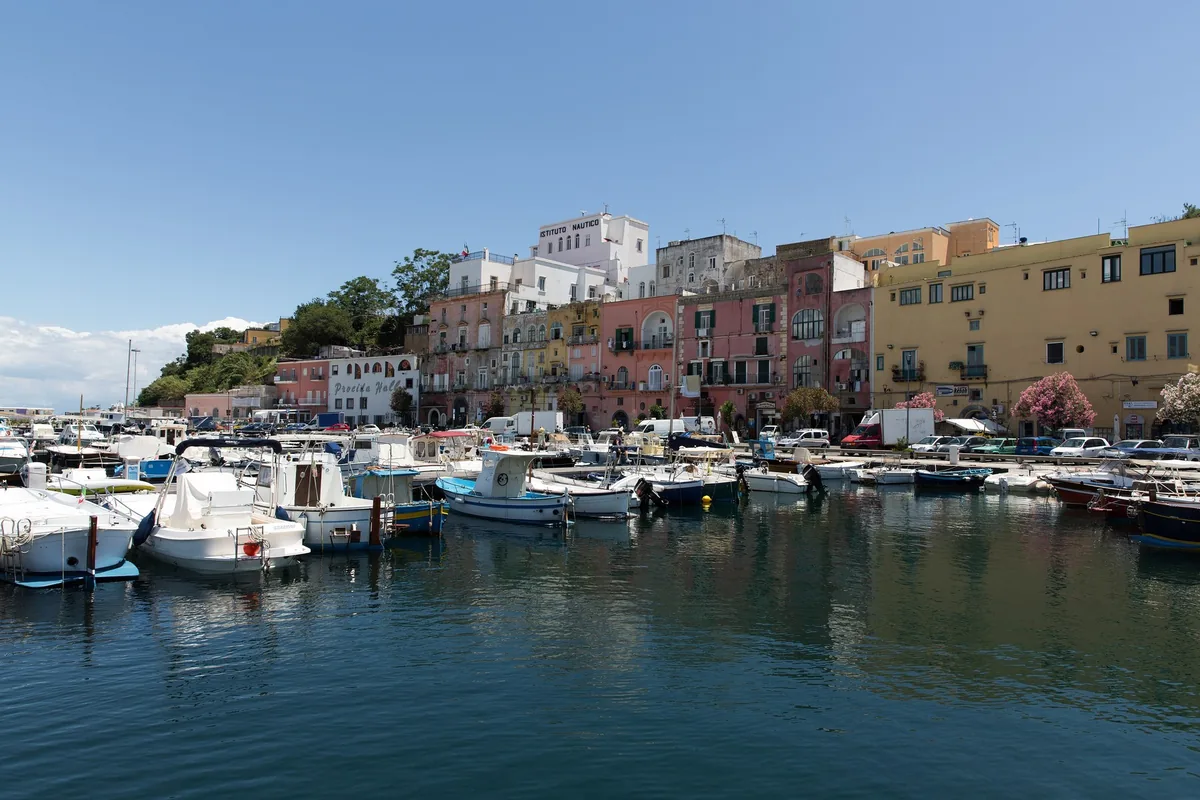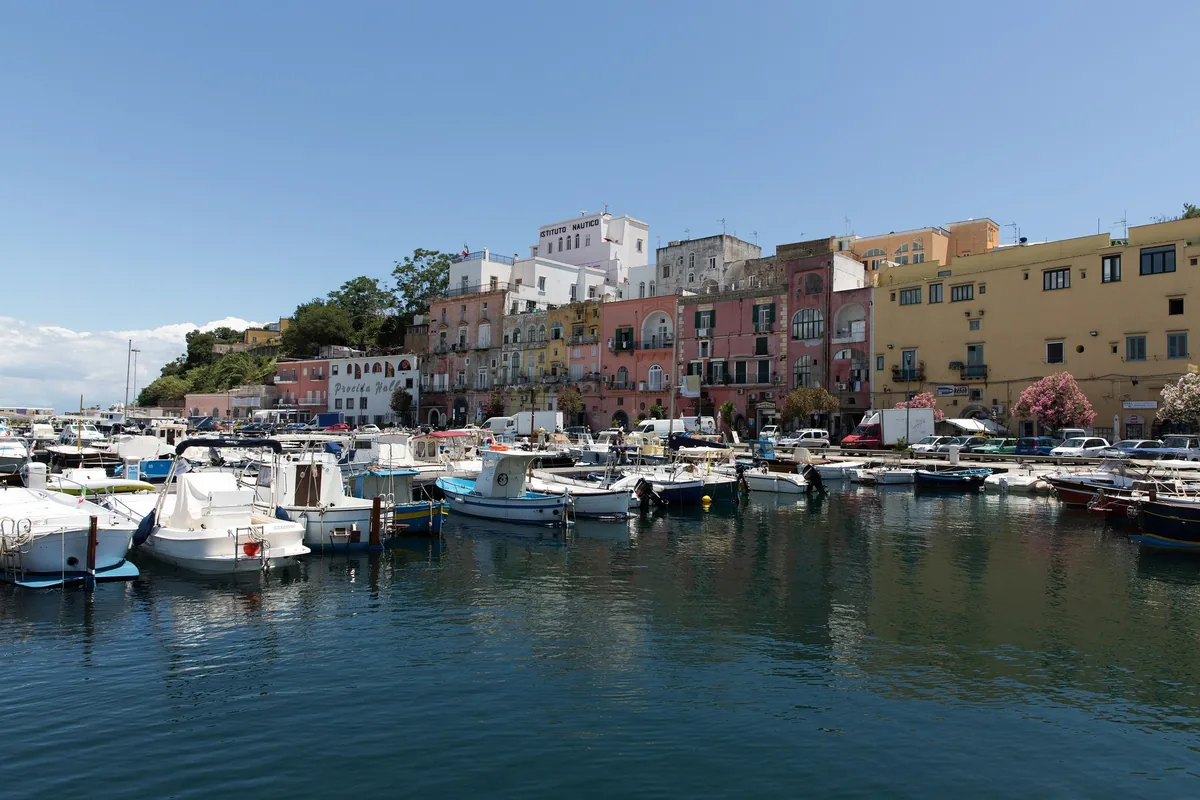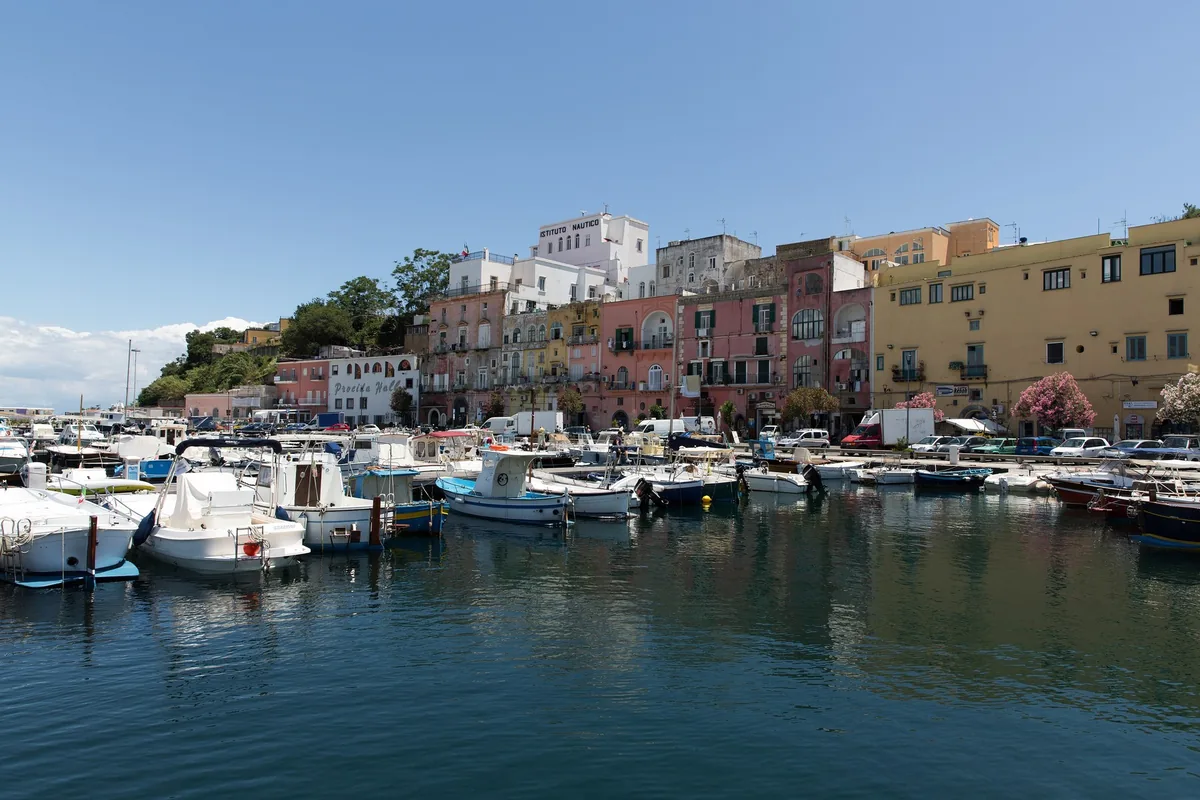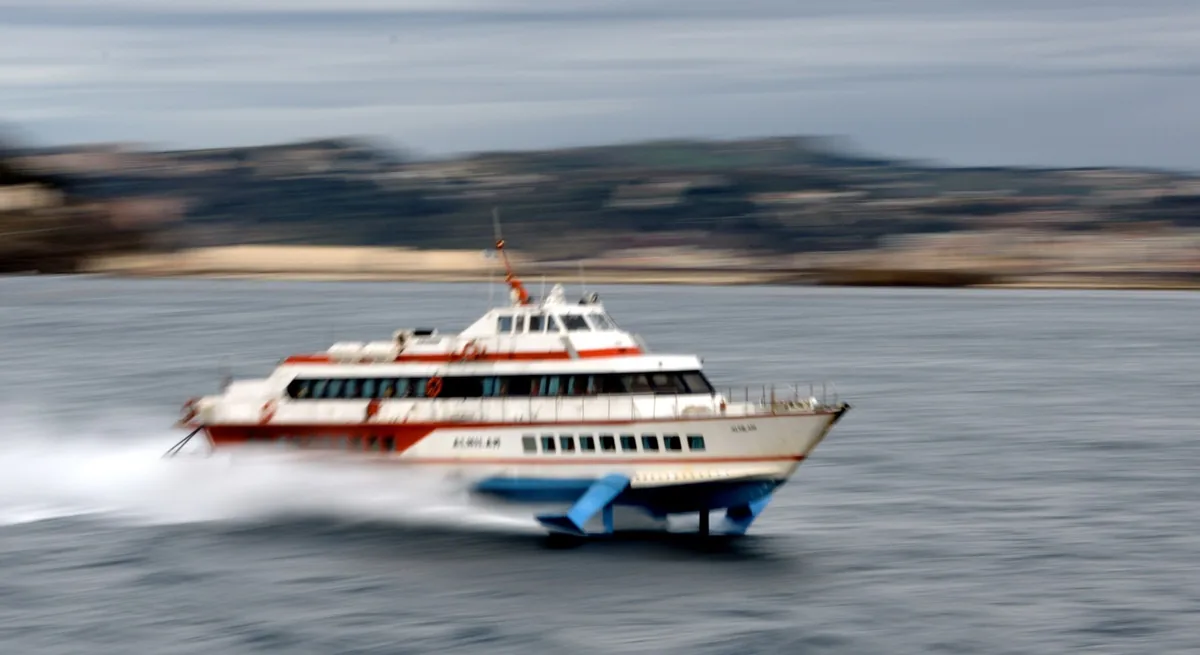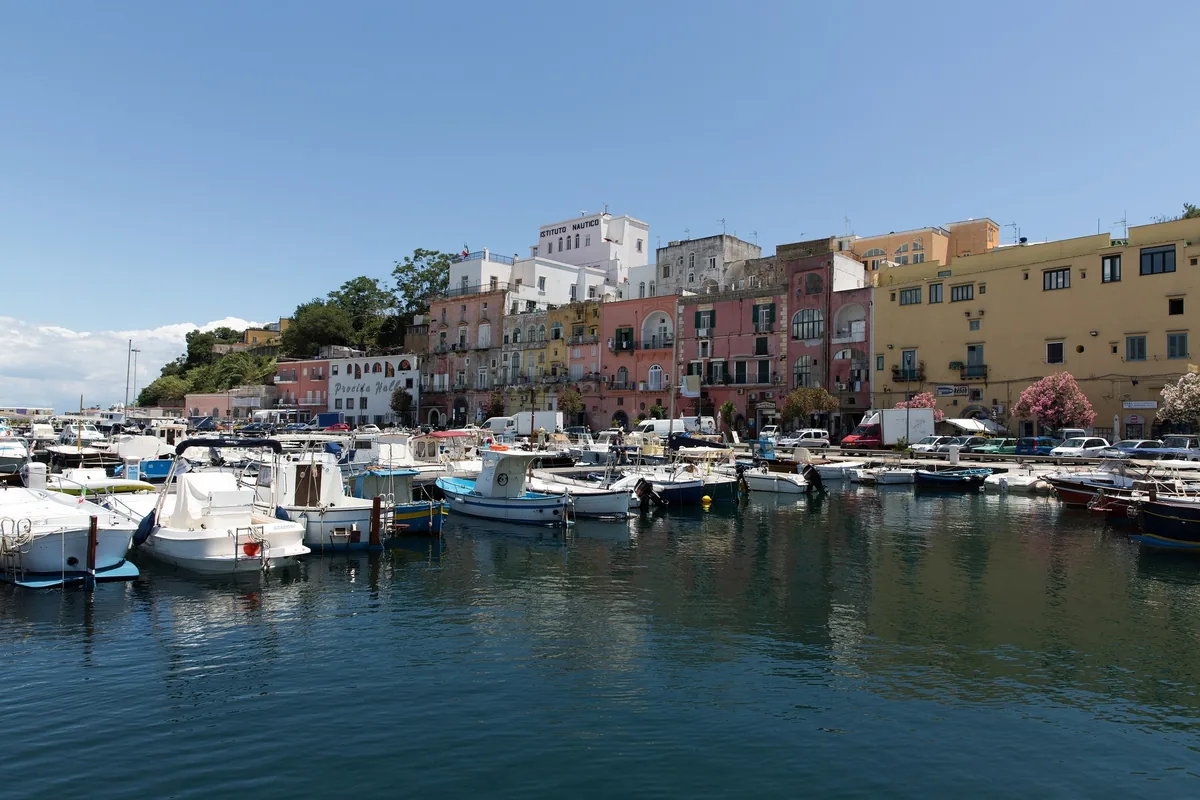
You come down the gangway and you are already in the town. There is no forecourt, there is no filter: the quay ends and Via Roma begins, with the houses crowded one against another, the yellow beside the pink beside the sea green. Behind you, you can still hear the hydrofoil’s engine. In front of you there are the taxis, the three-wheeled micro-taxis, the buses with their engines running and somebody offering you a boat trip. The first minute in Procida is noisy. It is also the only moment when the island looks crowded.
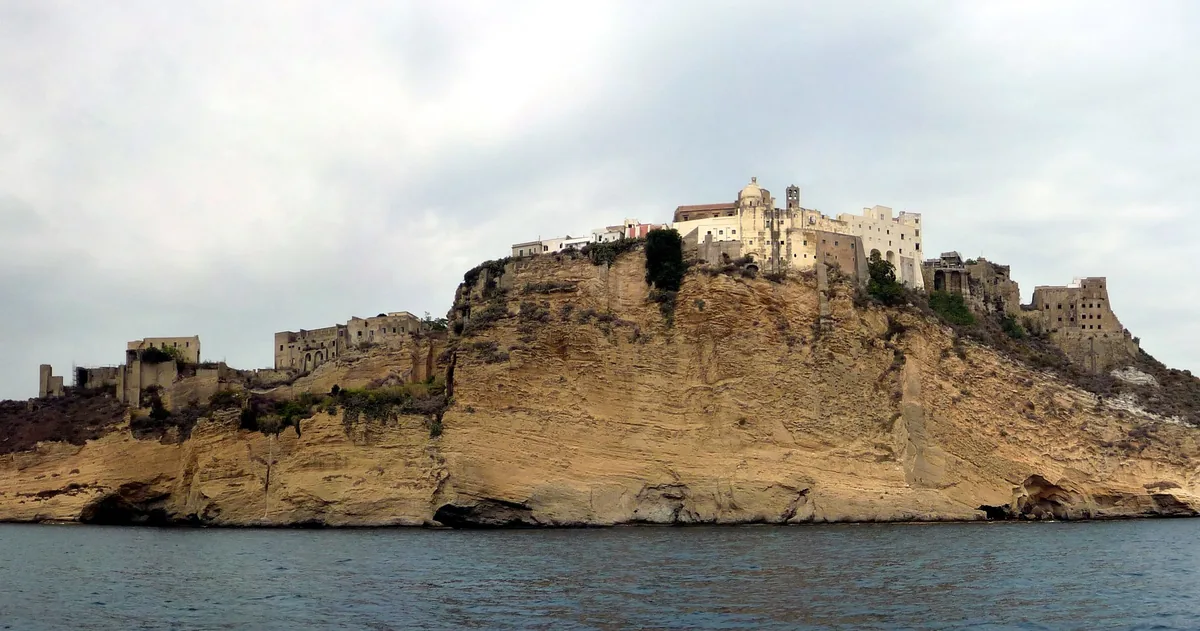
Marina Grande — Procidans also call it Sent’Co — is the working harbour and the longest inhabited front on the island. This is where ferries and hydrofoils berth, this is where every bus line starts, this is where the church you see first as you arrive from the sea stands. It is not the Procida of the photographs: that is Corricella, behind the hill. Marina Grande is the part that works.
Landing
Ferries and hydrofoils use the same front, a few metres from one another. That simplifies everything: if you change your mind about the return time, the ticket office is two steps from where you landed. The timetables and the companies are in the guide to the ferries to Procida, and it is worth reading it before booking the last sailing of the evening.
The first decision is the luggage. If you are sleeping at Corricella or Terra Murata, a wheeled case is a serious problem: it ends up in your hand on steep steps. If you are sleeping here or at the Chiaiolella, it is not. Deciding on the quay, before you set off, saves you half an hour of sweat.
The second is time. People who come over for the day from Naples tend to stay here twenty minutes too long, for a coffee and two photographs. If you have few hours, take the bus or start walking straight away: you will see the harbour again on the way back anyway, in better light.
Via Roma
Via Roma runs along the water and is the street where almost the whole harbour front is concentrated: long-standing bars, ticket offices, mini-markets, scooter and boat hire, shops selling lemons and ceramics. The carriageway is narrow and the Ape three-wheelers come through: walk in single file and keep the children on the sea side.
It is also the best place to grasp the scale of the island. From one end of the front to the other is a few minutes on foot, and in those minutes you have seen the fishing harbour, the church, the terminus and the start of the climbs inland. Procida really is small: here you notice it at once.
The island’s long-standing bars are on this front, and it is one of the few things Procida does better early in the morning than at sunset: the pages are in our list of bars, along with the pastry shops where you find the lingua di Procida.
The sailors’ church
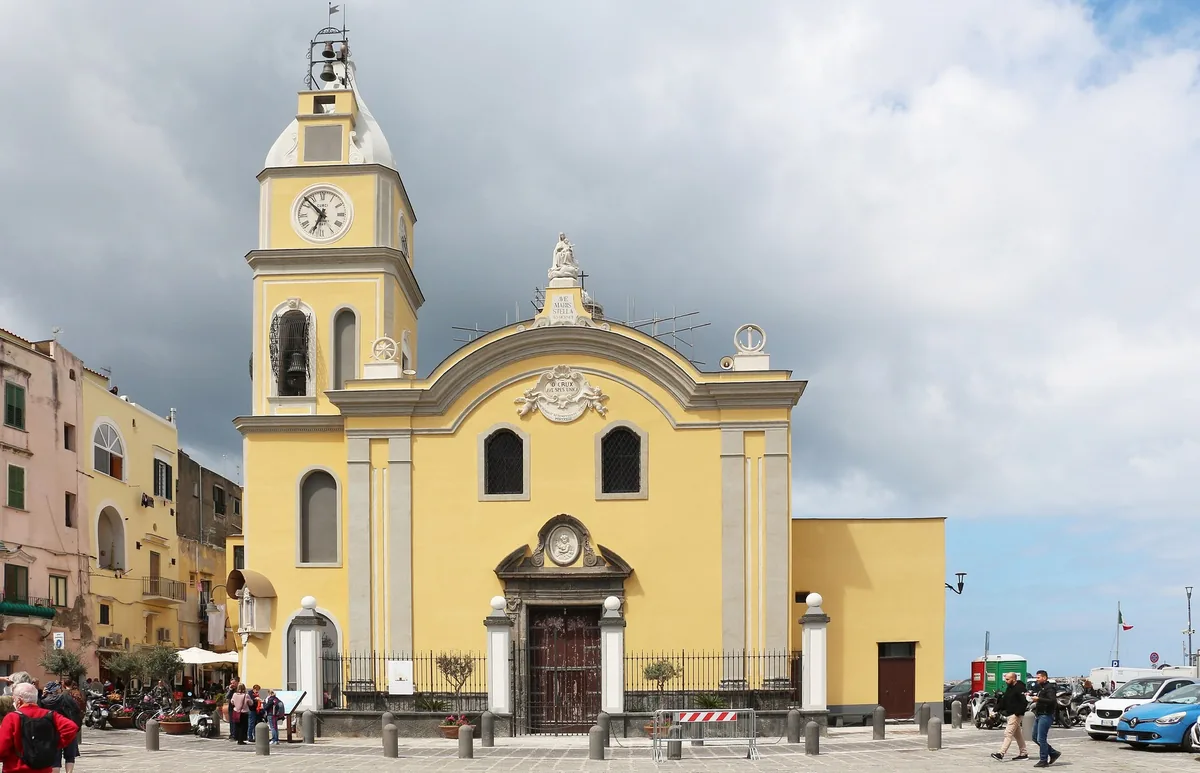
On the harbour square stands Santa Maria della Pietà, the first building you make out as you arrive by sea, with its baroque bell tower and its four-faced clock. The chapel came about at the wish of the shipowners of the Pio Monte dei Marinai: they asked the viceroy for it in 1616 and it was completed in 1619. Then they enlarged it twice.
Inside there are two canvases of 1722 by Antonio Fumo, a wooden pulpit of 1744-45 and the high altar of about 1766. Entry is free. The hours in circulation say 9:00-20:00, but they do not come from the parish: during services there is no visiting, and it is better to put your head in when you happen to pass than to plan it.
The harbour’s two beaches
West of the quay, on Via Roma, there is the Silurenza, also called delle Grotte: small, extremely convenient, with an equipped beach club and a bar-restaurant. It is the beach for anyone with two hours before the hydrofoil or a child who does not want to walk. A rock called the cannone is used for diving. The beach club’s prices are not published: ask on the spot.
At the opposite end, where Via Roma finishes, there is the Lingua beach, and here one has to be honest: it is tiny, with no facilities, no shade and next to a working harbour. It is not a day at the sea. You go for the pink light at sunset towards Monte di Procida and for the curiosity of the bottom: the sources describe it as the only pebble beach on the island, others speak of very coarse sand — they do not agree. The sea bed drops away quickly, so watch out with small children. From here you cross to the spiaggia dell’Asino, the one that appears in L’isola di Arturo by Elsa Morante.
If you are after a real day at the sea, take the bus and go west: the honest comparison between them all is in the guide to the beaches of Procida.
Getting about from here
The bus terminus is on the harbour, and it is the real reason Marina Grande counts. From here leave the lines that climb towards Terra Murata and those that go down to the Chiaiolella. The stops are few and the buses fill up: in August, getting on at the terminus rather than at an intermediate stop is the only way to sit down.
On foot you can do almost all of it just the same, but with height to gain: the island is a hill. For the scooters, the micro-taxis, the timetables and the real costs, the page to read is getting around Procida. Anyone coming for a single day will find the plan already made in the one-day itinerary.
Where to eat, where to sleep
Sleeping at the harbour has a practical advantage no other village offers: you arrive and you are in your room, with no steps and no transfers. It has an equally real disadvantage: the harbour front works early and makes noise. If you are a light sleeper, ask for a room that does not face the quay. The comparison between the areas is in where to stay on Procida.
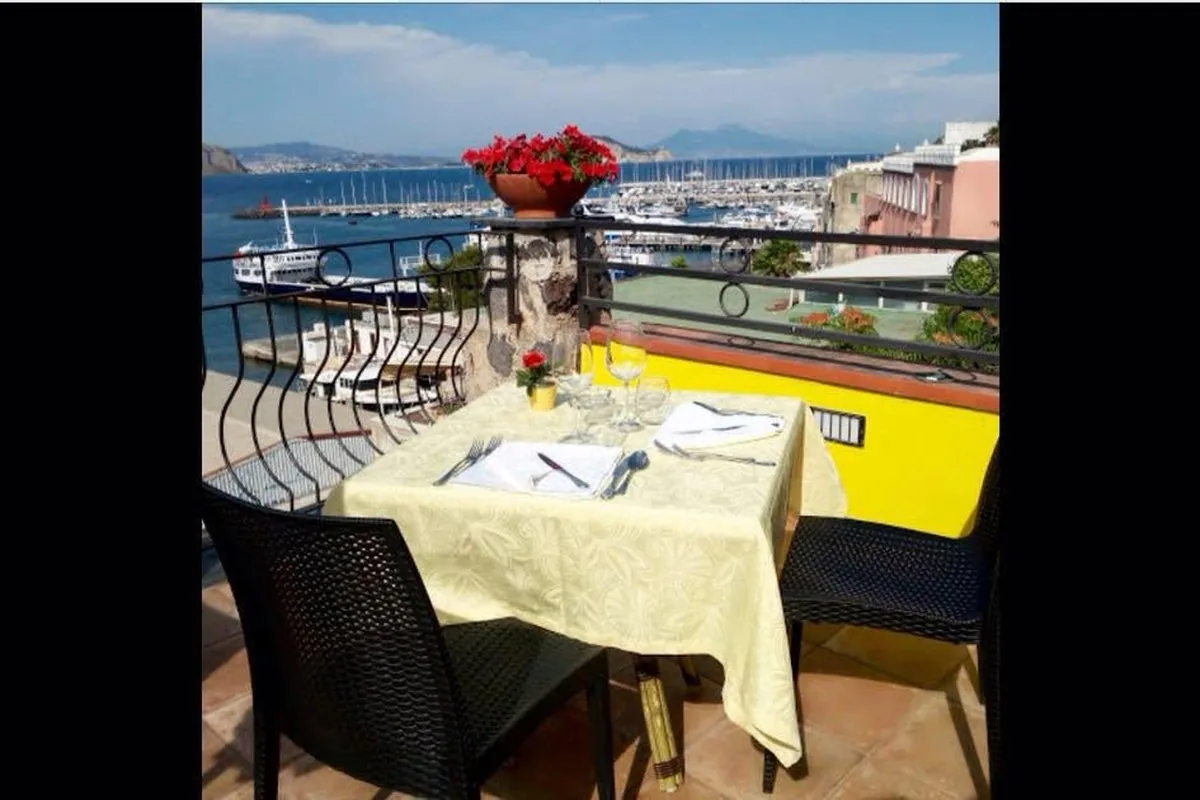
For eating, the most Procidan choice is not on the harbour but ten minutes of steps further on, on the Corricella quay, where the tables are on the water: La Lampara is the classic reference. For the harbour front and the rest of the island the considered list is in the guide to the restaurants of Procida. In any case order the fish and ask whether there is coniglio alla procidana: it is not always on the menu.