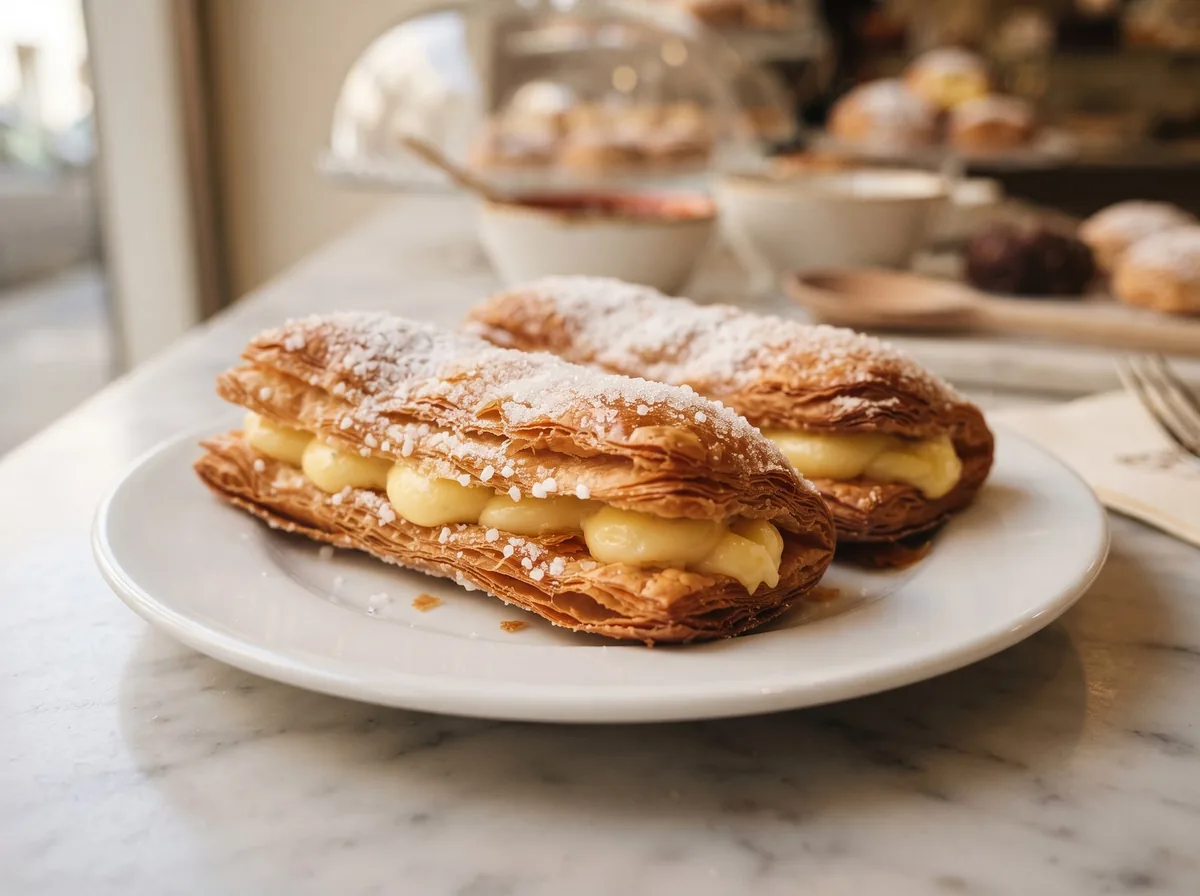
You eat it standing at the counter, at eight in the morning, while the ferry unloads the first load of people. It is as long as your hand, golden, covered in sugar nibs that end up all over you at the first bite. Inside there is lemon cream, not just any pastry cream: and it is exactly that difference, brought in in 1950, that turned an imported pastry into the island’s breakfast. The lingua di Procida is not a souvenir in a window, it is what Procidans buy before going to work.
What it is
A hand-rolled puff pastry, crisp, in a long tongue shape — lingua means tongue, and that is where the name comes from — filled with lemon cream and dusted with sugar nibs. The pastry has to make a noise. If it bends instead of breaking, it is yesterday’s.
The proportions for the cream published by Gambero Rosso give you the order of magnitude: 300 g of egg yolk, 200 g of sugar, 80 g of flour, a litre of milk, lemon zest and vanilla. It is a thick and very yellow cream, held together by the yolk and scented with the zest of the limone pane.
There is a chocolate version. At Paname’ they call it “malalingua” — a gossip, literally a bad tongue — which is the kind of joke you make on an island where everybody knows everybody.
1950 and Pasquale Mazziotti
The shape does not start here. The sources trace it back to a Sicilian pastry chef, which is also why similar pastries turn up elsewhere in the South.
The Procidan turning point has a date: in 1950 Pasquale Mazziotti, a Neapolitan who had moved to the island, reworked the pastry by replacing the classic pastry cream with the local lemon cream. From that moment the lingua stops being a generic filled pastry and becomes a product of the island, because the filling uses the one ingredient that here really is different from anywhere else.
Bar Roma, behind the sailors’ church at Marina Grande, is named as the place of the modern version. A note of honesty: at the counter the pastries are praised, table service is heavily criticised by reviewers, and the TripAdvisor rating is low (3.4/5 from about 235 reviews). The advice is simple — take the lingua at the counter and do not sit down.
The name: two accounts that do not match
Here the sources quarrel, and I have no intention of choosing for you.
- Version one: “lingua di bue”, ox tongue. Gambero Rosso and Il Golfo 24 trace the name to the elongated shape of the pastry, already called that in the pastry tradition. In support: at Bar Dal Cavaliere they still sell them under that name, with three fillings — classic cream, lemon, chocolate.
- Version two: the Spiaggia della Lingua. A tourist source (Dissapore) links the name to the place name of the Spiaggia della Lingua, on the north coast of the island.
The two reconstructions are not compatible and neither has archive documents behind it in the sources I have read. Anyone who tells you one of them alone as a certainty is simplifying. If somebody at the counter gives you their version, take it for what it is: oral tradition, which counts as a story and not as proof.
It is not a sfogliatella
Said plainly, because the confusion is common: the lingua di Procida is not related to the Neapolitan sfogliatella. The sfogliatella riccia has pastry rolled into a shell shape and a filling of semolina, ricotta and candied peel. The lingua has pastry rolled out and folded, a long shape, lemon pastry cream and sugar nibs on top.
They are two different pastries with different family trees. In Naples, in the pastry shops, you will not find the lingua di Procida: it is a pastry of the island, not of the mainland city.
Three counters, three different versions
On Via Roma, at Marina Grande, you can make the comparison in one morning. They are not the same thing.
Bar Dal Cavaliere is the island’s historic bar and pastry shop. It started as a trattoria in the 1950s and was later turned into a pastry kitchen; it sells the linguas under the name “lingue di bue”, with three fillings: classic cream, lemon, chocolate. It also has a speciality of its own, the frollicella, a crumbly shortcrust base with a creamy filling. On Sunday morning the counter is a Procidan ritual, and you can see it. In the evening the place changes its skin and becomes a cocktail bar with live music.
Bar Roma is the historic address of the modern version. Besides the lingua they make rum baba and sfogliatelle. I repeat the warning because it matters: at the counter it works, at the tables the reviewers are very critical.
Paname’ is not a pastry shop but an independent bakery, opened on 27 July 2023 by two cooks, Monia Di Lello and Leonardo Iori. They do everything by hand, with no ready-made mixes and no additives. Alongside the classic lingua and the chocolate “malalingua” you will find croissants, pain au chocolat, their own “Pane del Porto” and a tarte au citron made with limone pane. It is open all year, which from November to March makes it simply the only serious option.
How and when to eat it
It is breakfast, all year round. It is not a pudding for the end of a meal: the cream is generous and the pastry is rich, so after a plate of fish you are doing it no favours.
It should be eaten as soon as possible after it has been filled. The pastry takes up moisture from the cream and within a few hours goes from crisp to yielding. For the same reason, carrying one home on the ferry is half a defeat: it arrives, but it is not the same thing any more.
Where: Bar Dal Cavaliere for the Sunday morning ritual, Bar Roma for the historic version at the counter, Paname’ for the one from a bakery that works everything by hand and is open in winter too, when half the island shuts. All three are on Via Roma, at Marina Grande, a few minutes from one another: if you have a single morning and the comparison interests you, it is walkable.