Procida is small: 3.7 km², a perimeter of about sixteen kilometres, and you cross the whole of it on foot in around forty minutes. You would think the area you sleep in hardly matters. It matters a great deal, for one reason only: here you tackle the changes in level on foot. The most photographed village on the island has no roads, it has stairways. The highest village stands at ninety-one metres and no private vehicle reaches it.
There are four areas, and each is a different trade-off between beauty, convenience and effort. There is no right one for everybody. Below you will find the real advantage and the real cost of each, with the island’s places sorted by area.
On prices: the bands recorded in May 2026 give 80-180 EUR for a double in a three-star or a B&B and 160-280 EUR for a four-star with a sea view. Compared with the neighbouring islands, Procida is the cheapest of the three; Capri is the dearest, but for Capri we have no verified figures, so we leave that comparison qualitative.
Corricella: the postcard, with the steps in the price
This is the place people come for. The oldest fishermen’s village on the island, the seventeenth-century harbour, the arches and the domes, the multicoloured facades, the vefi — those little vaulted covered balconies of Arab descent. Corricella is the main set of Il Postino, and the small square carries Massimo Troisi’s name.
Now the part the photographs do not show. Nothing on wheels reaches the village. You walk down by four stairways: the Gradinata del Pennino from via San Rocco, the Gradinata Scura from via M. Scotti and two from the ends of the harbour. Otherwise you arrive by sea. There is no vehicle access, and it is not a limitation you can get round.
That means three concrete things. You carry the suitcases yourself, down a stairway on arrival and up the same one on departure. If you have a mobility problem, a pushchair or a delicate knee, this area is not for you. And every time you go out — for the ferry, for the bus, for the shopping — you climb back up.
What you get in return: the finest evening on the island. Once the last day trippers have gone, the quay belongs to the people who sleep there. The restaurants are on the water: La Lampara, Caracalè, Il Pescatore, Fuego, the last of these at the cheaper end.
To sleep, in the village itself: Hotel La Corricella, on the quay. A little above, with the view down over the little harbour, La Casa sul Mare.
Who it is for: couples, photographers, anyone travelling light who wants the evening. Who it is not for: families with pushchairs, heavy luggage, reduced mobility.
Marina Grande: the practical choice, and no shame in it
This is the port where you dock, and it is also the real centre of the town. Via Roma runs along the harbour front, with the old bars and the shops; the church of Santa Maria della Pietà is the first building you see arriving by sea; next to it is the terminus of every bus.
Sleeping here is the choice nobody puts in the photographs and almost everybody should consider. The reasons are banal and strong: you land and you have arrived, with no steps and no transfers; the bus lines start from your doorstep; you have the bars for breakfast and the pharmacies within reach; and on the morning you travel back you do not have to calculate margins.
There are two beaches within a few minutes on foot as well: the Silurenza, just west of the port, convenient and equipped, and the Lingua, small, pebbly and with no facilities, good for sunset but not for a day at the sea.
The drawback is the drawback of every harbour front: the noise of the manoeuvres, the mopeds, the coming and going at docking times. If you sleep with the window on the quay, allow for it.
Here you will find La Suite Hotel & Spa, the island’s top end, and Insula Boutique Hotel. For breakfast at the counter: Bar dal Cavaliere and Bar Roma, on via Roma.
Who it is for: short stays, anyone arriving with luggage, anyone with an early ferry. Who it is not for: anyone after absolute silence.
Chiaiolella: if you are coming for the sea
The marina in the south-west, with the marina harbour, the widest beaches and the services. It is the only area with direct road access to the beaches, served by the L2 line from Marina Grande. The footbridge to Vivara starts here.
Chiaiolella beach is the busiest and the best served: dark volcanic sand, shallow safe water, beach clubs and bars along the front, sun all day and the view of Vivara and Ischia. Next to it, Ciraccio beach is longer and windier, separated from the first by two tuff stacks: in the afternoon it catches the mistral and the sand flies.
The difference from the other areas is this: here you can have a beach holiday without organising yourself every day. You come out of the hotel, you walk a short way, you are on the beach. With children it is the only area that really holds up.
The price to pay is the distance from the villages. Terra Murata and Corricella, which are the reason Procida is famous, are on the other side of the island: you get there by bus on the L1 or the L2. How long it takes on foot from here we are not telling you, because no reliable source reports it and we have no wish to invent it.
To sleep: Hotel Crescenzo on the marina and Tirreno Residence. Also in the area, Albergo La Vigna, more secluded. At the table: Da Mariano and Da Girone.
Who it is for: families, beach holidays, long stays. Who it is not for: anyone with a single night who wants the villages.
Terra Murata: the view, and the climb every day
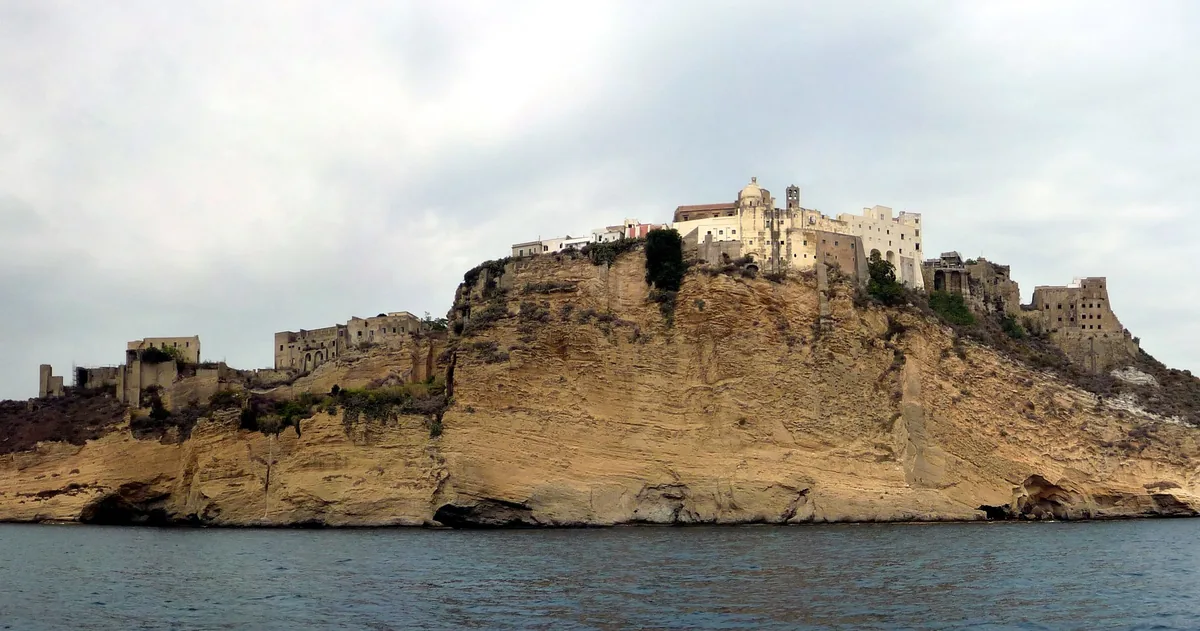
The fortified village at the top of the island, at about ninety-one metres above sea level: the highest inhabited point on Procida. Here stand the abbey of San Michele Arcangelo, Santa Margherita Nuova and Palazzo d’Avalos, the former prison. The walls, the two historic gates, the belvedere with the cannon of the 1799 Neapolitan Republic.
Sleeping here means having the widest view on the island from your window and silence after sunset, once the visitors have gone down. It also means facing the climb every single time you come back. From Marina Grande it is about ten minutes uphill: not much on paper, quite a lot in the heat, with the shopping or with two suitcases. The C2 line links the port to Terra Murata and Corricella, and it is the one you will actually use.
It has to be said plainly: the climb is not suitable for wheelchairs and in high temperatures it is heavy going. The micro-taxi — an ape car with a canopied trap, four to six seats — goes where cars do not and is the serious answer for the day you arrive. Bookings are on 081 896 8785.
The accommodation on offer here is thinner than elsewhere, and it partly overlaps with Corricella, which sits just below on the opposite slope: the boutique hotel and the houses looking out from the ridge cover the top end. In between, on the road down, is the Casale Vascello, which is a lived-in courtyard and not a monument: if you go through it, go through in silence.
Who it is for: couples, photographers, anyone who wants to wake up inside the island’s history. Who it is not for: anyone with walking difficulties or heavy suitcases.
How to choose in thirty seconds
| Area | The advantage | The real cost | Suits |
|---|---|---|---|
| Corricella | The finest evening on the island | Stairways only, no vehicle access | Couples, photographers, light luggage |
| Marina Grande | Ferry, buses and services on the doorstep | Noise from the port | Short stays, anyone arriving with suitcases |
| Chiaiolella | The big beaches on foot | Far from the villages | Families, beach holidays |
| Terra Murata | View and evening silence | A climb every time you come back | Couples, anyone who walks well |
Two rules that hold almost always. With one or two nights, sleep at Marina Grande or at Corricella: the villages are the reason you came and you have them right there. With four nights or more, in summer, with children, sleep at Chiaiolella and reach the villages by bus.
And one rule that always holds: look at the steps before you book. Ask the property how many steps there are between the nearest road and the door. It is the most useful question you can ask on this island, and almost nobody asks it.
On timing: prices and availability follow the season, and the best period for the balance between cost and island is the one described in when to visit Procida. If you are still deciding how many days to stay, a weekend in Procida is the format that works best.