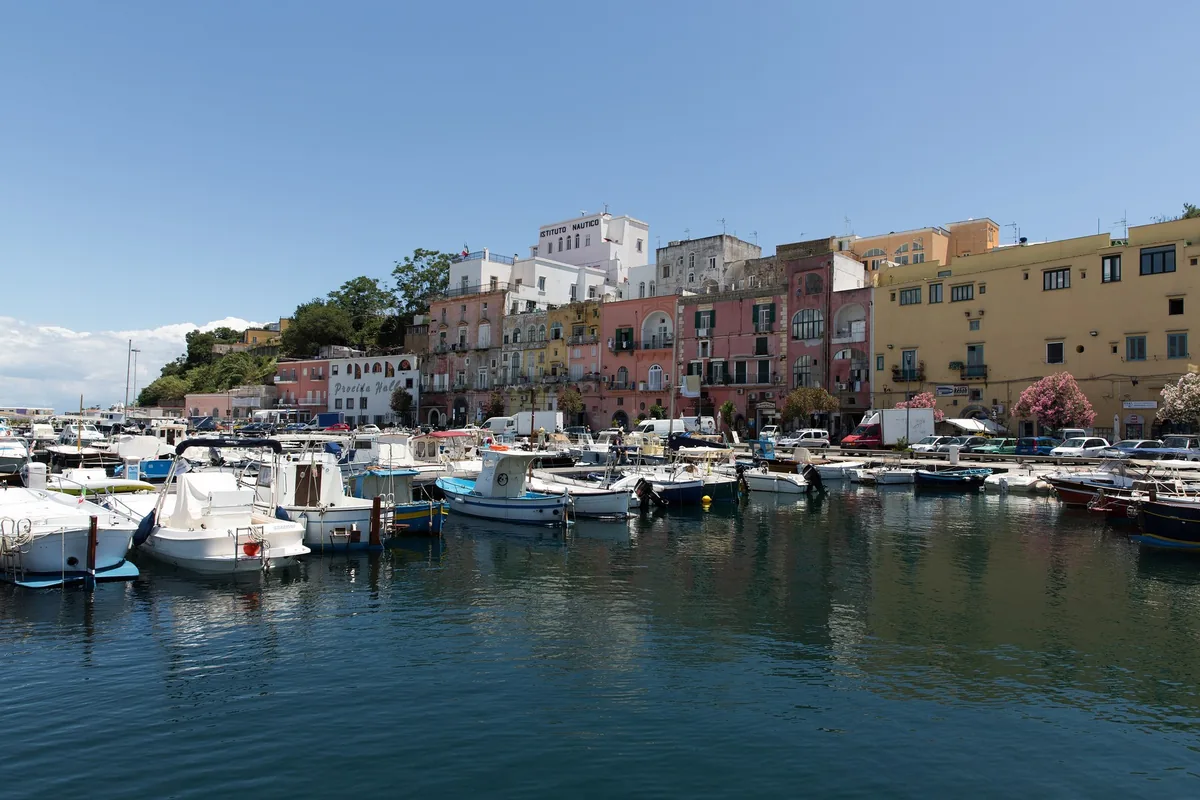
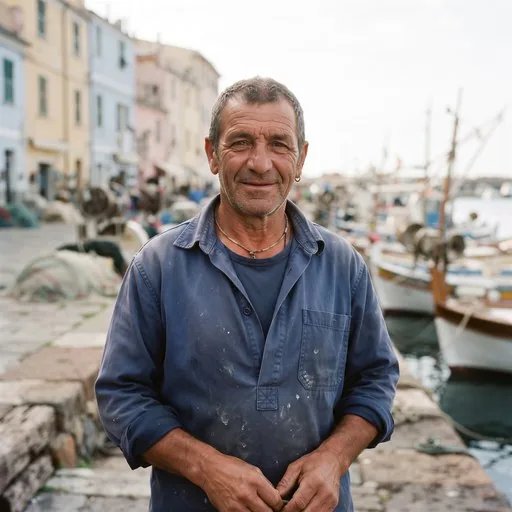
Let us say it straight away, so that nobody loses a day: the Lingua is not a beach for a day by the sea. It is tiny, it sits at the eastern end of the Marina Grande front, beside a harbour in full activity, it has no shade and no facilities. You come for another reason: here the bottom is pebbles instead of sand, the water gets deep at once, and at the end of the afternoon the light on the sea towards Monte di Procida turns pink. In an hour you have taken everything this beach has to give. If you are after parasols, sunbeds and a lunch, you are in the wrong place and you would do better to go down to the Chiaiolella.
How you get there: two minutes from the ferry
It is the easiest beach to reach after the Silurenza, and it is on the opposite side of the harbour. You get there from the continuation of Via Roma, walking eastwards along the harbour front, or by going down the stairway that starts from Via Bartolomeo Pagano. From the ferry quay it is a few minutes on foot: you do not need the bus, you do not need anything.
That makes it one of the few beaches on the island you can slot into a wait. If you have an hour before the hydrofoil and you do not fancy sitting in the bar, come down here. The departure times and the fares for the crossings are on the page about ferries to Procida.
Pebbles or coarse sand? The sources quarrel
On this beach there is a disagreement worth reporting rather than smoothing over. Two island guides describe it as the only pebble and stone beach on Procida, on an island where everything else is dark volcanic sand. A third guide describes it instead as "very coarse sand", that is an extreme version of the coarse grit you find elsewhere.
Anyone who has been knows that the difference, for a body lying on it, is minimal: in both cases a towel on its own is not enough and an air bed changes your life. But the substance stands: you do not stretch out here the way you do at the Chiaiolella. If you have children who play with a bucket and spade, this beach offers nothing they are looking for.
The bottom drops away at once: what that means in practice
It is the most important fact and it should be taken seriously. The bottom at the Lingua shelves quickly: a few steps and the water is already deep. There is none of the long shallow band that makes the Chiaia and the Chiaiolella safe.
Who it is an advantage for
For people who swim well, and for people who fish. The Lingua is used by divers for free diving precisely because of the bottom: you go in and you are straight onto good water, without having to walk twenty metres.
Who it is a problem for
For anyone with small children, for anyone who is not a confident swimmer, for anyone who wants to stand with the water at their waist. There is no lifeguard, there are no beach clubs, there is nobody on duty: it is a public beach at the end of a harbour. With children, the right choice is the Chiaia or the Chiaiolella.
The sunset light and the Asino beach
The Lingua looks towards the mainland and towards Monte di Procida, that is east and north-east: the sun does not set in front of you, but behind you. The result is the reason photographers come: in the last half hour of light, the coast opposite and the water take on a pink you cannot see from the beaches on the western side. It is a reflected light, soft, without the hard contrast of the sun in your face.
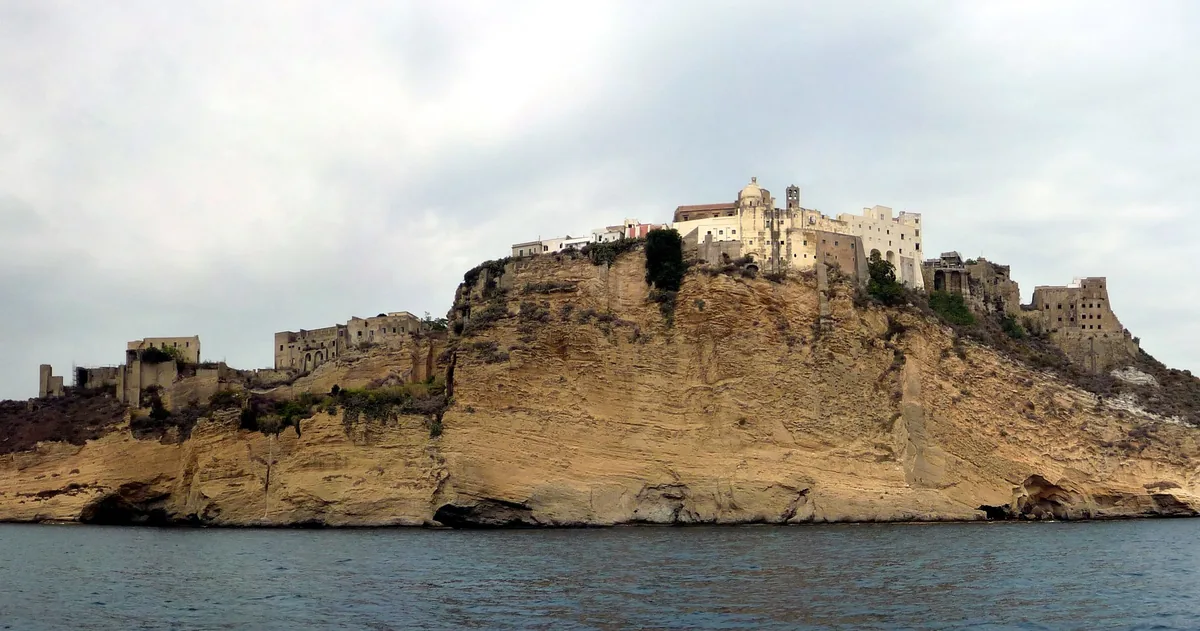
From here you go on to the adjoining Asino beach, which appears in L’isola di Arturo by Elsa Morante. Anyone who knows the novel knows how much that stretch of coast weighs in the book; anyone who does not know it finds another tiny beach. The story of the relationship between Morante and the island is in our article on L’isola di Arturo.
If you want to see this stretch of coast from the water, the boat trips round the island leave from a short distance away and go round the whole perimeter, which is about 16 kilometres.
What to expect, honestly
No shade, no facilities, no bar on the sand, a working harbour alongside with the ferries coming in and going out. The Lingua is a village beach, not a holiday beach. It makes sense that way: it is where Procidans have a swim before dinner, not where they spend Sunday.
To eat, the best solution is to go down to the Corricella, which from Marina Grande you reach in about ten minutes on foot downhill: on the quay there are the village fish restaurants, like La Lampara. Otherwise, the harbour front on Via Roma has the old bars where you have breakfast and wait for the hydrofoil. The full picture, beach by beach, is in the guide to Procida’s beaches.