Here is the thing the guidebooks leave out: the fish in Procida is exactly as good as the fish in the rest of the bay of Naples. Same sea, same boats, same stalls. If you are coming to eat fish and nothing else, you could have stayed in Pozzuoli and spent less. What exists here and nowhere else is the limone pane, a lemon whose white part is sweet and edible, and the small cuisine that has been built around it. This guide starts there, cuts the fish down to size a little, and ends with the restaurants split by marina, with the limits they state themselves.
Start with the lemon, not the fish
The Procida lemon has a thick, pale skin and, underneath it, a white layer up to a centimetre and a half deep, spongy and sweet. In the sfusato amalfitano and the ovale di Sorrento that part is bitter and gets thrown away; here it is the ingredient. It is the only serious gastronomic difference between this island and the rest of the coast, and it produces four things worth ordering.
- Insalata di limoni, lemon salad. Big pieces of lemon with the pith, garlic, onion, mint, chilli, oil. It began as a sauce for bread and as a side for fried fish: order it with a fry-up, not on its own.
- Lingua di Procida, the tongue-shaped pastry. An elongated puff pastry with lemon cream and a crunchy granella topping. It is breakfast, not dessert. The modern version dates from 1950, when Pasquale Mazziotti replaced the classic custard with the lemon one.
- Lemon pesto. It dresses the linguine with clams or mussels at Da Girone, at the Chiaiolella: it is the house’s signature dish.
- Limoncello made with limone pane, which several kitchens bring you with the bill.
One useful warning: "limone di Procida" is not a protected term. The fruit is on Campania’s P.A.T. list, but it is neither DOP nor IGP. The full story is in the long read on the limone pane.
The island’s other two products
The Procida artichoke is a Romanesco type: a large, globe-shaped head, pale green with purple veining. You will find it fresh from March to May; the rest of the year you meet it preserved in oil, a preparation that matures for two months in the jar with garlic, oregano and chilli. It is the most sensible edible souvenir on the island, far more so than the lingua, which goes soggy on the ferry.
Starza wine is the first denominated wine made with Procida grapes, launched in 2022: white, 90% falanghina and 10% levante. Watch the detail everyone gets wrong: it is bottled under the DOC Campi Flegrei, because a Procida DOC does not exist. Production is tiny. If you cannot find it, order a falanghina from the Campi Flegrei and you are drinking the same grape from the same volcanic ground.
The fish, without the hype
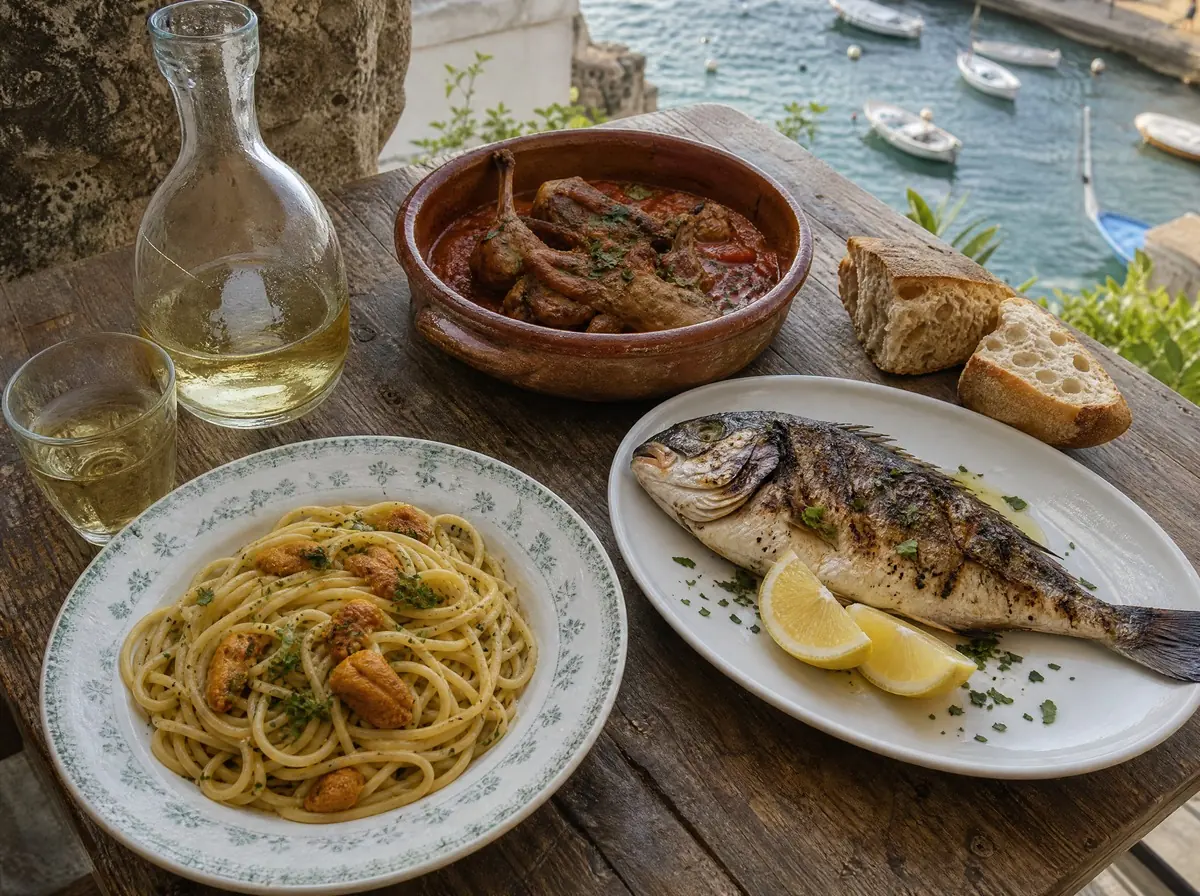
The catch is the bay’s catch: paranza, the mixed small fry you fry, octopus, squid, cuttlefish, scabbardfish, anchovies. Honest preparations and no distinct local school. Anyone who tells you about a "zuppa di pesce procidana" as a traditional dish is improvising: no source documents a version specific to the island.
Two dishes deserve a note. The first is the pasta alla pescatora povera at La Medusa: anchovies, fried friggitelli peppers and pecorino, no shellfish and no tomato. It is the fishermen’s own pescatora, and it is the signature dish of a kitchen open since 1954.
The second is spaghetti ai ricci, sea urchin spaghetti, with a large asterisk: urchin harvesting is now subject to limits for sustainable fishing. It is not a dish that is available by definition, not even in August. It stays printed on the menus even when the product is missing: ring that same morning and ask.
Then there is meat, which is a minority on the island. Coniglio alla procidana, rabbit the Procida way, is cooked in terracotta with cherry tomatoes, rosemary, garlic and white wine, and stays dry, with little sauce. Do not confuse it with the ischitana version, which is a different recipe: that one makes plenty of sauce to dress bucatini as a first course, and it comes from Ischia.
What you get told that is not Procidan
A few attributions circulate insistently. They are worth taking apart, if only so that you do not order the wrong thing convinced you are having a local experience.
- Spaghetti alle vongole fujute. A Neapolitan dish, tied to Eduardo De Filippo. It is not from Procida.
- Zuppa di pesce procidana. No source documents a version specific to the island. If you find it on the menu, it is a fish soup.
- Lemon granita. It is Sicilian. Making it with limone pane makes sense as a modern use, but it is not a local tradition.
- Tortano. Neapolitan, with nothing specifically Procidan about it.
- Casatiello dolce. It is documented as a speciality of Monte di Procida, which is on the Flegrean mainland and not on the island. The name confuses people, the two places are different.
- Coniglio all’ischitana. It is from Ischia, and unlike the Procida version it makes plenty of sauce to dress bucatini.
If you are after less obvious local material, two real things exist: the parmigiana alla procidana, which is eaten leaf by leaf instead of being cut into slices and rests for a day before it goes to the table, and the limoncello made with limone pane.
Where to eat: Marina Grande
This is where you dock and where the island’s entire bar offer sits. At Corricella and the Chiaiolella there are restaurants, not cafes: if you want breakfast, you have it here.
La Medusa, Via Roma 116, open since 1954, follows the day’s market; 4.1/5 from about 530 TripAdvisor reviews and a Travellers’ Choice 2025. An honest note: reviewers report high prices for the size of the portions.
Re Ferdinando, Via Libertà 5 bis, running since 1960, is a steakhouse as well as a fish restaurant: the only real alternative to the seafood monoculture, with a terrace over the bay. 4.5/5 from about 470 reviews.
For breakfast, three counters on the same street. Bar Dal Cavaliere, the historic bar and pastry shop, famous for its lingue di bue and its frollicella; on Sunday mornings it is a local ritual. Bar Roma, named as the home of the modern lingua, with a clear warning: 3.4/5 from about 235 reviews, pastries praised and table service criticised. Take the lingua at the counter and do not sit down. Panamé, an independent bakery opened in 2023, everything by hand, with a tarte au citron made with limone pane and a chocolate lingua: it is open all year, which is rare here. For an aperitivo or a coffee at impossible hours there is Bar Capriccio, Via Roma 99, open 6:00-2:00 every day.
Where to eat: Corricella
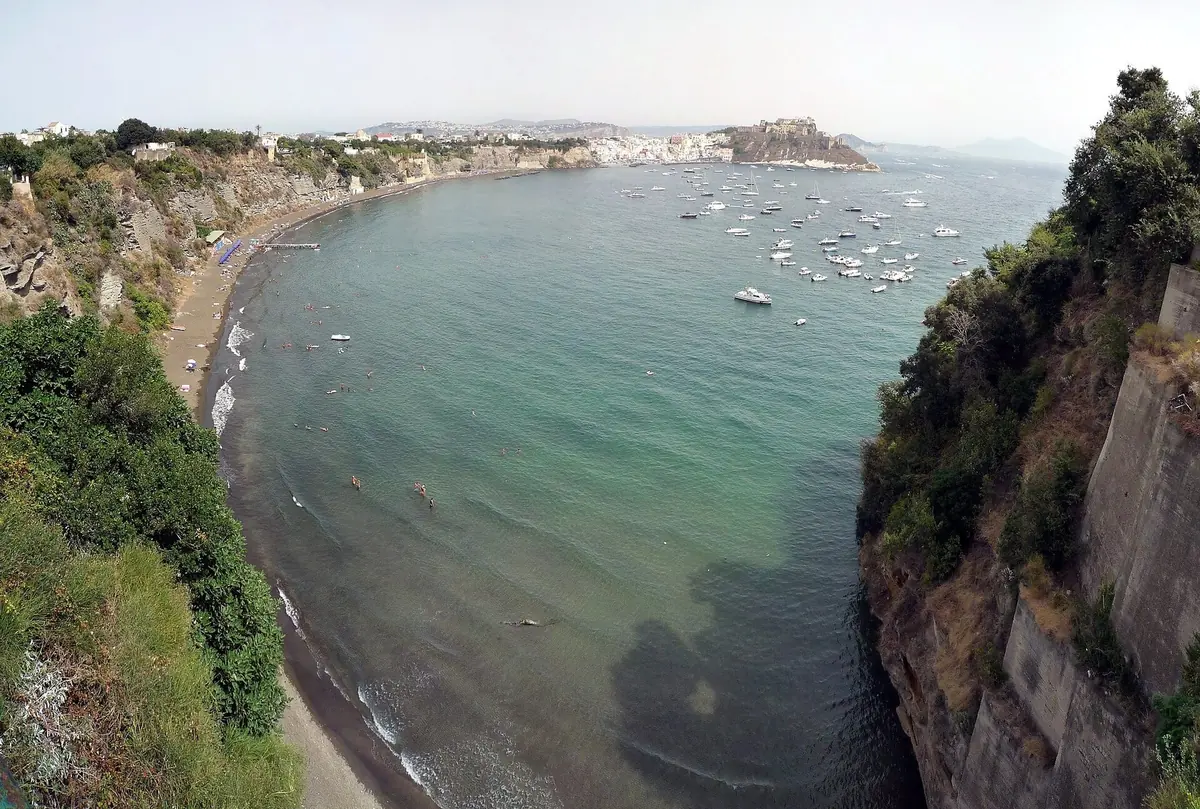
This is the bay of coloured houses and tables on the water. It is also the most photographed part of the island, so book, or eat at odd hours.
La Lampara sits at the highest and most panoramic point of the bay, attached to the Hotel La Corricella: tortelli and linguine with sea urchin, tuna with pistachio, seafood caponata, grilled octopus. 4.3/5 from about 1,395 reviews, the island’s first on TripAdvisor. The table on the railing has to be booked well in advance.
Caracalè occupies a restored former boat store, with vaults and bare stone. About 40 EUR a head (verified price). Spaghetti ai ricci, cannellini and mussel soup, seared cuttlefish with a julienne of raw courgette, scabbardfish fried in batter. Open all year, but from January to March only on Saturdays and Sundays; closed on Tuesdays.
Il Pescatore, Via Marina Corricella 63, panoramic terrace, online booking: octopus, paccheri with swordfish, salmon in a pistachio crust. 4.1/5 from about 630 reviews. Closed Mondays, 12:30-14:30 and 19:30-22:30.
Fuego is in practice the only pizzeria with a view over the quay, budget bracket, 4.4/5 from about 1,070 reviews. Monday to Friday dinner only, Saturday and Sunday lunch as well. With children, or on a tight budget, it is the obvious choice.
Above the bay, on the climb to Terra Murata, is Assafà, Piazza dei Martiri 2: about 30 covers, budget bracket, 4.6/5 from about 154 reviews and the highest rating on the island, with vegetarian options and takeaway. Cited in Lonely Planet 2025 and Guide du Routard 2025.
One last one, down on the Chiaia beach: La Conchiglia, about 40 EUR a head, remarkable fresh pasta and fried paranza. You get there down 170 steps from Via Pizzaco, or by sea from Corricella with a transfer the restaurant arranges — to be confirmed when you book. Open from Easter to November. Residents name it as the place where you eat best.
Where to eat: Chiaiolella
The small harbour to the south, quieter, with the view of the Santa Margherita headland and of Vivara.
Da Mariano, Via Marina Chiaiolella 32, does tradition with technique: pasta with cicarelle (the local wedge clams) and ravioli stuffed with aubergine. 4.4/5 from about 476 reviews, with gluten-free options flagged.
Da Girone, on the Lungomare Cristoforo Colombo, has a terrace over the sea and a verified bracket of 20–40 EUR. It is the lemon address: linguine with lemon pesto and clams or mussels, insalata di limoni, lemon and aubergine polpette. Limoncello offered with the bill. 4.1/5 from about 1,100 reviews. The sources disagree on the opening hours: ring, do not trust what you read online.
Practical rules that save you an evening
The season decides everything. Procida empties out in winter and many kitchens close or cut their days. Off-season opening information is largely unverifiable: ring before you cross the island. Anywhere open all year, like Panamé, is worth double from November to March.
No stars. No restaurant on Procida has a Michelin star or a Bib Gourmand. If a website or an owner lets you think otherwise, it is not the case.
Prices are almost never published. The verified figures are few: about 40 EUR a head at Caracalè and at La Conchiglia, 20–40 EUR at Da Girone. For the rest, look at the menu on display before you sit down, which is a good habit anywhere and here is a necessity.
Book the tables with a view. At Corricella the places on the railing and on the quay are few and go days in advance in high season. Without a booking you still eat well, but looking at a wall.
If you are coming for the day, do not rush. Four hours gets you lunch at Corricella and a lingua at the counter before the ferry: the rest is in the one-day itinerary.