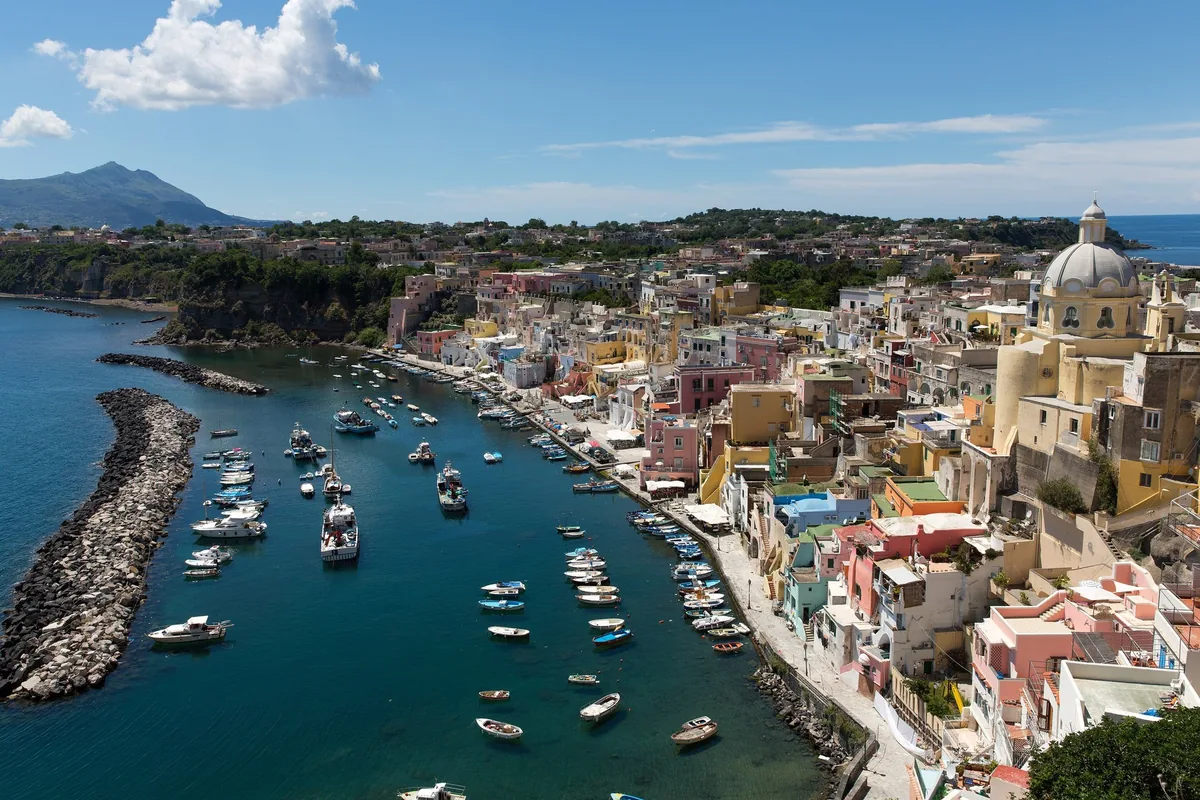
Caracalé sits on the quay at Corricella, at number 62, inside a former boat store: low vaults, bare stone, the door giving straight onto the water. It is the kind of room that has a precise explanation on Procida — this is where the gozzi were laid up for the winter, and when fishing became a trade for the few, the stores became something else. You eat fish, you spend about 40 EUR a head, and Tuesday is the closing day. What makes it more useful than plenty of other names is that it does not disappear in November: it stays open all year, and from January to March it opens on Saturdays and Sundays.
The dining room, and why it matters
The appeal of this address is not a panoramic terrace: it is the inside. A restored boat store has vaulted ceilings, thick walls and a temperature that saves you in summer from eight in the evening onwards. If you have already had dinner twice on a terrace looking over the bay, the register changes here: you are inside the village, not above the village. Outside, the quay carries on living its own life, with the boats two metres from the tables.
It is also the reason it works on a windy or rainy evening, when the places that live off outside tables empty out. Off season, with Corricella almost deserted, that room is worth the journey more than it is in August.
What to order
The dish it is cited for most often is the spaghetti ai ricci, sea urchin spaghetti: pasta stirred through raw with the urchin flesh, garlic and parsley. As everywhere on the island, availability is not guaranteed — urchin harvesting is subject to limits for sustainable fishing. Ring and ask, rather than taking it for granted in August.
The other things the place is known for describe a kitchen that does not stop at grilled fish. The cannellini and mussel soup is a land-and-sea dish together, the sort that tourist places no longer put on the menu. The seared cuttlefish with a julienne of raw courgette plays on the contrast of temperatures. The scabbardfish fried in batter "alla parmigiana" is the most interesting thing on the list: the scabbardfish is long, thin and cheap, and in the bay it was a family fish, not a restaurant one. The seared tuna closes the repertoire.
What you will not find on the table is the cooking of the limone pane, which remains the island’s real speciality and which the Corricella restaurants deal with very little. For that you have to go down to the Chiaiolella or stop at a pastry shop.
What you actually spend
About 40 EUR a head: it is one of the few published and verifiable figures for a restaurant on Procida, and it comes from a review by Luciano Pignataro. For a fish lunch or dinner in the bay, with a starter, a first course and a glass, it is not expensive. Be wary instead of comparisons made with the symbol brackets on the review portals: a double currency symbol is not a price, and converting it into euros is an exercise in imagination.
As always, the variable is the catch sold by weight. If you order the whole grilled fish, ask the price per kilo and the size before it goes to the kitchen: fifty grams more is very little on the table and quite a lot on the bill. The same figure of 40 EUR a head is also verified for La Conchiglia, while Da Girone at the Chiaiolella sits between 20 and 40 EUR.
When it is open
This is the point where Caracalé beats almost everyone. It opens year-round: from January to March the place works only on Saturdays and Sundays, then it goes back to the full week. Tuesday is the closing day. On an island where half the kitchens stop between November and March and hours change without warning, an address that stays open in winter is a resource. If you are planning a weekend off season, put it on the list straight away.
The island’s general rule still holds: before you cross half the place, make a phone call. Winter opening also depends on the weather and the ferries, and a weekend of heavy seas changes everyone’s plans, restaurateurs included. To work out what to expect month by month there is the page on when to visit Procida.
What to drink
The wine list, on Procida, is always a Campanian list with a few local lines. The island has always made wine, but for generations it sold it loose, and the Levante grape ended up mostly on the market stalls as table grapes. Starza wine, presented in 2022 during the island’s year as Italian Capital of Culture, is the first product made with Procida grapes under a denomination — DOC Campi Flegrei, because a Procida DOC does not exist. If you find it on the list, order it to understand how heroic viticulture works on an island of less than four square kilometres; if it is not there, do not be surprised, the bottles are few.
Failing that, the safe choice with this cooking is a falanghina from the Campi Flegrei or a white from Ischia: high acidity, little wood, nothing that covers the urchins or the mussels. On wine the advice is always the same: ask what they have loose or by the glass before opening an important bottle, because halfway through dinner in the heat nobody deserves a warm bottle.
The verdict
It is the address I recommend most willingly at Corricella, and not because it is the most scenic: because it has a stated price, a kitchen that tries something beyond the fryer, and a calendar that holds up through the winter. The travellers’ rating is 4.3 out of 5 from about a thousand reviews, in line with La Lampara.
There are two limits, honestly. The first: it is an indoor room, so if your purpose is the photograph of the bay at sunset you are in the wrong place and you would do better to climb up to La Lampara or stop in the square at Assafà. The second: on the Corricella quay in August you dine packed in, and that goes for everyone. The full picture of the alternatives is in the restaurant guide.