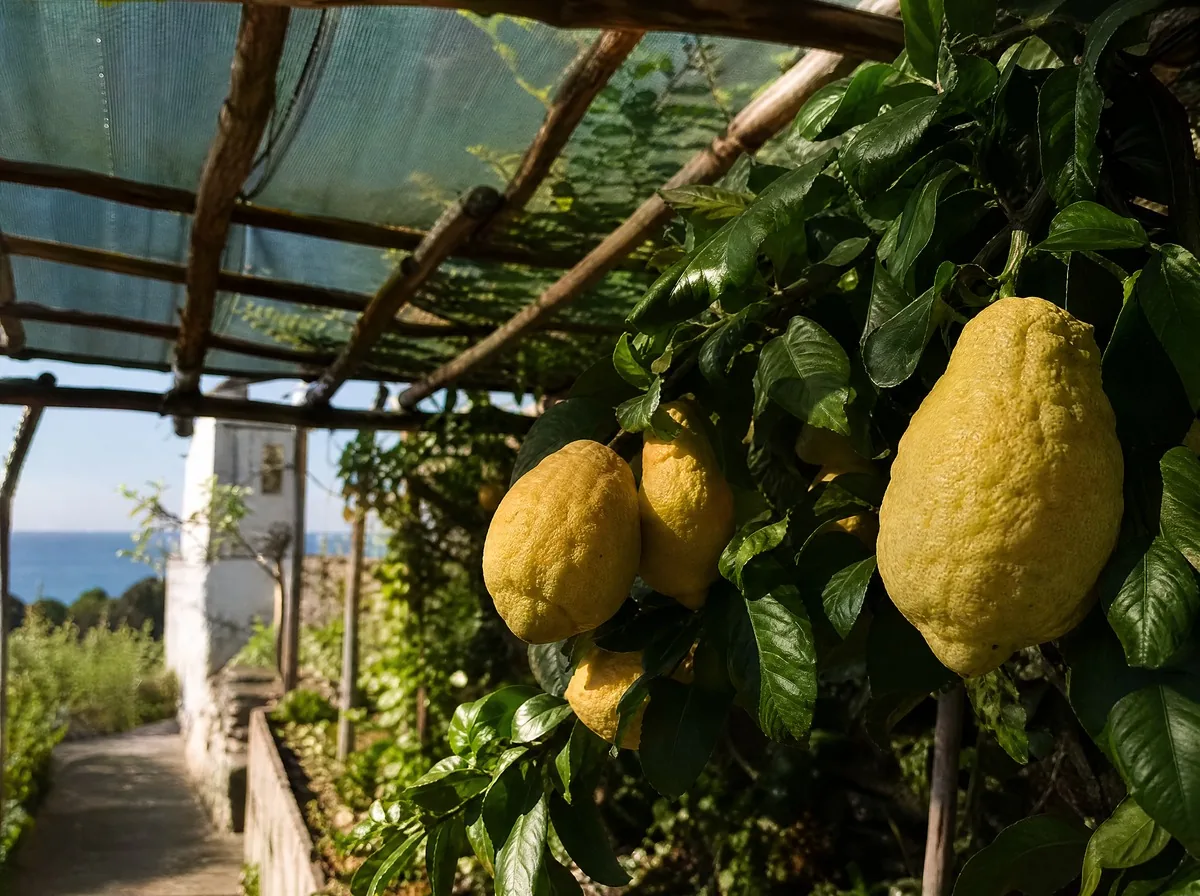

Pick up a Procida lemon and the first thing you notice is that the weight is wrong. It is as big as a large orange, the skin is thick and pale, and when you cut it you find out why: between the peel and the flesh there is a white layer up to a centimetre and a half deep, spongy, soft. In any other Italian lemon that part is called the albedo, it is bitter and you throw it away. Here it is sweet and you eat it. All of Procida’s lemon cooking comes out of this single botanical difference, and it is not a guidebook detail: it is the reason a Procidan lemon salad exists and an Amalfi one does not.
What the limone pane is
It is a local cultivar, grown on the island in walled kitchen gardens and on the terraces behind the houses. The fruit is medium to large and roundish, with thick, pale yellow skin. The flesh is juicy, has almost no pips and is barely acidic: taste it on its own and it does not pull the face out of you that you expect from a lemon.
The name is descriptive, not poetic. The white part is so well developed and so soft that when you cut it, it is like the crumb of a loaf — pane is Italian for bread. Procidans eat it that way, in thick slices, with a thread of oil and salt, the way you would eat a tomato.
The botanical sources give it as a probable hybrid of bitter orange and citron. The right word is probable: I have not found a published genetic characterisation that closes the question, and anyone who tells you it is settled is rounding up.
Why sweet pith changes everything
Put three lemons from the bay side by side. The sfusato from Amalfi has a thick pith, but a bitter one: the peel goes into limoncello, the juice onto fish, and the white part into the food waste. The ovale from Sorrento behaves the same way. The limone pane of Procida does not: the white part is sweet and tender, with a texture somewhere between a sponge and the white flesh of a watermelon.
The practical consequence is enormous. If you can eat the pith, the lemon stops being a seasoning and becomes a vegetable. You can cut it into big pieces and dress it, and you get a raw starter that in Naples, made with ordinary lemons, would be inedible. You can turn it into a cream that carries the filling of a lingua di Procida on its own. You can reduce it to a pesto and use it as the base for a seafood pasta.
The test to run. Ask for a slice of limone pane and bite the white part. If it is bitter, it is not a Procida lemon — it is a lemon.
What the kitchens do with it
Four uses, in the order in which you actually run into them.
- Insalata di limoni. Rough slices with the pith on, garlic, onion, mint, chilli, oil, salt. You crush it a little with a fork. It started as a sauce for bread and as something to eat alongside fried fish.
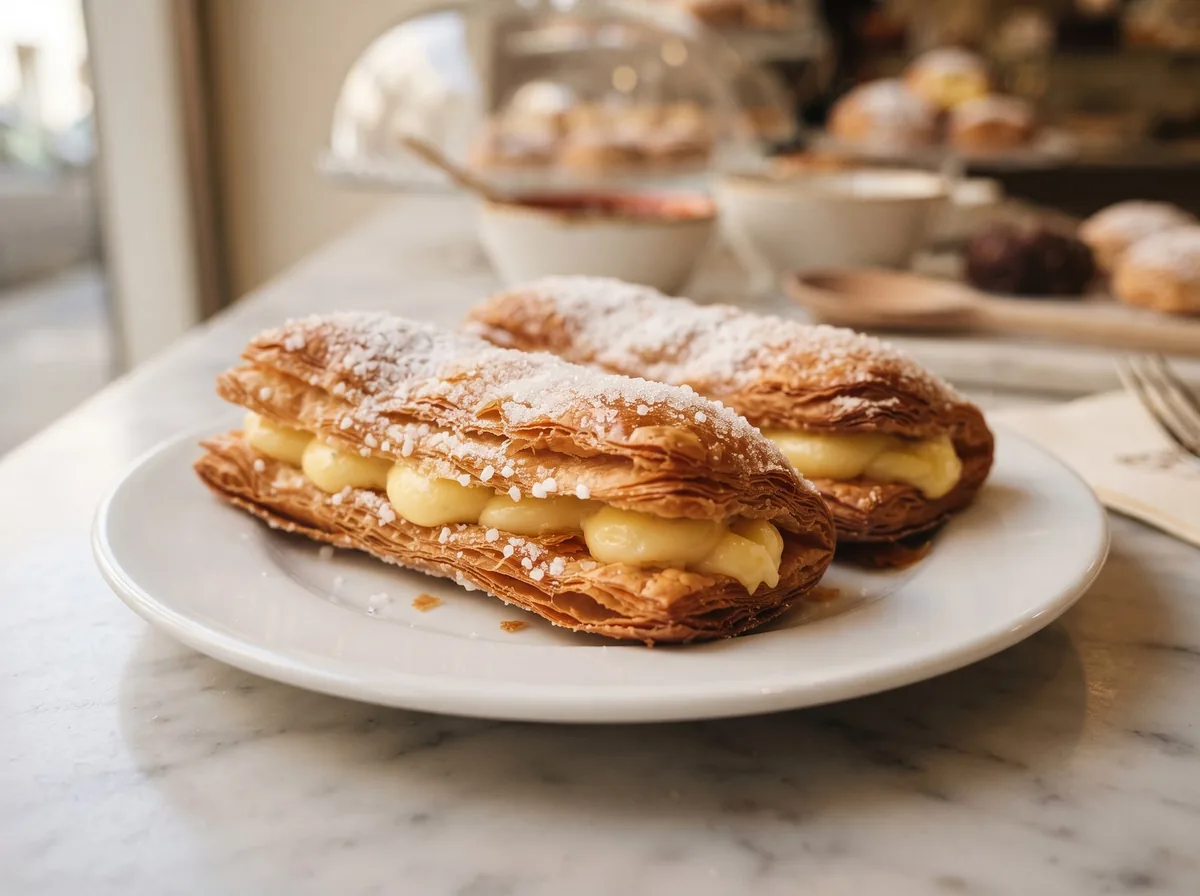
- Lemon cream. The filling of the lingua di Procida, the long pastry that is breakfast here all year round.
- Lemon pesto. The base for linguine with clams or mussels. At Da Girone, at the Chiaiolella, it is the signature dish of the house.
- Limoncello. Made with the peel of the limone pane. Plenty of kitchens offer it with the bill: at Da Girone it arrives without your asking.
You will also come across lemon and aubergine fritters, a tarte au citron made with limone pane at Paname’, and parmigiana alla procidana, which has nothing to do with lemons but is worth the digression: you eat it leaf by leaf instead of cutting it into slices, and it rests for a day before it goes to the table.
When you actually find it
Ripening runs from October to March, but the tree flowers again and produces all year. On restaurant tables you see it above all from spring to early summer, when the lemon salad moves into the starters and the heat makes it make sense.
If you arrive in August you will find it anyway, because demand keeps the supply chain open. If you arrive in November you find the best fruit and half the restaurants shut: Procida in winter genuinely empties out. In that case go for the places that stay open all year, like Paname’ at Marina Grande.
Production is small. We are talking about an island of less than 4 km² with domestic kitchen gardens, not an industrial supply chain: do not expect market stalls piled with crates.
P.A.T. and not DOP: what difference it makes
The Procida lemon is entered on the P.A.T. list, the register of Traditional Agri-Food Products (Prodotti Agroalimentari Tradizionali) of the Campania Region. It is not DOP and it is not IGP.
The difference concerns you as a consumer. The P.A.T. is a regional census of products with methods established over time: it records, it does not protect the name on the market. A DOP or an IGP, by contrast, create a set of production rules and a consortium, and anyone writing that name outside the rules can be prosecuted.
Translated: “limone di Procida” written on a menu or on a bottle is not a legal guarantee of origin. It does not mean you are being cheated, it means you have to ask. On the island the question makes sense; in Naples, on an industrial limoncello, the wording is worth little. I go into it at greater length in the long piece on the limone pane.
Where you see it growing
There are no organised lemon groves you can visit. The lemons are in private gardens behind walls, and you catch sight of them as you walk: on the climb up to Terra Murata, on the inland streets between Marina Grande and the Chiaiolella, along the low walls of the path towards Vivara.
It is one of the few things for which it is worth walking instead of taking the micro-taxi: the farming part of Procida is inland, not on the seafront.