
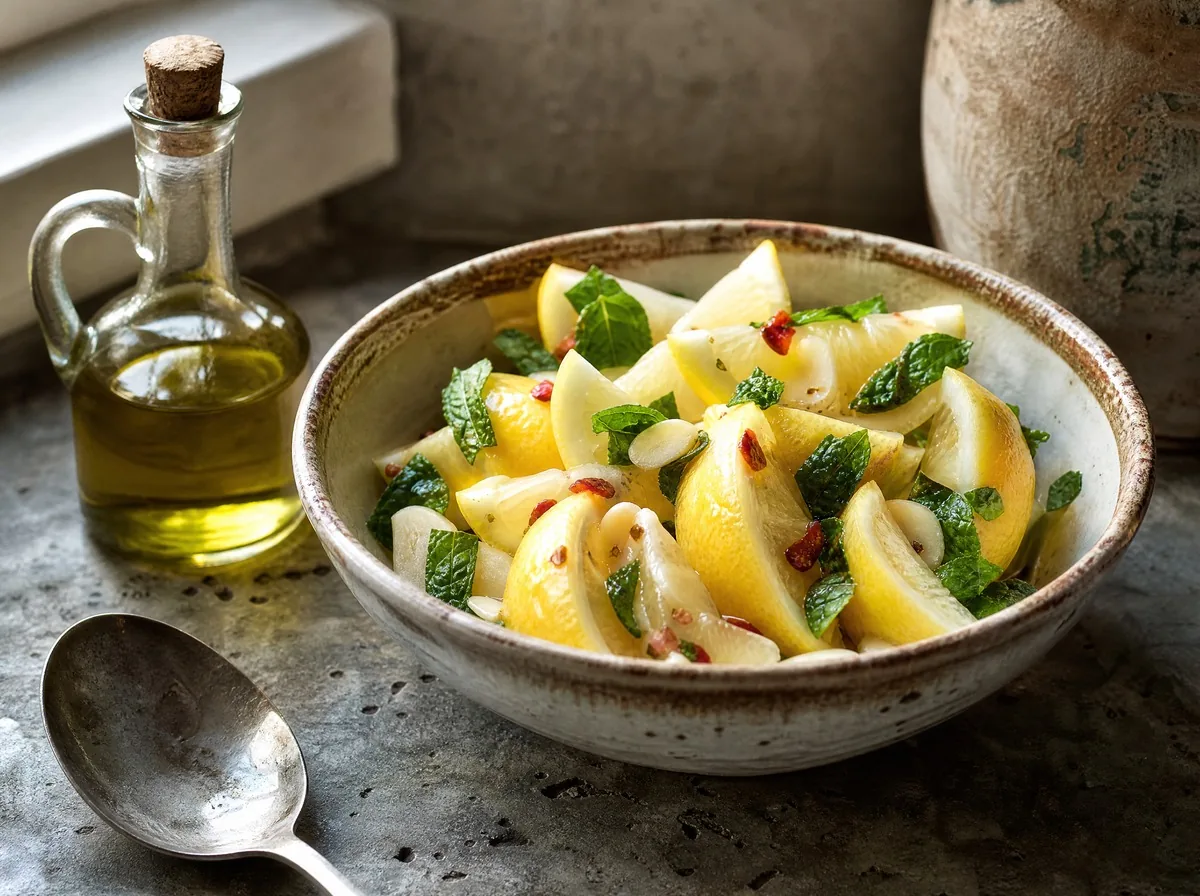
There are islands that tell their story through a view. Procida tells its own better through a fruit cut in half. Take a local lemon, put it on the board, sink the knife into it: between the yellow peel and the flesh you find a white layer as much as a centimetre and a half thick, spongy, that looks like the crumb of a loaf. In any other lemon in the gulf that part — the albedo — is bitter and ends up in the food waste. Here it is sweet, and it is eaten. Everything that follows, from the insalata di limoni to the lingua di Procida to the pesto that dresses the linguine at the Chiaiolella, comes down from that single difference. Take it away and what is left is an island of fish, as good as all the others in the gulf and no better.
What the limone pane really is
It is a local cultivar, not a widely traded commercial variety. The fruit is medium to large, roundish, with a thick, pale yellow skin. The flesh is juicy, almost seedless, and low in acid: bite it and it does not set your teeth on edge the way you would expect.
The name describes the texture. That enormous, soft white layer, when cut, is like the crumb of a loaf; hence “limone pane”, bread lemon. There is nothing metaphorical about it, it is an observation made in a kitchen.
On the genetic origin the sources indicate a probable hybrid between bitter orange and citron. The word to hold on to is probable. I have not found a published genetic characterisation that closes the question, and anyone who tells you it is settled is rounding a hypothesis up into a fact. The citron, incidentally, is the citrus in which the albedo is by definition the edible part: if the hypothesis holds, the explanation of the sweet character lies there.
The plant is everbearing: it produces all year round, with the main ripening from October to March. On the table, though, the lemon is seen above all from spring to early summer, when the raw preparations make sense and the restaurants are all open.
Three lemons of the gulf, one single difference
It is worth putting them in a row, because the confusion is constant and commercially useful to whoever is selling.
| Lemon | Albedo | What is done with it |
|---|---|---|
| Sfusato amalfitano | Thick but bitter | Peel for limoncello, juice for fish; the white is discarded |
| Ovale di Sorrento | Bitter | Juice and peel; the white is discarded |
| Limone pane of Procida | Thick, spongy, sweet | It is eaten: by volume it is the main ingredient of several preparations |
The consequence is a difference of category, not of nuance. If the albedo is eaten, the lemon stops being a seasoning and becomes a vegetable. You can cut it coarsely, salt it, dress it with oil, garlic, onion, mint and chilli, and you have a dish: the insalata di limoni. With the sfusato the same dish would be a punishment, because what you are mostly eating is precisely the white part.
This is also why in Naples the insalata di limoni does not exist as a codified dish, despite the city being an hour away by ferry. It is not a matter of a different tradition: it is that with the wrong ingredient it cannot be made.
What the islanders do with it
Four strands, in order of how often you actually meet them.
The raw. The insalata di limoni is the founder. It began as a peasant and seafaring dish with two functions: it was the sauce for the bread and it went with fried fish, cutting the grease. You crush it just a little with a fork to bring the juice out without breaking up the albedo, and you eat it cold.
The sweet. The lingua di Procida is an elongated sheet of pastry filled with lemon cream and covered in sugar nibs. The shape came from outside — the sources attribute it to a Sicilian pastry cook — but the turning point has a date: in 1950 Pasquale Mazziotti, a Neapolitan who had moved to the island, replaced the classic confectioner’s custard with the local lemon cream. It is that gesture that makes the pastry Procidan, and not simply a pastry sold on Procida.
The savoury, in the kitchen. Lemon pesto dresses linguine with clams or mussels: at Da Girone, at the Chiaiolella, it is the house’s signature dish, and on the same menu you find the lemon and aubergine polpette and the insalata di limoni. If the subject interests you, there you can order three versions of it in one meal.
The liqueur and the bakery. Limoncello made from limone pane, using the peel. And baking: at Paname’, an independent bakery opened in July 2023 by two cooks, the limone pane ends up in the tarte au citron. It is also one of the few addresses open all year, which on this island is not a detail.
Why the lemon and not the fish
If you ask an agency to describe the cooking of Procida, it will talk to you about the sea. That is understandable and it is also partly wrong.
The catch here is the catch of the gulf of Naples: the same water, the same boats, the same markets at Pozzuoli and Torre del Greco. The preparations are those of the Campanian coast — frittura di paranza, octopus, anchovies, pasta with clams — and there is no distinguishable Procidan school of fish cookery. Said without any polemic: you eat well, but you do not eat something you would not find elsewhere.
The lemon, on the other hand, is a material and local fact. It is not a recipe that can be copied, it is an ingredient that does not exist elsewhere, and the cooking that has been built on it cannot be exported. This is the only thing that makes Procida different gastronomically, and it is worth saying so plainly instead of drowning it in a list of seafood dishes.
There is a corollary that is useful to visitors, too. Several things you will read attributed to the island are not from it: spaghetti alle vongole fujute is a Neapolitan dish, the sweet casatiello is documented as a speciality of Monte di Procida, which is on the Phlegraean mainland, and lemon granita is Sicilian, however much sense it might make to do it here with the local fruit. They are harmless attributions, but they shift attention away from the one thing that really is native here.
P.A.T., not DOP: the protection that does not exist
The Procida lemon is entered on the P.A.T. list, the Traditional Agri-Food Products (Prodotti Agroalimentari Tradizionali) of the Campania Region. It is not DOP and it is not IGP. The distinction looks bureaucratic and in fact it changes everything.
The P.A.T. is a regional register: it records products whose processing methods have been established over time. It registers the existence of a tradition. It does not set up a set of production rules, it does not draw a binding production area, it does not create a consortium, and above all it does not stop anybody writing that name on a label or on a menu.
DOP and IGP do the opposite: they define who may use the name, how, and with what controls. Anyone using it outside the rules can be prosecuted.
The practical consequence. “Limone di Procida” written on a bottle of limoncello in Naples is not a protected term. It does not mean it is false; it means nobody is checking it on your behalf. The only control available is you, and the right question is: who do you buy it from?
The same goes for the carciofo di Procida, also a P.A.T. and not a DOP. And it goes, in a different form, for Starza wine: the first denominated wine made with grapes from the island is not bottled as “DOC Procida”, which does not exist, but under the DOC Campi Flegrei. On this island the names of the protections do not follow the borders of the tourist rhetoric.
Why nobody has protected it
I have no sources that explain with certainty why DOP or IGP status was never applied for, so I am not giving you an invented reconstruction. What can be observed is the context, and it is eloquent enough.
Procida has less than 4 km², densely inhabited. The citrus trees stand in walled gardens behind the houses, not in structured agricultural businesses. An application for DOP status requires a consortium, a set of production rules, certification costs and a volume of production that justifies all of it. With a domestic and fragmented supply chain, the sums do not add up.
The result is a product that is full of identity and unknown to the market: extremely strong as a local story, indefensible as a trade mark. If you are wondering why you do not find the Procida lemon in supermarkets the way you find the sfusato, that is the answer, and it has nothing to do with quality.
How to recognise it, on the island and off it
One test always works and needs no expertise: taste the white part. If it is sweet and spongy, it is limone pane. If it is bitter, it is an ordinary lemon, however excellent.
On the rest, three rules of common sense. First: production is small, so do not expect stalls loaded with crates or endless availability. Second: in the island’s restaurants, asking where the lemon comes from is not rude, it is normal. Third: off Procida, an industrial product with the island’s name on the label should be judged for what it is — an uncertified commercial indication.
If you want the full picture of what to eat on the island and in which marina, I have put it in the food guide. If instead only the fruit interests you, the page on the limone di Procida has the seasons, the uses and the addresses.