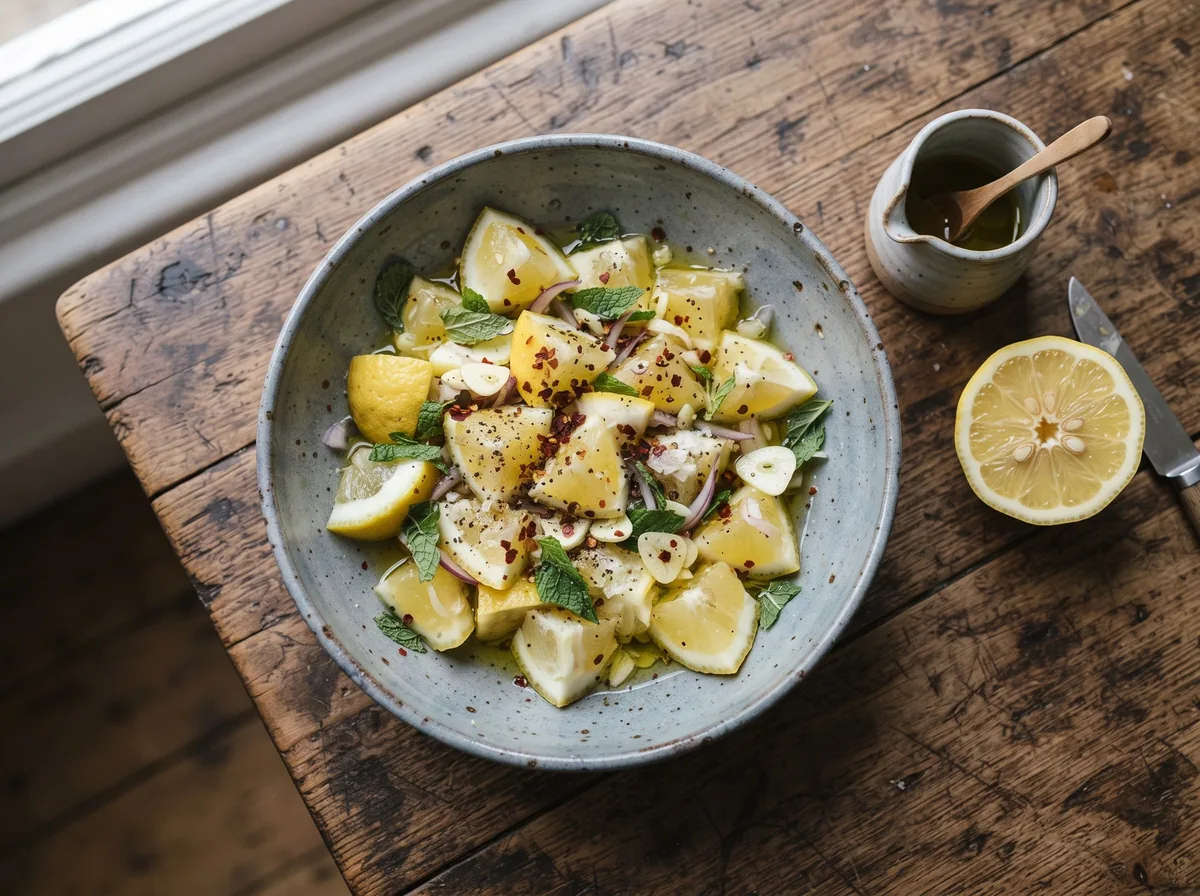

It comes to the table and it looks like a mistake: big pieces of raw lemon, white and yellow, buried under onion and mint. The first forkful throws you. It is not as sharp as you feared, it is not bitter at all, and it is crunchy and juicy at the same time. The insalata di limoni is the dish that explains Procida better than any postcard: it exists only here because only here does the limone pane have a sweet white part. With a normal lemon it would be a punishment.
How it is actually made
The lemon is cut coarsely, with the pith on: irregular pieces, not transparent slivers. Then garlic, thinly sliced onion, extra virgin olive oil, mint, chilli and salt. You crush it a little with the tines of a fork, just enough to bring the juice out without reducing the white part to mush.
There is no vinegar and there is no sugar. The oil and the onion do the balancing; the lemon brings light acidity and sweetness together. Every kitchen changes something: some use mint alone, some add oregano, some measure out the chilli as though it were a personal challenge. The frame stays the same.
It rests briefly. Made too far ahead, the salt draws water out and the pith goes limp. If they serve it to you already soft, that plate had been standing a while.
How you eat it, and what with
It began as a poor dish with two practical jobs. First: it was the sauce for the bread, the liquid in the bottom of the plate mopped up with the crumb. Second: it went alongside fried fish, which is fatty and asks for acidity.
Do those same two things. Order it together with a fry-up rather than on its own, and keep the bread for the end. As a single starter it is interesting but unbalanced; next to a fried paranza it works the way it worked sixty years ago.
Portions: it is a side dish, not a main course. One plate is enough for two, and anyone who cannot take raw garlic and onion should know that before ordering it.
Why it does not exist in Naples
Look for insalata di limoni on the menus of the city and you will not find it as a fixed dish. The reason is not cultural, it is botanical: with a bitter-pithed lemon the dish would be inedible, because the main ingredient by volume is precisely the white part.
The same goes for the Amalfi coast. The sfusato from Amalfi has a thick and generous pith, but a bitter one: you use the peel, not the white flesh. That is why Procida’s lemon cooking has no equivalent a few miles away, and it is the one genuinely exclusive food argument the island has. The fish, on its own, is as good here as in the rest of the bay and no better.
Where it makes sense to order it
You will find it among the starters of several kitchens on the island in spring and summer. At La Gorgonia in Corricella the reviewers point to it as the best; that is a reviewers’ judgement, not a ranking of ours, but it comes up often enough to be worth flagging. At Da Girone, at the Chiaiolella, it is on the menu alongside the lemon and aubergine fritters and the linguine with lemon pesto: if the lemon theme interests you, that is the place to order three versions of it in a single meal.
It is not a dish that is everywhere. Out of season it disappears from a good many menus along with half the restaurants. Ask before you sit down, if that is what you came for.
A poor dish with a precise logic
It is worth understanding where it comes from, because that explains why it is made this way and not another.
On an island of less than 4 km² there is little good land and it has to be shared between kitchen gardens, houses and vines. The lemon, on the other hand, grows anywhere there is a south-facing wall and produces almost all year round. It was the most available and least expensive ingredient a family had to hand, along with oil, onion and a bit of mint.
The two original jobs were concrete. As a sauce for bread, the salad solved a meal when there was nothing else: the liquid in the bottom of the plate, mopped up with the crumb, was the most fought-over part. As an accompaniment to fried fish, it did the work we now hand to a squeeze of lemon, but with more substance and as a dish in its own right.
It is also the reason it has no expensive seasonings. No vinegar, no sugar, no herbs bought at a market: garlic, onion, mint and chilli were all in the garden, or in the pot on the windowsill. When a restaurant serves it to you with creative additions — nuts, other citrus, sauces — that is not a scandal, but it is no longer this dish.
Making it at home (and why it often fails)
The recipe is trivial. The ingredient is not. With supermarket lemons you get a bitter salad: ordinary pith is full of bitter flavonoids and no trick will sweeten it.
If you want to try, you need real limoni pane, brought from the island or bought from someone who grows them. Minimum rules: cut them big, salt at the last moment, plenty of oil, mint torn by hand and not chopped, ten minutes of resting and not an hour. Serve the dish cold but not straight from the fridge, because the chill kills the aroma of the peel.