The Processione dei Misteri, the Good Friday procession of the Misteri, is the most important thing that happens on Procida in a year, and it is not a show for tourists: it is a rite the island organises for itself, with its confraternities, its inconvenient hours and its written rules. Anyone who arrives knowing how it works sees it well. Anyone who arrives late in the morning on the hydrofoil finds themselves in the middle of a crowd, at the bottom of a slope, when the most intense part has already gone by.
The fact that decides everything is this: the confratelli assemble at Terra Murata by 05:00 and the procession sets off at 07:30. At five in the morning, you have to be on the island already. This guide explains what happens on the Thursday, what happens on the Friday, where to stand at each moment and how to organise a night in March on an island that in March is almost entirely closed.
The next edition is Friday 26 March 2027.
Holy Thursday: the hooded Apostoli
The day before the Misteri there is a procession that many visitors miss, and it is the one Procidans mention first when they talk about atmosphere: the procession of the Apostoli incappucciati, the hooded Apostles, of the Confraternita dei Bianchi, by candlelight.
We are not giving you a precise time because we do not have a verified one, and for an event like this a wrong time sends people wandering about for nothing. What we can tell you is that it takes place on the evening of Holy Thursday and that the candles are its characteristic element. The precise information is found on the island in the preceding days, on the posters and in the churches: it is the way things are still communicated here.
The practical sense of it is another matter: if you are on the island on the Thursday evening, you have also solved the problem of Friday morning. Sleeping here on the night between Thursday and Friday is not a logistical detail, it is the condition for seeing the main procession from the start.
Good Friday: how the day unfolds
The day has a precise structure, fixed by a set of rules.
Before dawn
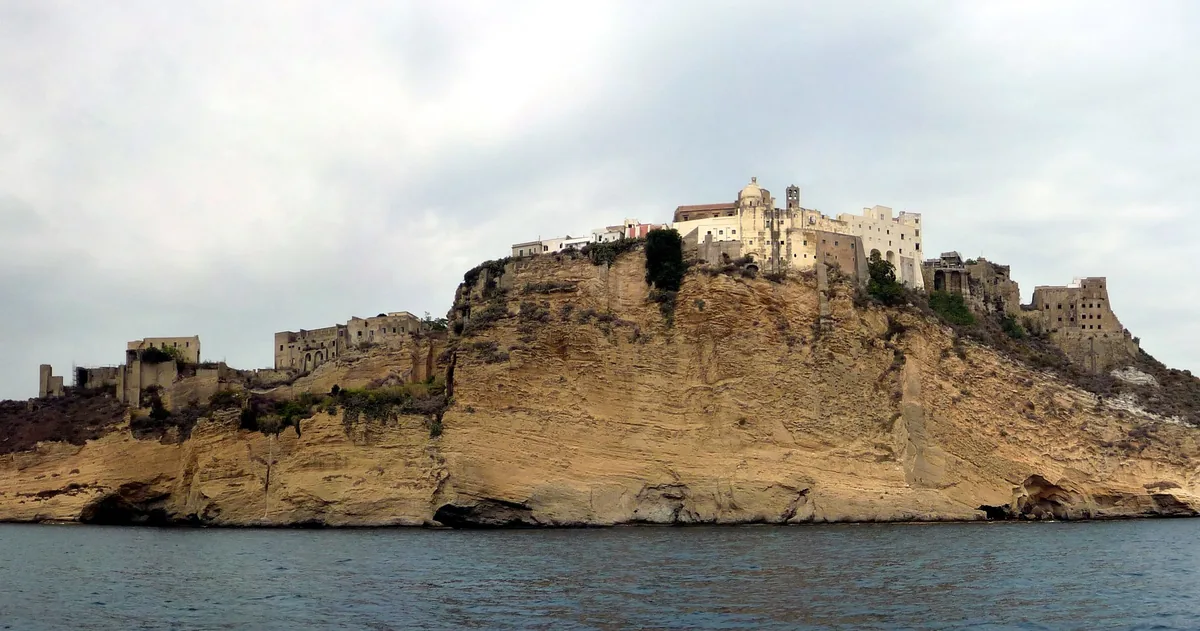
At 05:00 two things happen at once. The confratelli have to be assembled at Terra Murata; and the Congrega dei Turchini moves the statues of the Cristo Morto and the Addolorata, the dead Christ and the grieving Virgin, from its own church to the Abbey of San Michele. It is the moment when the island is still dark and when, if you are up here, you understand that this thing is not organised for you.
The departure, at 07:30
At 07:30 comes the "chiamata", the call, and the procession leaves the abbey. From here the Misteri come down through the historic centre to Marina Grande, where they are lined up in the eastern sector of the square. The descent is photographically the strongest part, because the floats pass between the houses in narrow streets, accompanied by trumpets and drums.
The afternoon and the evening
In the afternoon the Misteri climb back up to Terra Murata. In the evening a candlelit procession carries the Cristo Morto back to the confraternity’s church, San Tommaso d’Aquino. Anyone who stays until evening sees the day close as it opened, in the dark and with candles.
All of it is free: it is organised by the Arciconfraternita dell’Immacolata Concezione dei Turchini, there is no ticket and no stand.
What the Misteri are, exactly
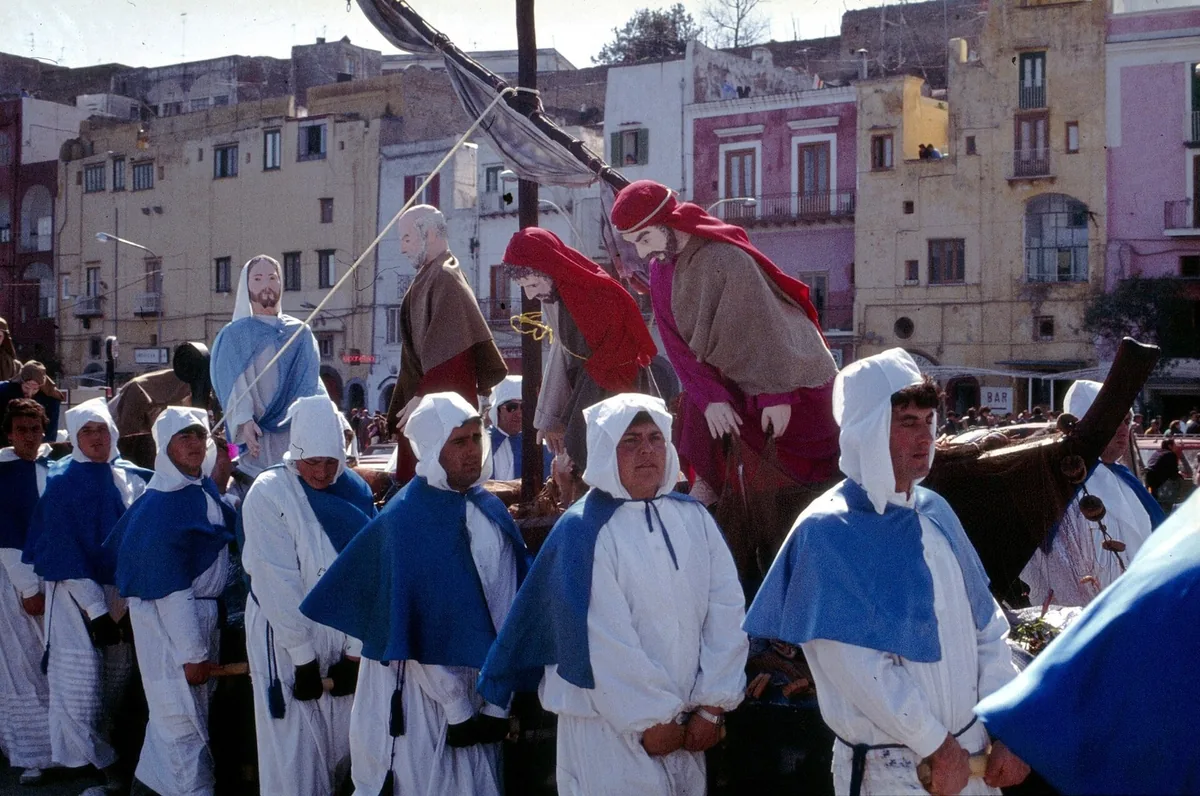
They are tableaux and floats representing scenes from the Old Testament and the Gospels, and the thing that makes them extraordinary is that they are built from scratch every year. They are not kept and not brought out again the following year: they are constructed anew, in papier-mâché, wood, glass, metal, plastic and salvaged materials. Normally there are between 40 and 60 of them.
The island’s families and groups make them in the preceding months, and the rules also fix the dimensions: for 2026, a maximum of 8 metres in length, 1.8 in width, 3.3 metres in height at the sides and 3.8 at the centre. These are numbers that say a great deal about the streets these floats have to pass through.
The confratelli’s dress is regulated too: a white alb, a cord and a turquoise mozzetta, the short shoulder cape, a hood, white shoes, and an explicit ban on carrying non-religious symbols. The procession originates between the end of the sixteenth century and the seventeenth and derives from the Spanish processions that reached Naples.
One detail that is worth a visit outside Holy Week as well: the best Misteri go into a permanent museum, which is at Terra Murata near the belvedere of the cannons. If you come in summer and they intrigue you, that is where you see close up how they are made.
Where to stand, moment by moment
There is only one route and it goes downhill, so the choice is between three positions, and each has a price.
- Terra Murata, before 07:30. It is the right place if you want to see the departure and the assembly. You have to climb in the dark and you have to accept cold and waiting: in March, at dawn, it is not warm up here. You get there on foot up the steep climb from Corricella, and off season do not count on the buses at that hour.
- Along the historic centre, on the way down. It is the best position for photographs: narrow streets, floats up to nearly four metres high, trumpets and drums booming between the houses. Find a point where the street widens slightly and stay there: following the procession on foot means seeing it from behind.
- Marina Grande, on the square. It is where the Misteri are lined up in the eastern sector, and it is the only moment when you see them all together and standing still, which is to say the only one when you can really look at them. It is also the most crowded point.
If you are coming with children or with someone who walks slowly, the sensible choice is the third: the harbour square is flat, is reached without stairways and has bars and services around it. The island’s climbs and stairways, with the crowd, are another matter.
Why you have to sleep on the island, and how to arrange it
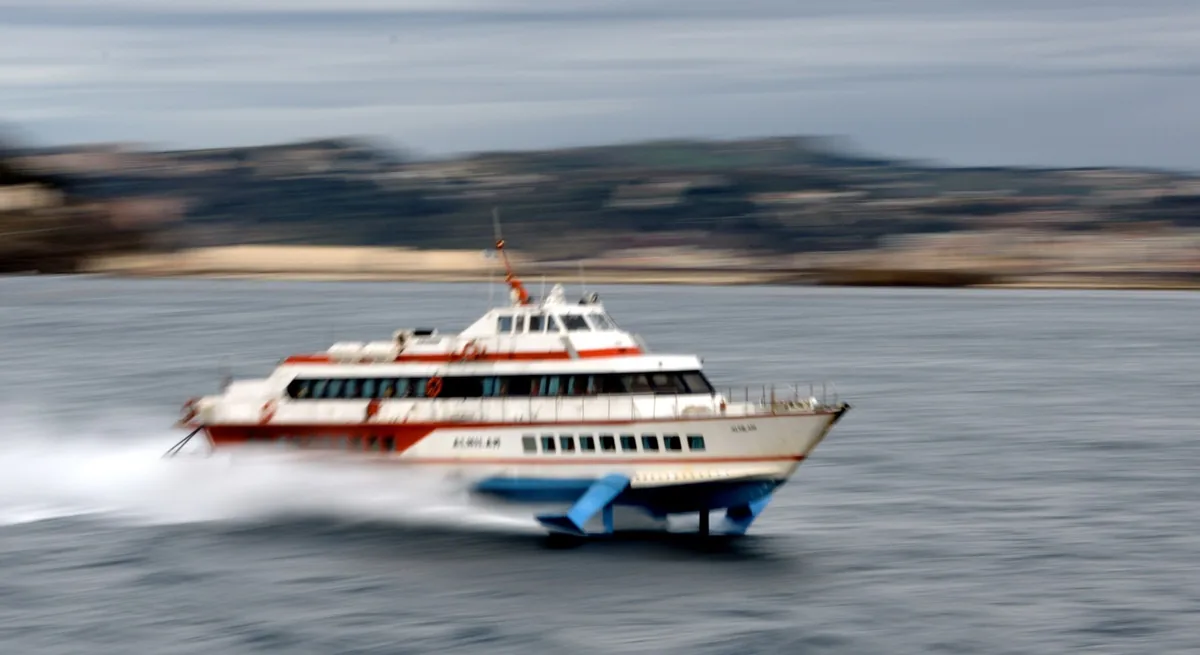
Let us do the sums. The assembly is by 05:00 and the departure at 07:30. The first Caremar connection from Naples is the 06:00 ferry, which takes about an hour; the first hydrofoil is at 07:30. Even taking the 06:00 ferry you would reach the port while the procession is setting off on the other side of the island, at the top. From Pozzuoli there is a very early sailing, but only on weekdays and with times that have to be checked again for the exact date. The conclusion is simple: to see the Procidan Holy Week you have to be on the island the night before.
The problem is that Holy Week falls in March or April, and Procida has about 90 places to stay in all. In those days they fill up. Book well in advance and check that they are open: the seasonality of the properties on the island is largely undeclared. Among those we know something about, the Tirreno Residence at the Chiaiolella states that it is open all year. The areas and the criteria are in where to stay in Procida.
On transport, two things. The first: off season the EAV buses finish around 21:00 and the summer evening services are not running. The second concerns the car: in 2026 the ban on landing and driving for non-residents’ vehicles ran from 30 March to 15 October, but the regional decree changes every year and has to be checked again in March. For Good Friday 2027, which falls on 26 March, check before you put a car on a boat. In any case, on those days, the car is only one more problem: see getting to Procida.
It is a rite, not a show
It is worth saying plainly, because for some years now the procession has also drawn people who have no idea what they are looking at. There is no stand, there is no ticket, there is no service designed for visitors: there is a community of ten thousand people carrying on something of their own, with confraternities that have precise rules even about shoes. Anyone watching is a guest.
In practice that means three things. Do not cross the procession to change position: wait for it to pass. Do not put your lens in the face of the hooded confratelli, who are local people and not extras. And keep the volume down during the halts, which are not pauses but parts of the rite. Nobody will say anything to you: here people prefer not to make a scene. Which does not mean it goes unnoticed.
On the logistical side, expect the streets of the historic centre to be effectively closed for hours and the climbs to be full. If you have a ferry to catch in the afternoon, allow plenty: from Marina Grande to the quay is a few minutes’ walk, but with the square occupied by the Misteri and the crowd, the few minutes become a good many.
One last thing about eating. Good Friday is a day of fasting and of abstinence from meat, and on the island you feel it: in March the kitchens open are few in any case, and on that day there may be fewer still. It is not the day to improvise a lunch at Corricella: ring the day before, or arrange something simple at the port, where the bars and the bakery are.
The rest of the year: the island’s other feasts
Holy Week also opens the monument season: the opening service of the Abbey of San Michele, with the free guided visits, runs from Holy Week to All Saints. Anyone coming for the procession therefore finds the abbey at the start of its calendar, with the warning that in 2026, the Millennium Year, the hours may change without notice.
The other two big dates of the year are the feast of San Michele Arcangelo, the island’s patron, celebrated on 8 May and 29 September, and the Sagra del Mare at the end of July, with the election of the Graziella and the sea games. Then in June there is the literary festival Procida Racconta. If you are choosing when to come, the page on when to go to Procida lines up seasons, connections and opening times.
One last note on what to expect from an island in March: many kitchens are closed or open only at weekends, and ringing first is not pedantry. The Panamé bakery, open all year, is worth double in those days.