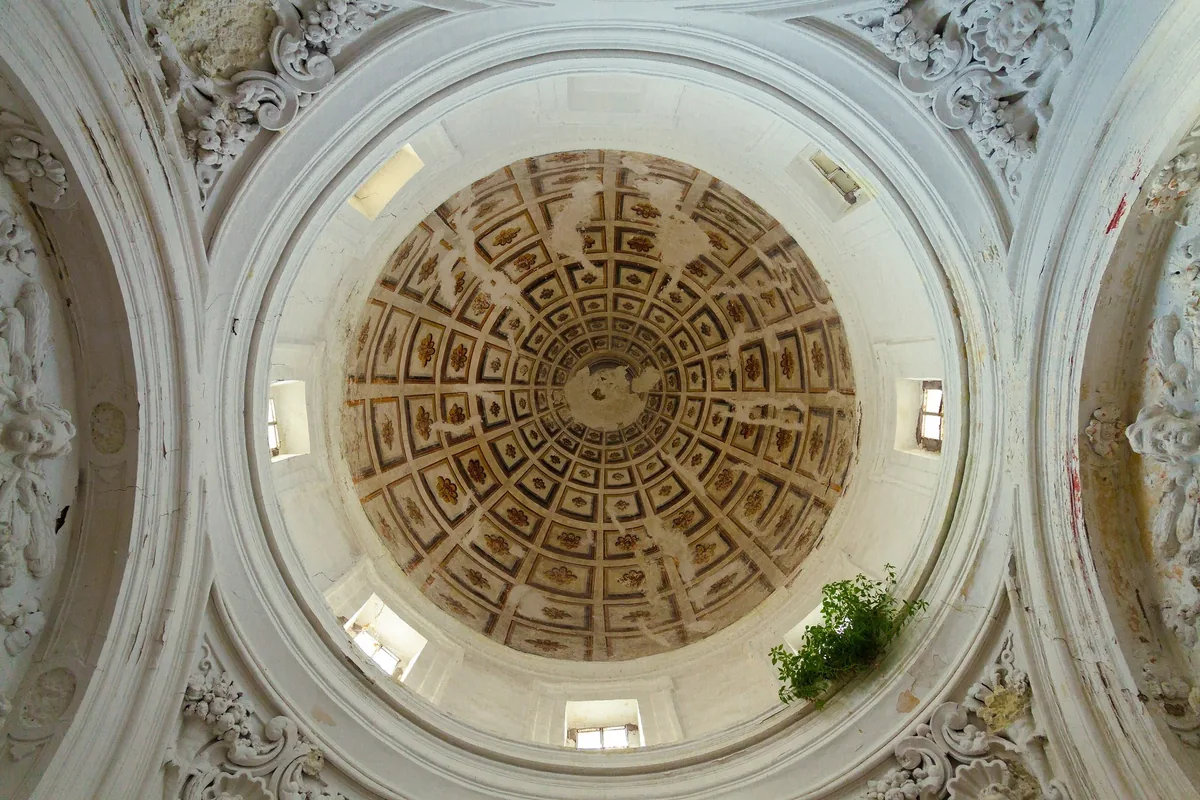
You climb the last few metres of Terra Murata, push the door open and the noise disappears. Inside it is cool even in August. The ceiling is high, the gilded wood of the organ glints in the half-light, and somewhere there is always a volunteer asking you whether you want an explanation. The right answer is yes: the explanation is free and it is worth more than going round on your own.
Monks are documented here from 1026: that is why 2026 is the Millennium Year. The building you see, though, is sixteenth-century, like almost everything inside the walls of the upper village. A thousand years of continuity on an island of four square kilometres: it is the oldest thing Procida has to show you, and it is free.
What you see in the church
The main piece is the bellows organ of 1770, in carved and gilded wood, the work of Domenico Antonio Rossi: look at it from the side, where the gilding catches the light coming in from the high windows. The statue of San Michele was donated in 1811 and it is the one that goes out for the feast of San Michele, the moment when this church stops being a visit and goes back to being the centre of the town.
The nave is plain: do not expect picture-postcard Neapolitan baroque, this is the church of a fishing island and it shows. The value is in the layering, not in the richness. The same stones have seen the monks of the Middle Ages, the d’Avalos, the Bourbons and then the prison: four different regimes looking onto the same courtyard.
Take two minutes over the relationship between the church and the village as well. The abbey stands at the top of the fortified settlement, behind the walls, and that is no accident: in the sixteenth century church and defence were the same structure of power. The d’Avalos complex, a little further on, was part of the same design.
The underground levels are closed
To know before you climb up: the abbey’s official website states that at present the underground levels cannot be visited. Many guides, printed and online, still describe them as part of the visit. They are not.
It is a real shame, because down there is the most interesting part of the complex, spread over three levels. The first holds an eighteenth-century Neapolitan presepe, a nativity scene in wood and terracotta, and the chapel of the Madonna del Rosario. The second has the chapel of San Michele, with eighteenth-century frescoes restored in 1907, and the library: about 8,000 volumes, sixteenth-century choir books on parchment and paper, a geographical atlas dated 1570 and a book from 1534, the oldest in the collection.
The third level is "La Segreta", with the eighteenth-century confraternity bench, a Deposition of Christ of 1746 by Domenico Guarino — a pupil of Luca Giordano — and three carved and gilded nineteenth-century chests. All of this exists, it is a few metres beneath your feet, and for now you cannot see it. If somebody sells you a visit to the underground levels, ask for confirmation before you pay.
Opening hours and entry
The opening service for visits runs from Holy Week to All Saints, that is from the Easter period to 1 November. Out of season the church remains a place of worship, but the welcome service is not guaranteed.
The official 2026 hours are: Monday 10:00-13:00; Tuesday to Friday 10:00-13:00 and 16:00-18:00; Saturday 10:00-13:00; Sunday 11:00-13:00. Sunday and feast-day Mass is at 09:30 and there are no visits during the liturgy.
Entry is free, with a voluntary offering to the parish, and the guided explanation by the Associazione culturale Millennium is free too. Leave something: it is the only way this place keeps itself going.
A warning the official website gives explicitly: in 2026, for the Millennium Year, the calendar may be varied or suspended without notice. Other sources online publish different hours — do not trust them. Check the abbey’s website the day before, or ring 081 8967612, before you take on the climb.
Getting there
The abbey is at the top, inside the walls of Terra Murata. You go up on foot from Marina Corricella — steep, no shade, a good quarter of an hour in the heat — or with the C1 and L1 buses from the terminus at Marina Grande. The route is not suitable for wheelchairs.
The best way is to go up by bus and come down on foot: the view is in front of you the whole way down. Take water, because there is nothing along the climb. The real lines and timetables are in getting around Procida.
What the visit is like
It is not a long visit. Without the underground levels what is left is the church and its fittings, and taken slowly that is forty minutes; with a volunteer’s explanation it comes to an hour. Anyone who arrives expecting a museum complex comes away disappointed, and it is right to say so beforehand: here you pay nothing and you see a church, not a museum.
What changes the experience is precisely the explanation. The volunteers of the Associazione culturale Millennium tell you the dates, the donations, the restorations and the ties with the island’s families, and without that account half the objects stay mute. Ask for it as soon as you go in, not at the end.
There is no ticket office, there is no bookshop, there is no café. There is an offerings box, and few people use it. If you liked the place, that gesture counts for more than a review.
What to combine it with
You are already at the top: make use of it. A few steps away is Palazzo d’Avalos, the former Bourbon prison, which is only visited by booking and whose hours should be checked before you climb up. Going down towards the ridge you come to Santa Margherita Nuova, with the terraces you photograph the Corricella from, and a little below it the Casale Vascello.
Then you go down to eat: on the Corricella quay the tables are on the water, and Il Pescatore is one of the long-standing addresses. The full circuit, step by step, is in the Terra Murata-Corricella walk; if you only have one day, look at the one-day itinerary.