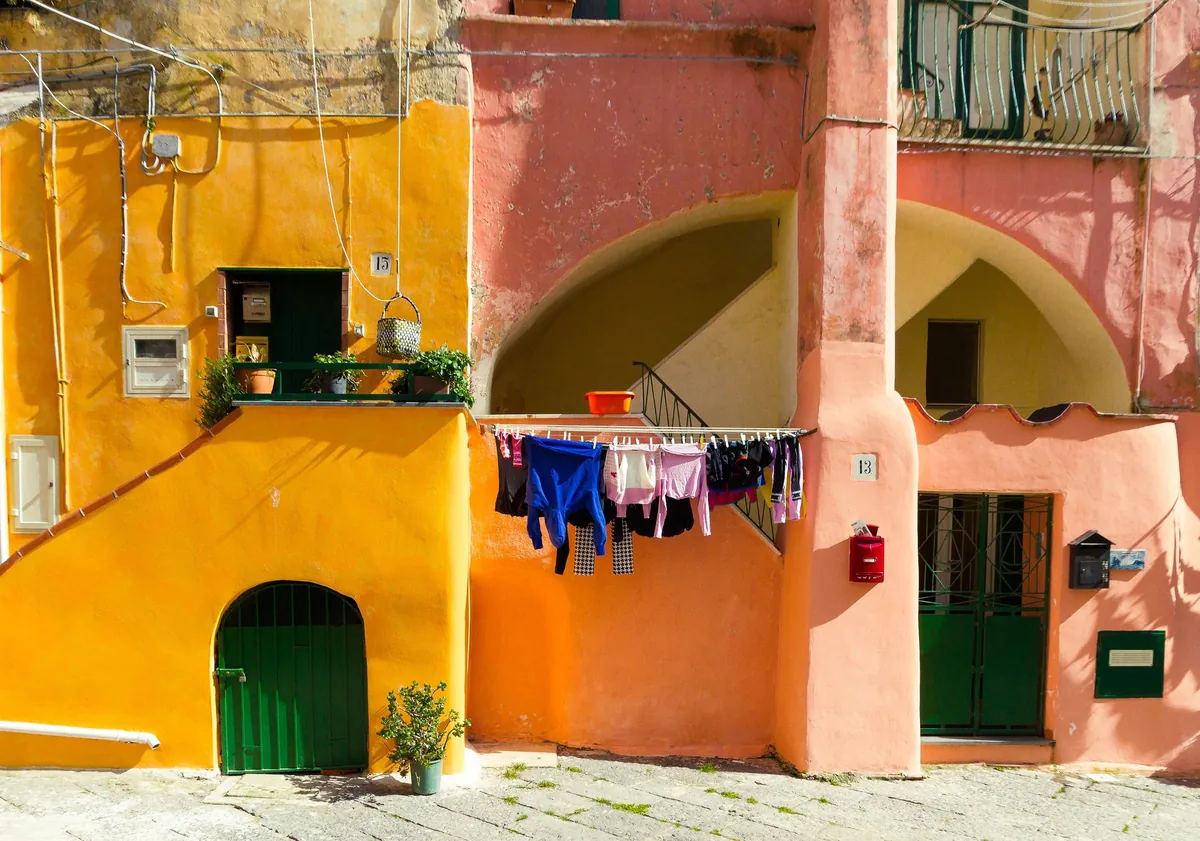
You go under a narrow arch and the noise dies away. In front of you is a wide courtyard, closed on every side by houses built up against one another, with outside staircases, covered balconies and washing hung out. There is a cat. There is somebody talking loudly from a window. There is no sign telling you where you are, and that is the best thing about the place.
The Casale Vascello is a seventeenth-century fortified courtyard settlement, the first residential nucleus to grow up outside the walls of Terra Murata. It is not a monument and it is not visited: it is a four-hundred-year-old block of flats where people live now. It has to be looked at with that in mind, or not looked at at all.
Why it exists
To understand it you have to look up, towards the walled village. For centuries the Procidans lived up there, at the top, because the Saracen raids made the rest of the island impossible to defend. In the seventeenth century those raids fell away, the population grew, and people began to come down.
The Casale is the result of that precise moment: you come down, but you do not trust it yet. So a middle way is born, a settlement outside the walls that brings the walls with it. It is town-planning history written in stone, and it can be read in ten minutes without needing a guide.
The name, as often on Procida, has no certain explanation and several versions go round. None of them is documented by a source worth citing, so we are staying out of it: it is a casale, that is a rural settlement, and that is enough to know what is being talked about.
The same dynamic explains Corricella, a little further on: the fishermen’s village comes down as far as the water, where nobody would have built two centuries earlier. The island expanded from the top downwards, and these two places are the two stages of that movement.
How it is built
The layout is defensive and you can see it with the naked eye. The coloured houses are built up against one another, with no gaps between one block and the next, to stop the enemy getting through. Everything turns around a large central courtyard, with narrow alleys linking it to the outside.
It is a fortress made of dwellings: no tower, no bastion, only the continuous wall that comes from putting the houses shoulder to shoulder. Anyone coming in had to go through the openings, and the openings were closed.
The element to look for is the vefio: the small covered balcony with an arched vault, of Arab influence, which on Procida you find everywhere, in particular along the front at the Corricella. Here, looking onto the courtyard instead of the sea, it has a different function: it was there so you could be outside while staying inside.
What to look at
Three things, and they are all free. The first is the colour: here the fronts are duller than at the Corricella, because they did not have to be recognised from the sea. Washed-out pinks, ochres, dirty whites. It is the palette of a place that was not born to be looked at.
The second is the outside staircases. Every house has its own flight going up to the floor above, propped against the front, because the dwellings multiplied vertically as the families grew. In a closed courtyard, the only space available was the air.
The third is the openings. Look for where the continuous wall breaks and see how narrow they are: two people side by side, no more. That measurement is not accidental, and it is the only defence this place has ever had.
How you get in
There are two entrances: one on Via Principe Margherita, the other on Via Salita Castello, the ridge that climbs towards Terra Murata. It is not a given that both are open, and there is nobody to ask: they are the gates of a private courtyard, not a ticket office.
If you find it shut, do not press and do not ring the bells. You can walk the outer perimeter anyway, the arches and the fronts are visible from the street, and at worst you have lost five minutes along a route you were already walking.
If you find it open: go in, stay in the courtyard, speak quietly, do not go up the private staircases and do not photograph the windows of the houses. These are common sense rules that count double here, because the distance between the visitor and somebody’s kitchen is three metres.
When to go
Early morning is the best moment: the courtyard is still in shade, the town is waking up and there is nobody there apart from the people who live in it. The late afternoon works for the light on the fronts, but it is also the hour when the courtyard goes back to belonging to the people who live there: children, shopping, chairs outside the door.
Twenty minutes is enough. There is no route, there is nothing to read, and there is nothing to buy: you look, you understand how it worked, you leave. It is a stop that makes sense inside a longer walk, not an objective to climb up for on purpose.
How to fit it into the circuit
It sits exactly on the road between the upper village and the lower one, so it fits in by itself. Coming down from Terra Murata after the abbey of San Michele and Palazzo d’Avalos, you pass Santa Margherita Nuova and the ridge, and the Casale is there just below.
From here to the Corricella is a few minutes downhill, and it is the right place to stop for lunch: on the quay the tables are on the water, from Caracalè to the other places in the row. Anyone who wants to finish on the beach goes down to the Chiaia, at the bottom of a stairway of about 180 steps — the sources move between 182 and 186, so do not trust anybody’s precise count.
The full route, with the stops in order, is in the Terra Murata-Corricella walk. The general picture of what to see on the island is in what to see on Procida.