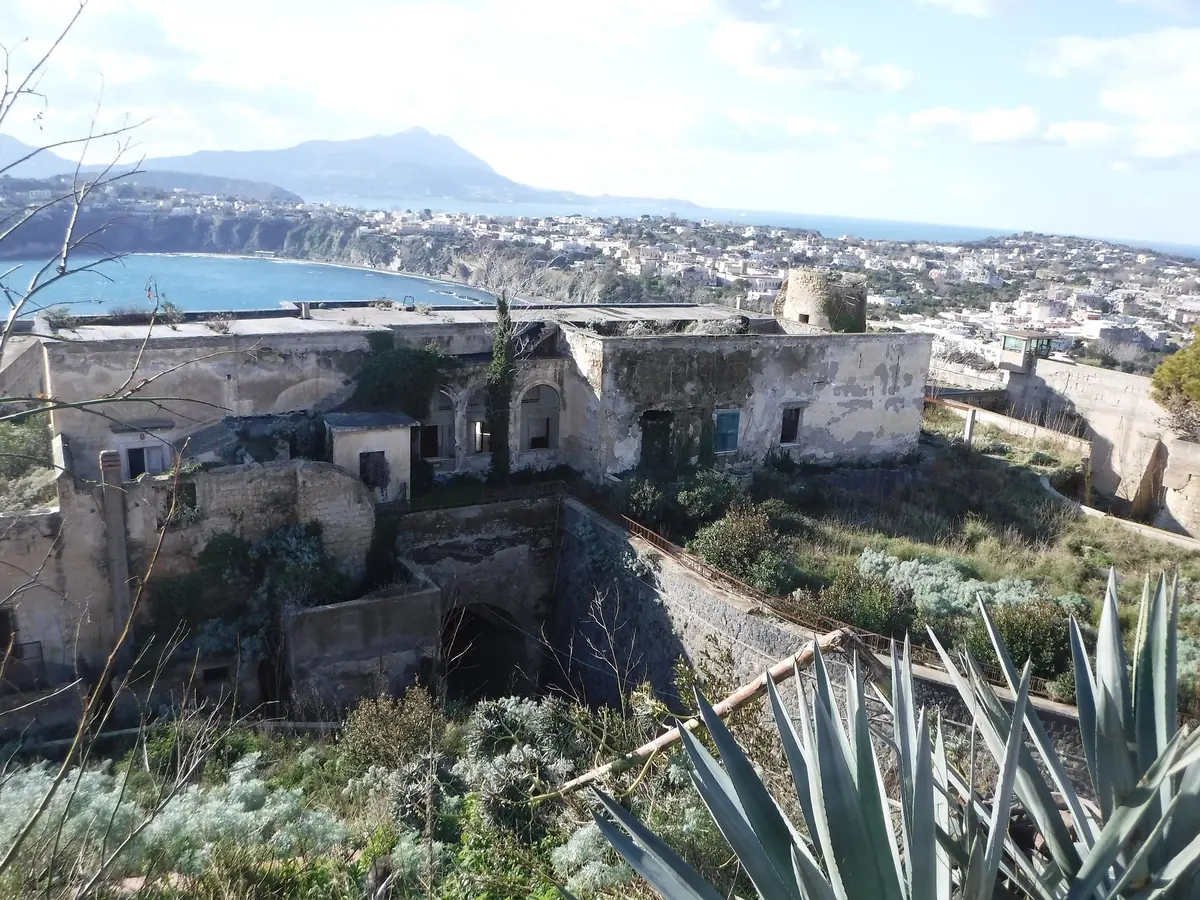
The guide opens an iron gate and the noise booms through three floors. Inside the cell block there is no stage set: rusted iron beds, plaster falling off, personal objects left where they were. In one room the surgical theatre is still there. From the windows you see the bay, blue and very wide, and that contrast is the only thing the place explains to you without words.
Palazzo d’Avalos is the toughest visit on Procida, and it is not a relaxing one. Built in the sixteenth century as the residence of the island’s lords, it became a military school under the Bourbons and then a prison of the kingdom: penal use from 1830, final closure in 1988. A hundred and forty years of gaol at the top of an island that today lives on tourism.
A palace that became a prison
The complex was built in the sixteenth century by the d’Avalos, governors of Procida until the eighteenth century, to a design by the architects Cavagna and Tortelli and at the wish of Cardinal Innico d’Avalos — the same man credited with the defensive system of Terra Murata. So it starts out as an instrument of power, not as a holiday house.
The Bourbons turned it first into a royal military school, then into a prison. The penal conversion dates to 1830 and holds until 1988. The State acquired the complex in 2013, after the restoration, and the guided visits began in 2016.
A clarification about the address, because it causes confusion: the sources give Via Terra Murata 33, while OpenStreetMap puts it on Via Borgo. It is the same complex, at the top of the walled village: follow the signs for Terra Murata and you cannot get it wrong.
It is not a single building
The word "palazzo" misleads. What is here is a small closed town: the palace, the courtyard, the guards’ barracks, the block of single cells, the veterans’ quarters, the infirmary, the governor’s house and the farmland where the prisoners worked.
Walking through it you understand that the prison was not a building but a self-sufficient system, with its own economy. The fact that stays with you is this: after a hundred and forty years of penal activity, almost every Procidan family still keeps an object made in the prison. It is not a piece of folklore — it is the reason why on the island this place is not talked about with detachment.
Among the cells there is also a contemporary installation, 7.0 by Alfredo Pirri. It works or it does not depending on how much art inside places of memory you can take: visitors’ reactions divide, and it is worth knowing that beforehand.
What you see today
In June 2025 the complex reopened with the permanent display Non ho aspettato altro che il giorno pieno, within the project "Ecosistema Palazzo d’Avalos". There is a video room with the documentary Terra Murata by Domenico Palma, which is the best way to put in order what you have just seen.
The mayor, Dino Ambrosino, has pointed to this restoration as the main legacy of the year as Italian capital of culture, in 2022. That is his judgement, not our fact, but it says clearly how much the island has invested in it.
The visit is guided only, booked at least two days in advance, with a minimum of two and a maximum of twenty people, and it lasts about an hour. You do not go in on your own and you do not walk freely through the cell block.
Opening hours and prices
The opening hours are not reliable. We found three different calendars on three different sources: weekends with a single slot at 11:00; daily opening in the morning; and a scheme that adds Saturday afternoon and the whole of Sunday. We are not choosing one of them. Write to [email protected] and get the day and the time confirmed before you take on the climb.
The price, on the other hand, is solid: 13.00 EUR per person. Under six there is nothing to pay, and for the 7-14 age band there is a reduction, the amount of which we have not managed to verify: ask for it when you book.
The practical point is this. Terra Murata is at the top of the island, the climb from Corricella is steep and without shade, and finding the gate shut after a quarter of an hour of stairway is an avoidable disappointment. Book, get a written confirmation, and go up with that in your pocket.
How to prepare
It is worth arriving knowing what you are looking at, because the visit is dense and lasts only an hour. Two dates are enough: 1830, when the palace becomes a prison, and 1988, when it stops being one. Everything you see sits in between.
Expect a place left as it was, not restored to a polish. The plaster is flaking, the bedsteads are rusted, in some rooms there is dust. It is a curatorial choice and it holds: a repainted prison would tell you nothing. Anyone looking for an orderly museum, with captions everywhere and air conditioning, will not find it here.
One last thing, which counts on Procida. Many people on the island had a relative who worked here, as a guard or as a clerk, and the prisoners were part of the town’s economy. If during the visit somebody local adds a memory, listen to it: that is the part no plaque writes down.
Getting there and what to combine it with
You go up on foot from the Corricella or with the C1 and L1 buses from the terminus at Marina Grande: the real lines and timetables are in getting around Procida. The route is not suitable for wheelchairs, and nor is the inside of the complex entirely.
Once you are up there, the abbey of San Michele is a few steps away and entry is free; on the ridge going down you come to Santa Margherita Nuova and the Casale Vascello. Then you go down to eat on the quay, where the tables are on the water: Caracalè is one of the addresses at the little harbour.
The full route between the upper village and the lower one is in the Terra Murata-Corricella walk. If you have two days, the prison sits well in the morning of the second: look at the two-day itinerary.