The wall arrives suddenly, after a bend in the climb, and then it opens out. Below you is the whole of the Corricella, facing you, with the pastel houses piling up on one another down to the water and the boats still in a half circle. This is the view you see printed everywhere, and this is the point it was taken from. From the quay, down below, that photograph cannot be made.
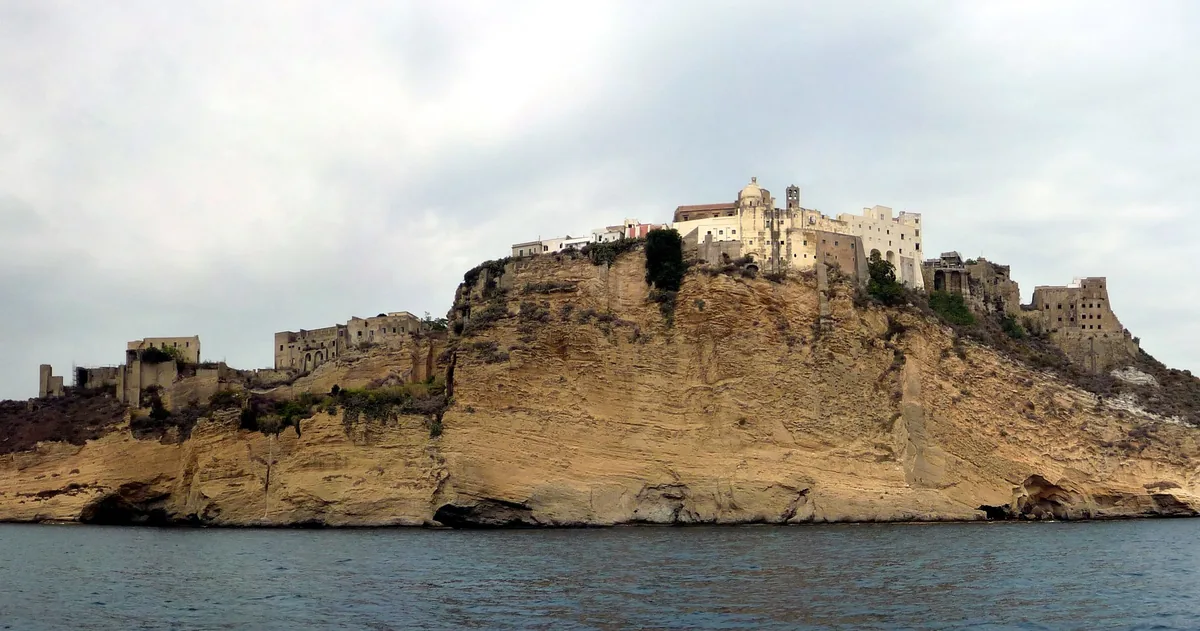
Santa Margherita Nuova is a church with a former Dominican convent attached, planted on the ridge between Marina Corricella and Terra Murata. Today it is above all a space for exhibitions. Most visitors go past without going in, look out over the wall and carry on: it is a legitimate choice, and sometimes the only one available.
The Dominicans in flight
The church was built from the second half of the sixteenth century onwards, and the reason is written in the name. The Dominicans were at Santa Margherita Vecchia, down below, on the Chiaiolella side — the headland that closes the beach still carries that name. They came up here to escape the Saracen raids.
It is the same logic that explains Terra Murata and its walls: in the sixteenth century, on Procida, being high up meant staying alive. The new convent starts as a refuge, not as a choice of view. That the refuge then happened to have one of the best views in the bay is a consequence, not a plan.
On the lower levels there is a remarkable system of cisterns for collecting rainwater, and it is the detail that tells you most about life here: on a ridge with no springs, water was problem number one and it was solved by collecting every drop from the roofs.
Collapses and restorations
In the winter of 1956 the complex suffered serious structural collapses. For decades it stayed a ruin looking over the most photographed village on the island, which on Procida was for a long time an embarrassment.
The restoration of the church was completed in September 2012. The one on the convent is still going on: it means that part of the complex is not accessible and that the works can move openings and routes from one season to the next. If you read somewhere that all of it can be visited, that source is old.
What you actually visit
Do not take entry for granted. The building works as an exhibition space, and opening, ticket and route depend on the exhibition running at the time. The hours that circulate — Monday to Friday 10:00-19:00, Saturday and Sunday closed — are an unusual pattern, almost certainly tied to one specific display. The ticket price does not appear to be published.
The practical rule is simple: come up here for the view, which is guaranteed and free, and treat the inside as a bonus. If the door is open, go in and ask what it costs; if it is shut, you have not wasted the trip, because the reason you came up is outside.
When the rooms can be visited, the value is in the space rather than in the objects: the nave, the convent rooms, the relationship between the masonry and the drop below. Do not expect a museum with captions and permanent collections.
The view
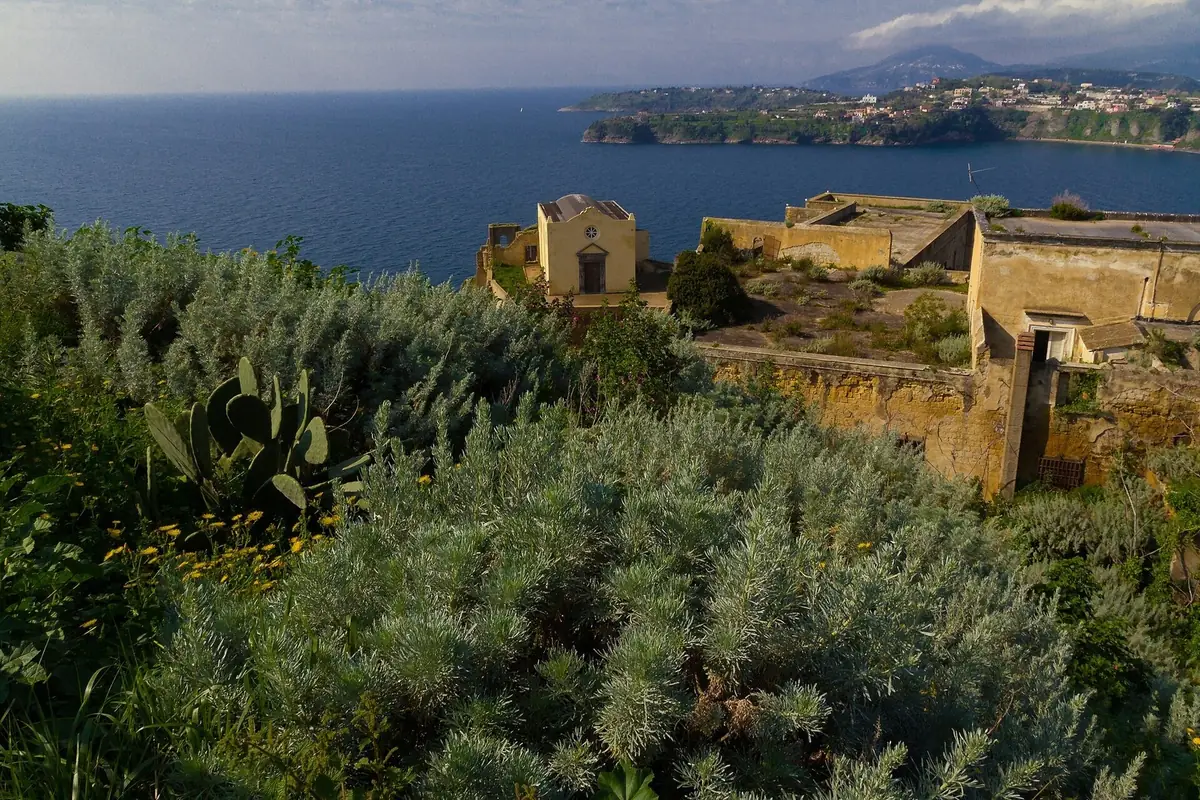
It is the reason this page exists. From the terraces and from the edge of the climb the Corricella is seen head-on, from above, with the fronts one on top of another and the quay closing the semicircle: the most classic view from above on the island.
The best light is early in the morning, when the sun comes from the east and lights the houses full on; in the late afternoon the front goes into shadow but the colour warms up and the boats come back in. In the middle of the day, in summer, the contrast is too harsh and the fronts flatten out.
A note for anyone taking photographs: the spot is narrow and in high season you take turns. Arriving before nine means having the wall to yourself, and seeing the village waking up rather than the village having lunch.
A building half done
It is worth looking at it for what it is: a complex in mid-stream, half restored and half building site, balanced on a ridge. It is not a finished monument and it does not pretend to be one.
From outside the structure reads clearly. The church is the compact volume holding the front towards the sea; the convent stretches away behind, on the landward side, with the retaining walls dropping towards the Corricella. It is those low walls that hold the rest up, and they are the same ones that gave way in 1956.
It is also the right place to understand why Procida is built the way it is. On a narrow island, with little flat ground, people have always built up against the rock and on top of what was already there. Here you see it in section, without anyone needing to explain it to you.
Getting there
You get there on foot along Salita Castello, the ridge that links the Corricella to Terra Murata. Uphill from the lower village it is a steep ten minutes or so; downhill from the upper village, far less hard work. The route is stepped and is not suitable for wheelchairs.
The sensible sequence is this: the C1 or L1 bus from the terminus at Marina Grande up to Terra Murata, then down on foot passing through here, and arrival at the Corricella for lunch. Lines and timetables are in getting around Procida, the full route in the Terra Murata-Corricella walk.
What to combine it with
Above there are the abbey of San Michele, which is free, and Palazzo d’Avalos, which is only visited by booking and with hours that have to be checked. A little below, the Casale Vascello, a seventeenth-century fortified court still lived in.
Below, the Corricella: tables on the water at Il Pescatore and at the other places along the quay, and the stairway of about 180 steps that goes down to the Chiaia beach — the sources say 186 or 182, so count on about 180 and do not be surprised if both of them are wrong.