If I had to pick a single day to come to Procida, I would pick this one. On Good Friday the island brings the Misteri out onto the street: tableaux and floats with scenes from the Old Testament and the Gospels, built from scratch every year, between forty and sixty of them, carried on shoulders down the descent from Terra Murata to the harbour. In 2027 it falls on Friday 26 March.
It is not a tourist event. It is something the Procidans have done by themselves, for themselves, for about four hundred years, and which you are allowed to watch. It is free to attend because there is nothing to attend. And there is one practical fact that decides everything: by 07:30 the procession has already set off. The first hydrofoil from Naples is not enough.
What the Misteri really are
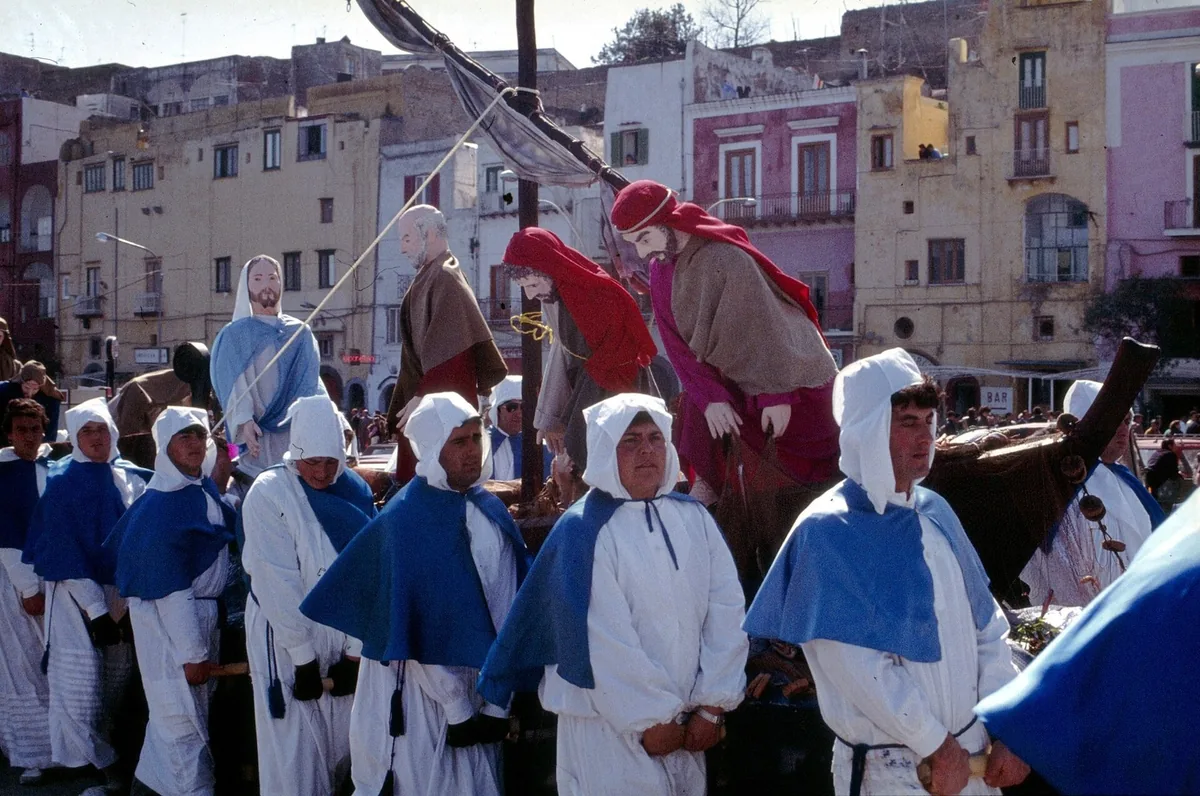
A Mistero is a built scene: an episode from the Old Testament or the Gospels, made in papier-mâché, wood, glass, metal and reclaimed materials, mounted on a frame carried on shoulders. The 2026 rules set the maximum dimensions: eight metres long, 1.8 wide, 3.3 high at the sides and 3.8 at the centre. They are big objects, and they go through narrow streets.
The part that surprises anyone coming from outside is this: they are made afresh every year. They are not kept, they are not reused. Every group — families, gangs of young people, neighbourhoods — starts work months in advance, in garages and courtyards all over the island, and in March brings out something that did not exist before. If you walk around Procida in February you come across open doors and work in progress: that is half the phenomenon.
Normally there are between forty and sixty. The number changes every year because it depends on how many groups organise themselves. The best ones go into a permanent museum near the cannon belvedere, at Terra Murata: that is where you understand the level of the craft, with no crowd in the way.
Times and route: the practical part
The times that matter, from the 2026 rules. The brethren assemble at Terra Murata by 05:00. At 05:00 the Congrega dei Turchini moves the statues of the Dead Christ and the Addolorata from its own church to the Abbey. The “chiamata” and the departure of the procession are at 07:30.
The route goes down from Terra Murata — from the Abbey of San Michele — through the old town and reaches Marina Grande, where the Misteri are lined up in the eastern part of the square. That is the moment you see them all together, standing still, and can look at them one by one.
In the afternoon the Misteri climb back up to Terra Murata. In the evening a candlelit procession carries the Dead Christ back to the confraternity’s church, San Tommaso d’Aquino. That is the most private part of the day, and the least photographed.
The day before, on Maundy Thursday, the procession of the hooded Apostles of the Confraternita dei Bianchi goes out by candlelight. Anyone staying two nights sees it; anyone arriving on Friday morning does not.
How to actually be there
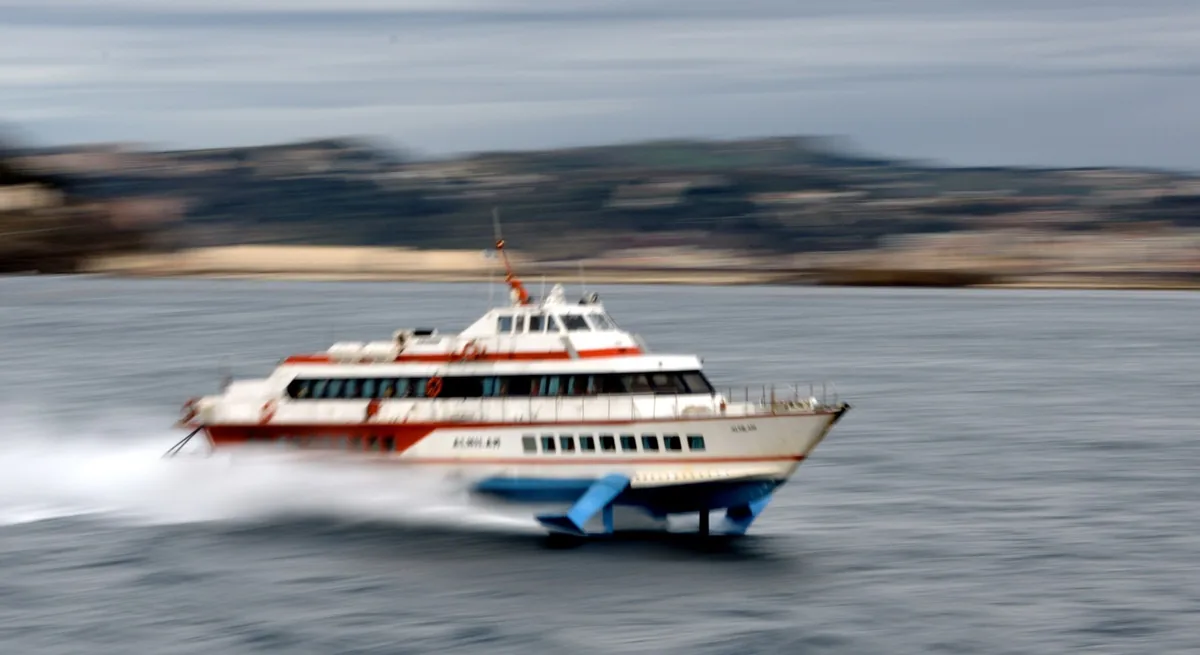
Here is the practical truth nobody writes clearly enough. If the procession leaves Terra Murata at 07:30, then to be there you have to be on the island already. The crossings from Naples and from Pozzuoli do not put you at Terra Murata at dawn: the first one gets you to the harbour when the day has been going for a good while. There are two options, and both are honest.
The first: sleep on the island. It is the only one that gives you everything — the 05:00 assembly, the departure, the descent, the line-up in the square, the climb back, the candles in the evening. In March the island is not as full as in August, but Good Friday is the day Procida fills up out of season: it is booked months ahead. The Tirreno Residence states that it is open all year; for the other properties, in March, a phone call to check is compulsory. The overview is in where to stay in Procida.
The second: the first crossing of the morning. You lose the assembly and the departure, but you arrive in time to see the Misteri coming down towards the harbour and lining up at Marina Grande. It is an acceptable compromise, and for many people it is the only possible one. Check the actual times in ferries to Procida: on public holidays they change, and Good Friday is not an ordinary Friday.
What does not work is the halfway plan: turning up mid-morning thinking you can “also fit in” the procession inside a day trip. By that hour you have arrived at the end of the day, not the beginning.
Where it comes from
The origin lies between the late sixteenth and the seventeenth century, derived from the Spanish processions that came to Naples with Spanish rule. Trumpets and drums go with it, and the sound is as much a part of what you remember as the images.
It is organised by the Arciconfraternita dell’Immacolata Concezione dei Turchini, based in the church of San Tommaso d’Aquino. The brethren’s uniform is compulsory and regulated: white alb, cord and dark blue mozzetta, hood, white shoes; non-religious symbols are forbidden. These are details that say a great deal about what this day is for the people who make it.
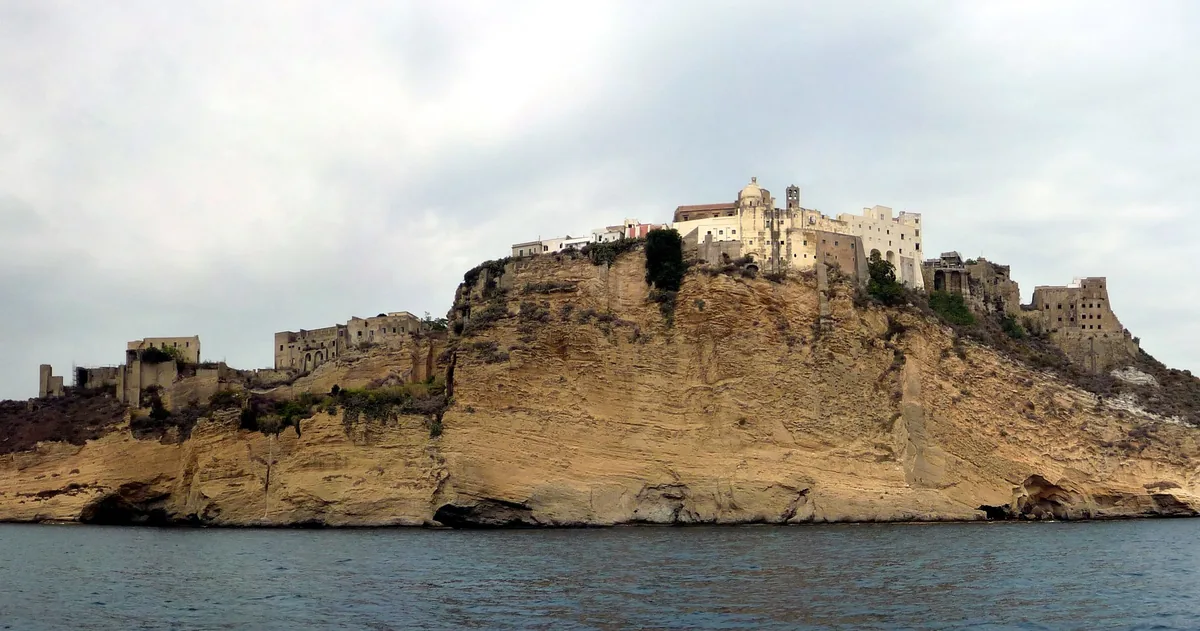
The setting is the upper village. Terra Murata is the island’s fortified acropolis, a fief of the d’Avalos family from 1529, with the Abbey, the church of Santa Margherita Nuova and Palazzo d’Avalos, the former prison. The procession is born there and comes down from there: if you do not know those places, the walk from Terra Murata to Corricella is worth doing the day before.
Where to stand
Three positions, three different days. At Terra Murata before dawn, for the assembly and the departure: it is the most intense part and the least crowded, but it is cold and you have to be up there already. Along the descent through the old town, to see the Misteri squeezing between the houses: it is the best position for grasping the size of them. At Marina Grande after they arrive, where the Misteri are lined up in the eastern part of the square: it is the only moment you look at them standing still, one by one, and the only one where the photographs work.
A piece of advice from a resident: do not try to follow the whole route on foot in the middle of the procession. Pick a spot, wait, let it pass. And remember that you are inside a rite, not in front of a parade: the silence, in the moments when there is silence, is not an interval.
The island that day, and the day after
March is not high season, and that has two faces. The good face: excellent light, no queues, low prices. The awkward face: many restaurants on the island open on and off between November and March, and Good Friday is a particular day for them too. Ring ahead, wherever you want to eat — that goes for La Lampara and for the other addresses in the restaurant guide.
On the Abbey of San Michele, be careful: the guided visit service runs from Holy Week to All Saints, so Good Friday is effectively the boundary of the opening, and in 2026, the Year of the Millennium, the official site warns that the calendar can change without notice. Check again before you climb.
If you have two or three days, Procidan Holy Week is told in full in Holy Week in Procida. If your days fall elsewhere, the most deeply felt appointment of the year after Easter is the feast of San Michele on 8 May.