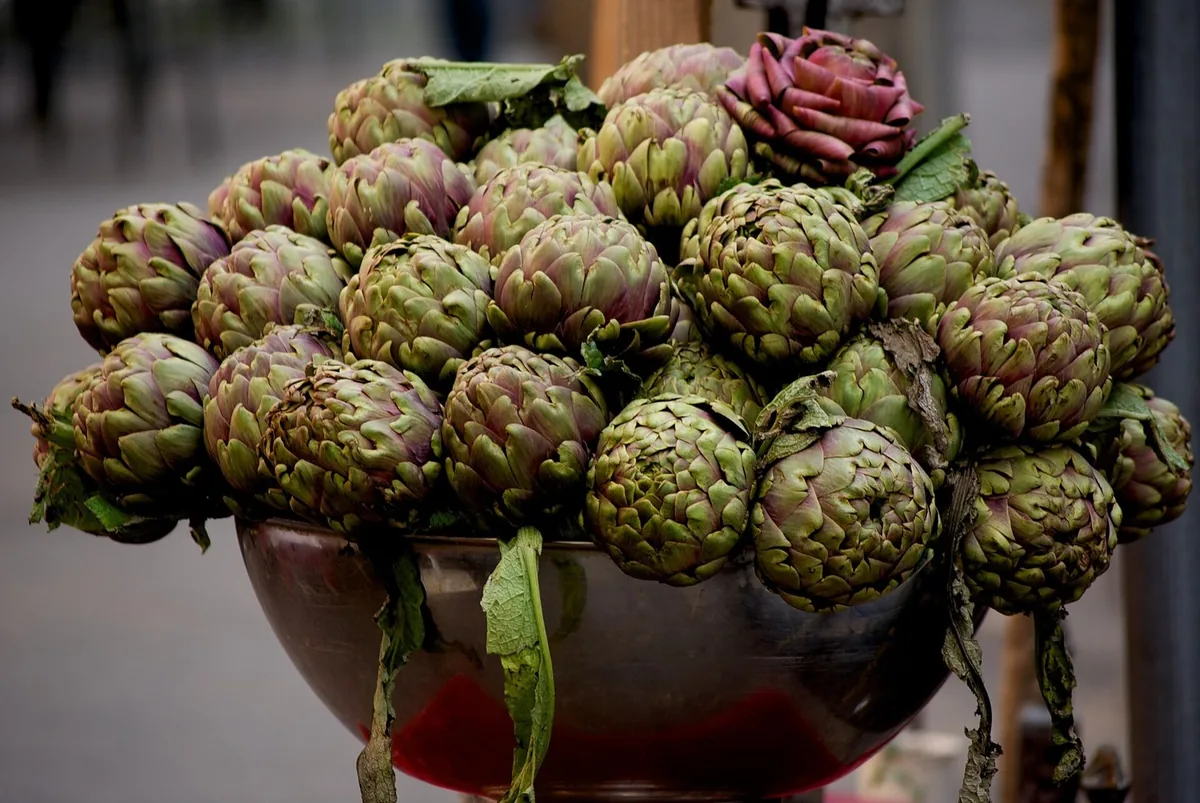
The lemon takes all the attention, but the island’s other serious farm product is the artichoke. You see it in spring on the small stalls and in the gardens behind the walls: big round heads, pale green streaked with violet. Then it disappears from view and comes back in a jar, under oil, where it stays good for months. Anyone arriving in July looking for fresh artichokes is three months late.
What kind of artichoke it is
It belongs to the Romanesco type. The plant produces a large, globe-shaped primary head, pale green with violet veining, and then smaller secondary heads that are distinctly more violet.
This distinction is not botany for hobbyists: it decides the use. The primary head, big and tender, is eaten fresh — stuffed, in the pan, fried. The secondary heads, smaller and more compact, are the ones that end up under oil, because they go into the jar whole and stand up to preserving without turning to mush.
Like the lemon, it is entered on the Campania Region’s P.A.T. list. The same warning applies: the P.A.T. is a regional register of traditional products, not a DOP and not an IGP. It does not protect the name on the market.
The preserve in oil, step by step
It is the traditional preparation, and it takes a long time, which explains why a well-made jar costs what it costs.
- The secondary heads are trimmed, taking off the hard outer leaves and the fibrous part of the stalk.
- They are blanched in water, white wine vinegar and salt. The acidity is there for the keeping and it holds the colour.
- They are drained and dried thoroughly. Leftover water is enemy number one of anything preserved in oil.
- They go into jars in extra virgin olive oil with garlic, oregano and chilli.
- They are left to mature for two months before opening. After opening, and kept properly, they hold for more than six months.
Two months of waiting means that what you buy in spring is the previous year’s crop or the first cutting: ask for the date if the jar is home-made and has no industrial label.
How you meet it at the table
In practice you find it in three forms. In mixed starters, as the vegetable component alongside fried things and seasonal vegetables — at Assafà, above Corricella, seasonal Campanian vegetables are a declared part of the cooking, and there are vegetarian options. In side dishes, when the fresh one is in season. And in a jar, as something to take away.
In home cooking it also goes into pasta, tossed with oil and garlic, and into fillings. But its natural place is the starter: sharp, savoury, oily, made to be eaten with bread before the fish.
If you want to understand it, taste an artichoke in oil and the insalata di limoni in the same meal. They are the island’s two raw-and-preserved starters and they work in the same register: acidity, oil, aromatics.
What to do with it when it is fresh
The primary head — the big globe-shaped one — is the prize piece, and on the island it stays for the most part in home kitchens. It is eaten three ways.
- Stuffed. You open the leaves out, fill it with stale bread, garlic, parsley and pecorino, and cook it in a pan with a little water and oil. This is the feast-day preparation.
- In the pan, in wedges, with oil, garlic and parsley: a straightforward side dish, which sits well with grilled fish and with rabbit.
- Raw, sliced very thin with oil, lemon and shavings of cheese. Here the limone pane makes the difference: being barely acidic, it dresses the slices without cooking them.
A practical warning: fresh artichoke goes black quickly once cut. In the kitchen it is kept in acidulated water, and in a restaurant a plate of raw artichoke that arrives grey was prepared too early.
When to find it and where to buy it
The season for the fresh one is March to May. It is a narrow window, and it coincides with the best time to come to the island in general: good weather, restaurants open, no queues for the ferries.
The preserve in oil is available all year in the food shops of Marina Grande and the Chiaiolella. There are no producers with an advertised shop that I have been able to verify: what you buy generally comes from small domestic production, and the quality varies from jar to jar.
Prices: there are no published price lists for the Procida artichoke, either fresh or preserved. Ask in the shop and compare two or three stalls before buying five jars.
Taking it home
It is the most sensible food souvenir on the island, more so than limoncello and far more so than the lingua di Procida, which goes off within hours.
Ferry precautions: pad the glass, keep the jar upright, and in hold luggage a sealed bag is worth having in case the lid gives way. Once you are home, keep the artichokes covered in oil at all times after opening and in the fridge: if they come up out of the oil, they go mouldy.