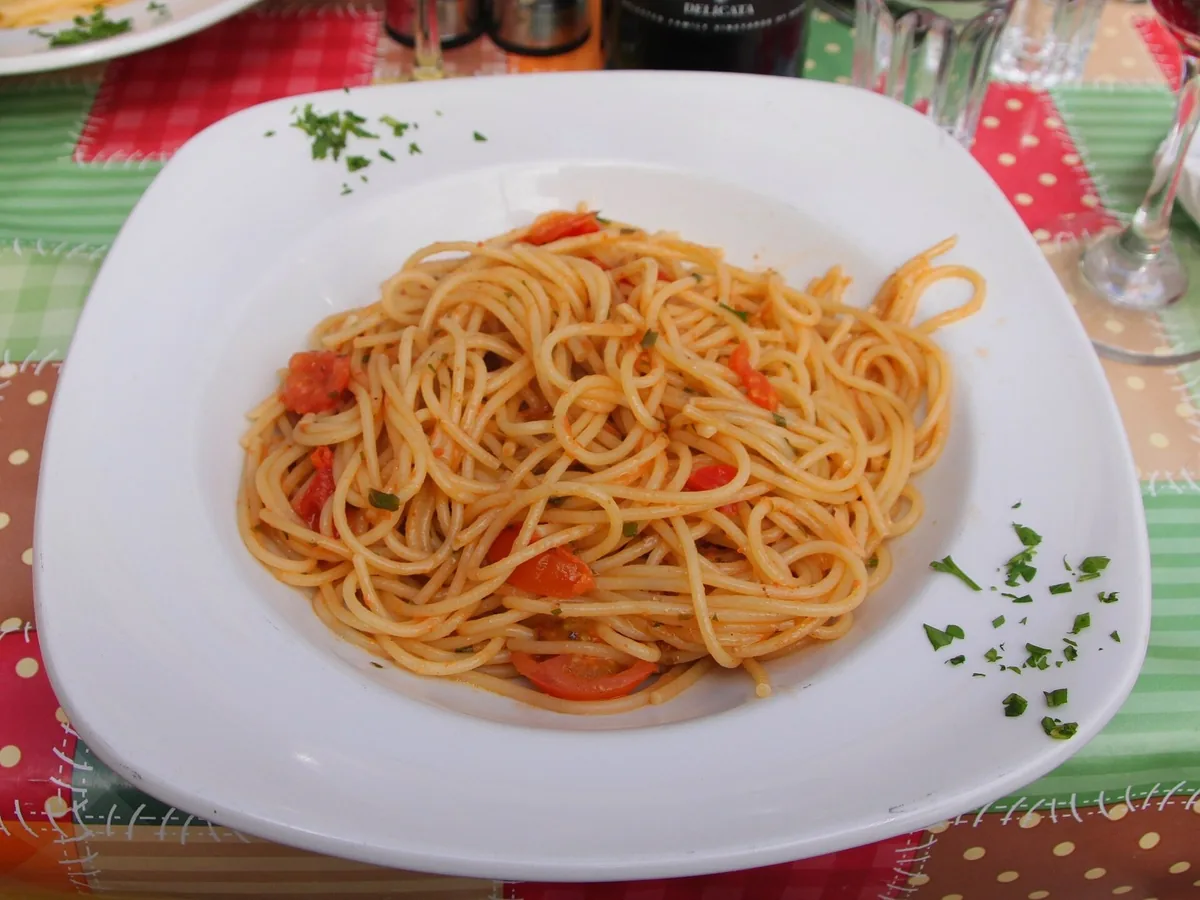

Let us get the most useful thing straight first: spaghetti ai ricci is not a dish you find as a matter of course. The harvesting of sea urchins is now subject to limits for sustainable fishing, and that means a kitchen can have them on Tuesday and not on Thursday. If you have come to Procida in August hoping to order them, ring before you sit down. Anyone who promises you they are always available, all year round, is telling you something the sea does not guarantee them.
Why you might not find them
The Mediterranean sea urchin is a resource under pressure, and its harvesting is regulated for reasons of sustainability. The practical consequence for anyone eating is simple: availability is on and off, it depends on the rules in force and on what comes in that day.
The rule worth following. Ring the restaurant on the day itself and ask whether they have sea urchins. Do not trust the printed menu: the dish stays on it even when the ingredient is not there. And if the place says yes without hesitating at some random time of year, ask where they come from.
I have not verified which specific limits are in force in the bay of Naples at this moment, and I am not inventing them: the rules on closed seasons and quantities change. The substance for you stays the same — this is a dish to ask about, not to take for granted.
How it is made, and how to tell if it is made well
The technique is all in stirring it through raw. You make a light base with oil, garlic and parsley, deglazed with white wine. The pasta is cooked al dente, drained, and the sea urchin roe is added off the heat, stirring with a little of the cooking water.
The reason is that cooked sea urchin roe loses everything: the colour turns from orange to greyish brown, the iodine smell disappears and a flat taste is left. If the plate that reaches you is dark and uniform, the sea urchins have been cooked.
There is a version with cherry tomato, more savoury and less delicate. It is legitimate, but it covers things up. If you are tasting sea urchin for the first time, take the plain version.
Sea urchins are also eaten raw, cut in half with lemon, scooped up with bread. In that case the island’s limone pane makes a different contribution from the usual one: it is barely acidic, so it does not cover the iodine.
What part of the sea urchin you eat
The orange part you see on the plate is not “roe” in the strict sense: they are the animal’s gonads, five strips arranged in a star inside the shell. Two characteristics of the dish follow from this.
The first is the yield. You get very little from one sea urchin, and a portion of spaghetti takes a good many. That is why the dish costs what it does and why the ingredient has to be handled carefully.
The second is biological seasonality. The gonads are full in the cold months and empty out after breeding: historically sea urchins were eaten in winter and spring, not in the middle of August. Today, though, the variable that really decides is the regulation of the harvest, which can make the ingredient unavailable regardless of the calendar.
If a place offers them to you on any day of the year without hesitation, there is only one question to ask and it is not rude: where do they come from. A precise answer is worth more than any description on a menu.
Where it is on the menu
On the island the dish appears on the menus of La Lampara at Corricella, which also makes tortelli with sea urchin, of Caracalè in the same bay, of La Medusa and Re Ferdinando at Marina Grande, and of La Gorgonia.
A few practical notes on these addresses. Caracalè has a verified price of around 40 EUR a head, stays open all year but from January to March on Saturday and Sunday only, and is closed on Tuesday. La Lampara is at the highest and most panoramic point of the bay: the table on the railing has to be booked a long way ahead. At La Medusa reviewers flag high prices relative to the portions, and it is worth knowing beforehand.
No restaurant in Procida has a Michelin star or a Bib Gourmand. If somebody tells you otherwise, it is not true.
What it can cost
There are no published prices for the dish on the island, so I am not inventing one. What you can bear in mind is the context: sea urchins are an ingredient with a very low yield — it takes many of them for one portion — and a regulated one. A plate of spaghetti ai ricci sits almost everywhere in the upper band of the menu, and that is consistent with the ingredient, not a tourist-island trick.
The average bill verified at two Corricella kitchens (Caracalè and La Conchiglia) is around 40 EUR a head. With a sea urchin first course you land above that, not below.
What to drink with it
A dry white, fresh, with no wood and no intrusive aromatics. The iodine of the sea urchin is killed off by any wine that is sweet or too soft. On the island there is Starza wine, a falanghina-based white made with Procida grapes but bottled under the DOC Campi Flegrei; production is tiny, so do not count on it as a guaranteed option.
No squeezed lemon over the pasta, please. On raw sea urchins it makes sense; on stirred-through spaghetti it covers up the dish you have just paid for.