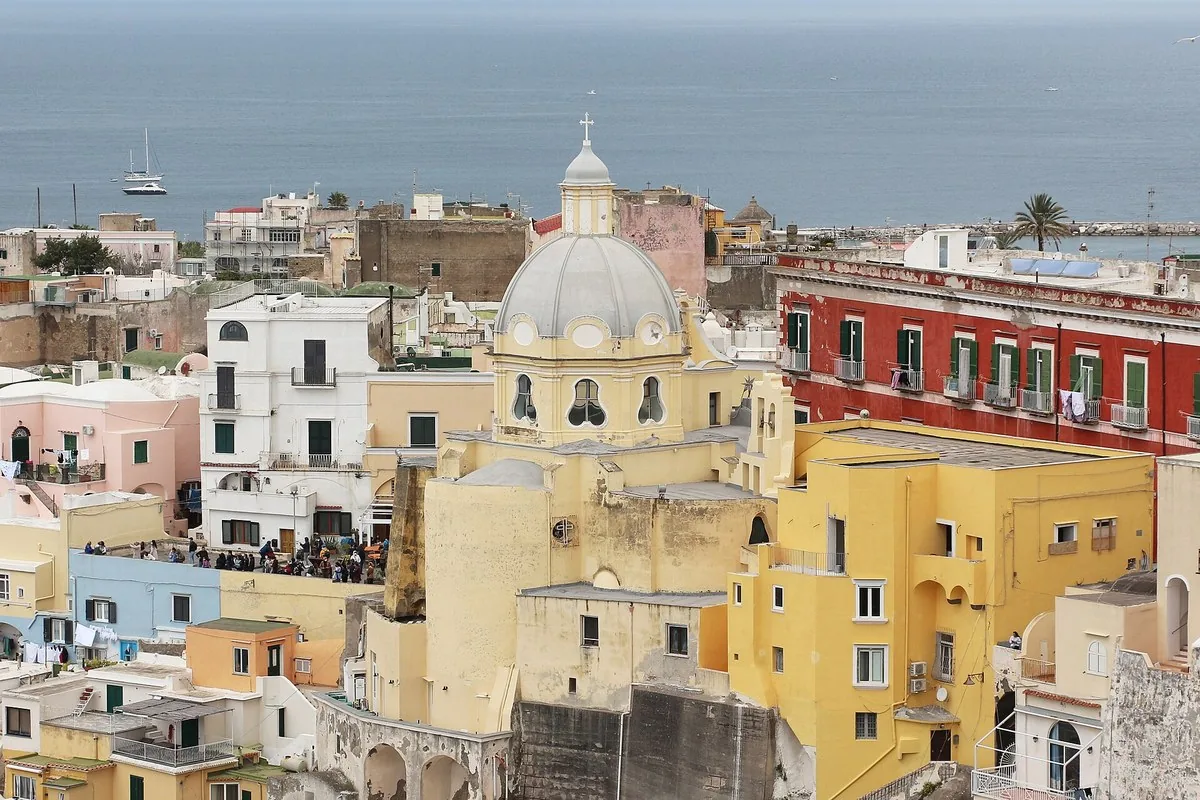
Read this before anything else. Marina Corricella is an entirely pedestrian village, with no vehicle access at all. You reach the hotel only on foot, going down one of the village’s stairways, or by sea. There is no taxi that will take you to the door, there is no road. The property is not accessible to people with impaired mobility, and it is strongly advised against for anybody travelling with heavy luggage: the cases go down and up the steps by hand. This information is worth more than any list of services, and it is worth deciding on it before you look at the photographs.
That said: sleeping at Corricella is something you can do almost nowhere else. Nine rooms looking over the oldest fishing harbour on the island, with the boats below and the pink and yellow houses crowded around. From 80 EUR a night, which is little for what you see out of the window.
The steps: how many, which ones, and what they mean
You go down to Corricella by four stairways: the Gradinata del Pennino, from via San Rocco; the Gradinata Scura, from via M. Scotti; and two that come down from the two ends of the harbour. There is nothing else. The village has no roads for vehicles, and that is not a picturesque affectation: it is the reason it has stayed as it is.
In practice it means three things. First: you come from the harbour at Marina Grande by bus or taxi as far as the nearest point, then you walk down. Second: you carry the cases yourself, or you ask the property whether it arranges help — that is the first question to ask on the phone, before even availability. Third: every time you go out and come back there are steps. At the end of a day at the sea, with the bag and the tiredness, that climb makes itself felt.
There is a partial alternative and it is the sea. A boat service links Corricella to the Chiaia beach, and the boat tours leave from the quay just below. But for getting to the island and leaving it, the steps remain.
The nine rooms
There are nine, looking over the village. The Superior rooms have a private terrace, and they are the ones worth spending more on: the terrace over the quay, in the evening, is the reason you accepted the steps. Ask for it by name when you book.
Reception is open 24 hours. In a three-star with nine rooms at the bottom of a stairway that is a service that counts for more than it seems: it means that if you arrive on the last hydrofoil or come back late from dinner, you find somebody there.
Breakfast is served on the terraces. We have no verified check-in and check-out times and we are not writing them at random: they have to be asked about when you book, along with the deadline for leaving luggage on the last day.
The La Lampara restaurant
The hotel has an in-house restaurant, La Lampara, and it is not just any hotel restaurant: it is one of the best placed addresses on the island in the travellers’ rankings, known for sea urchins when there are any, for tuna with pistachio and for grilled octopus. It sits at the highest point of Corricella, above the rooms, and the tables on the railing are booked weeks ahead in high season.
Sleeping above a restaurant like that has an obvious advantage: in the evening you do not have to climb back up. It also has a disadvantage, and that is laziness. On the quay, a few metres away, there are Caracalé, Il Pescatore and Fuego, the only pizzeria with that view. Alternate, instead of eating three evenings running in the same place.
What it is like to live in the village
Corricella is the oldest fishermen’s village on the island; the harbour as you see it today is 17th century. The architecture is spontaneous: arches, domes, steps, loggias, facades in different colours. The typical local element is the vefio, the small covered balcony with an arched vault, of Arab influence.
It is also the main set of "Il Postino": the little square is called Piazzetta Massimo Troisi. Anybody coming for the film finds half of what they are after here; the other half is at the Pozzo Vecchio beach, on the other side of the island. The full map is in the locations of "Il Postino".
The real merit of sleeping here is the timetable. From eleven to six in the evening the village is full of day visitors; early in the morning and after dinner it belongs to the people who live there and the people who sleep there. Those are the hours that repay the steps.
Is it worth it, and for whom
Yes, if there are two of you, if you walk well, if you travel with a rucksack or a light wheeled case, and if you stay at least two nights. With a single night the steps weigh too much against the time you spend there.
No, if you have mobility difficulties: it is not a matter of preference, the property is not accessible. No if you have a pushchair or big suitcases. In those cases, to keep the same view, you sleep above it: La Casa sul Mare looks down on Corricella and has road access. For a flat seaside holiday there are the Hotel Crescenzo and the Tirreno Residence at the Chiaiolella. The comparison is in where to stay at Procida.