In 1994 Procida became the island of a film that a great many Italians have seen: Il Postino, with Massimo Troisi as Mario Ruoppolo and Philippe Noiret as Pablo Neruda. Ever since, one of the island’s six beaches has been called, even by people born here, the Postino beach, and the little square at Marina Corricella carries Troisi’s name.
People who come for the film locations often expect something that is not here: a marked route, signs, a house museum. Nothing of the kind exists. On the spot there is nothing set up for the visitor: the bay is still the bay, and that is all. Anyone with the scenes in their head recognises it at once; anyone without them sees a small beach below a cemetery. It really is worth watching the film again before you set off.
And then there is the problem of the attributions. On the island, houses, corners and terraces are pointed out as film locations, and most of these claims do not come from any verifiable source. We keep them separate, and we say which two things we can confirm.
What the sources confirm
Few things, but solid ones.
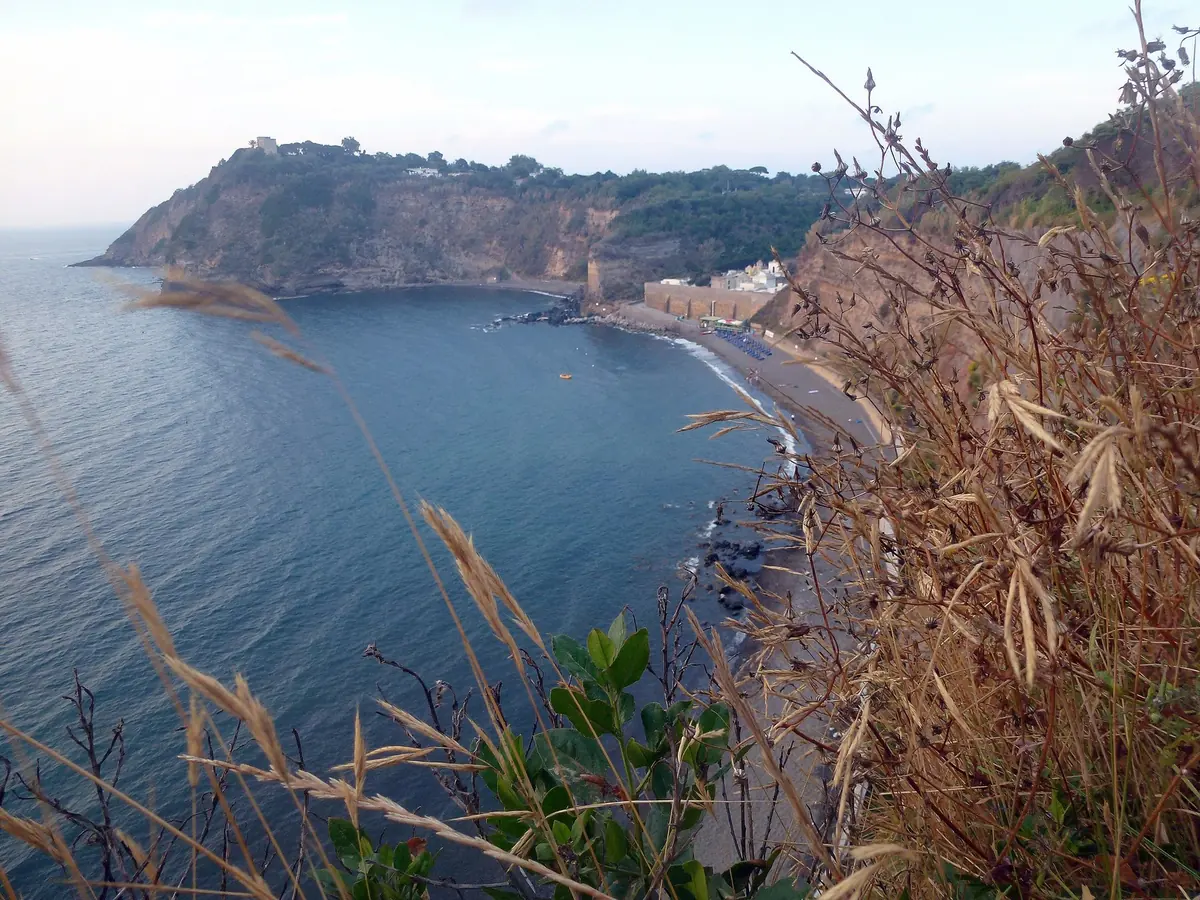
- The Pozzo Vecchio beach is the set of the scene in which Mario Ruoppolo, played by Massimo Troisi, reads Beatrice the poems of Neruda. It is the most precisely documented location of the whole film on the island.
- Marina Corricella is the main set. The fishing village with its coloured houses is the setting the film lives in, and the local sources name it as such without ambiguity.
- The Piazzetta Massimo Troisi, at Corricella, is named after the actor. It is a dedication made after the film, not a set with an identified scene: the distinction matters.
Outside this list the "they say" begins. We do not contradict them — we have nothing to contradict them with — but we do not present them as facts.
The Pozzo Vecchio beach: how you actually get there
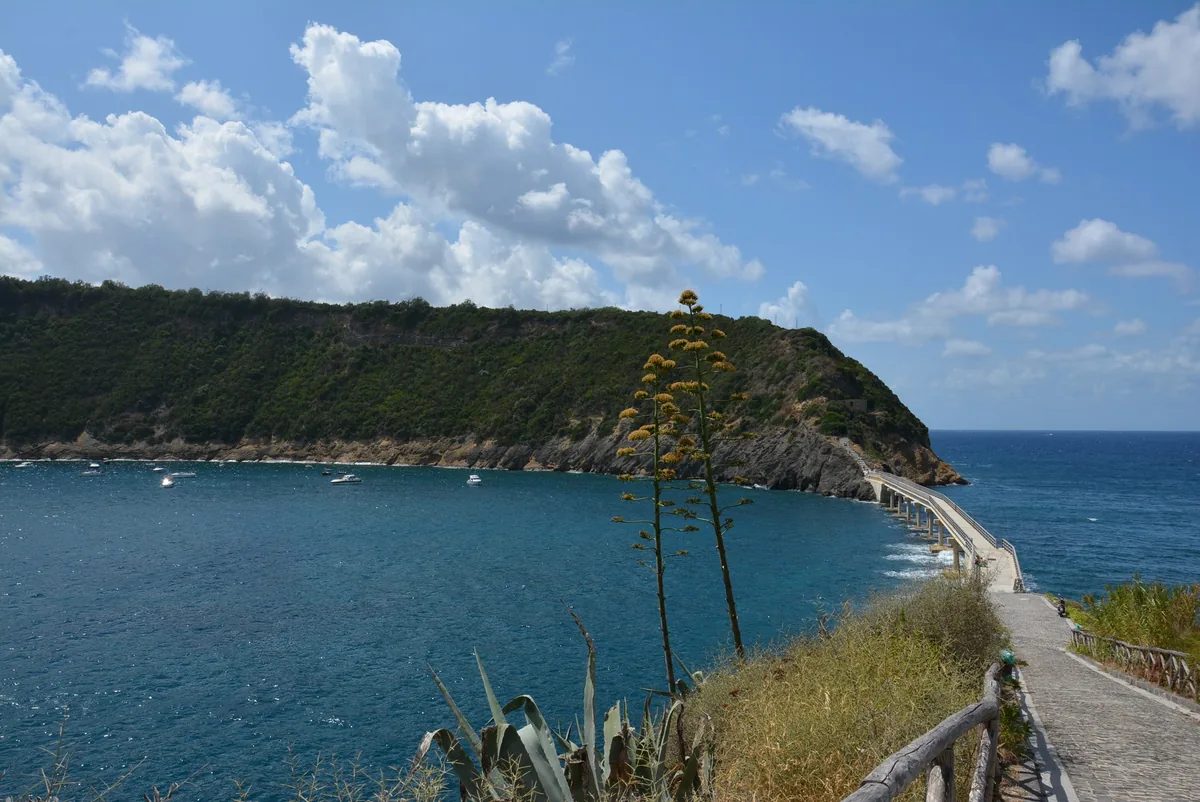
It is a small horseshoe bay on the north-west coast, below the municipal cemetery, closed off by Punta Serra to the south and Punta Ottimo to the north. You reach it from Via Cesare Battisti, beyond the cemetery: from the port there are two ways, the C1 bus line, which runs exactly port–Pozzo Vecchio beach–port, or twenty minutes or so on foot from Marina Grande. The bus ticket costs 1.20 EUR bought on land in a bar or tobacconist, 1.40 EUR on board.
From the road you go down a short but steep stairway. How many steps there are we do not write: no source states it and counting them by eye is not a figure. Around it there is open countryside and one small bar; on the sand, described as very coarse, a single beach club operates, the Lido Annamaria, whose prices and contact details do not appear to be published.
Three practical warnings, because this is not only a cinephile stop. There is almost no shade: in the middle of the day the bay has no cover, and you need a parasol. Buy your water first, because there is only one bar here. And it is not a whole-day beach: it is small and exposed, and it works very well for two or three hours. The full picture is in the entry for the Pozzo Vecchio beach.
The right moment is late afternoon. From 17:00 onwards the sun drops onto the sea in front of you, the light becomes the good light for photographs and the bay empties. If you are here for the film and not for a swim, half an hour at that time is worth more than three hours at midday.
Marina Corricella, the main set
It is the oldest fishing village on the island: the port as you see it today is seventeenth-century, and the architecture is the spontaneous kind of arches, domes, stairs, loggias and multicoloured facades. The local element to look out for is the vefio, the small covered balcony with an arched vault, Arab in influence: it is the detail that makes Corricella recognisable in a photograph even to someone who has never been.
The thing to know before you go down is the access. There is no vehicle access at all: the village is entirely pedestrian and you reach it only by four stairways — the Gradinata del Pennino from via San Rocco, the Gradinata Scura from via M. Scotti and two from the ends of the port — or by sea. From Marina Grande it is about ten minutes downhill, and the way back is uphill. With luggage, or with mobility difficulties, it is a real obstacle.
The Piazzetta Massimo Troisi is on the quay, where the village widens out. Around it are the restaurants that work on the water: La Lampara, Caracalè, Il Pescatore and Fuego, which is the only pizzeria facing the quay and the lowest price bracket in the village. In high season the tables on the water are booked days in advance.
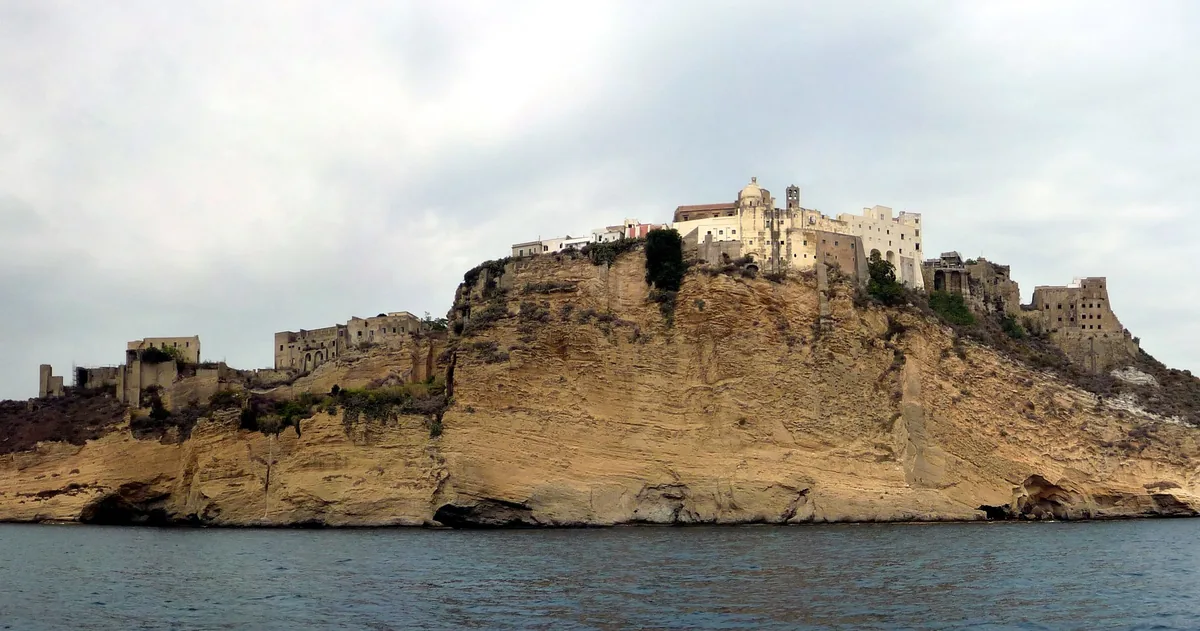
The view from above, the one everyone is after, is not had from the village but from over it: from the Belvedere dei Cannoni at Terra Murata and from the terraces of Santa Margherita Nuova, when the church is open. The Terra Murata–Corricella walk lines the two up without making you climb twice.
What gets told, and what we do not confirm
Going around the island you will hear people point out with confidence the postman’s house, Beatrice’s window, Neruda’s terrace, the stretch of road ridden by bicycle. These are widespread attributions, repeated by informal guides and by the people who accompany visitors, and they do not come from any of the sources we have checked.
That does not mean they are false. It means we cannot confirm them, and that a guide that publishes them as facts is making a leap. If someone tells you them on the spot, listen gladly: oral storytelling is part of how an island keeps itself alive. But keep it for what it is.
Another thing you will not find: displays, explanatory plaques, a museum of the film, an official signposted route. They do not exist. The most concrete risk for anyone coming here is the wrong expectation, not disappointment with the place.
The half-day round, if you are short of time
It makes sense to build it around the light, and it works well in an afternoon.
- From the port, the C1 bus to the Pozzo Vecchio in the early afternoon, or twenty minutes on foot if you would rather walk. Go down the stairway, have a swim if you feel like it, stay until the late afternoon light.
- Back to the port on the same bus, and then the walk down to Corricella, about ten minutes from Marina Grande.
- Corricella at aperitivo hour: the quay, the Piazzetta Massimo Troisi, the vefi and the boats. If you stay for dinner, book.
- The climb to Terra Murata, if you have the legs and the light left: the view from above over the village is the one you remember afterwards.
One recommendation on timing that concerns anyone coming for the day: in summer the buses are frequent, but off season, from October to May, the last departure is around 21:00, and the seasonal evening runs disappear. Check the last hydrofoil too: the 20:05 Procida-Naples sailing only operates from 15 June to 15 September.
If instead you want to see the coast from the sea side, the boat tour around the island passes in front of the Pozzo Vecchio bay and stops for photographs in front of Corricella: two hours, and no stairways.
Corricella is not a stage set: people live there
It is the thing we ask you to keep in mind more than any other. The village is the oldest fishing settlement on the island and it goes on being lived in and worked in: the boats on the quay are real boats, the nets spread out are somebody’s nets, and the stairways you go down to take photographs are the way home for the people who live there. The windows are a metre from where you walk. A little restraint about the volume of your voice and about the lens pointed through open doors is the least you can do.
The same goes, a little further up, for the Casale Vascello, the seventeenth-century fortified courtyard that many people visit as though it were a monument: it is not. It is an inhabited residential courtyard, with no hours and no tickets, and two entrances that may not both be open.
You can sleep in the village, and it changes the experience a great deal: when the last hydrofoil takes the day trippers back to Naples, the quay is left to the residents and to the people sleeping here. The Hotel La Corricella has nine rooms facing the village and the La Lampara restaurant on the top floor, with indicative prices from 80 EUR; the warning, though, is a serious one and we repeat it: pedestrian area, reached only on foot by the stairs, not accessible to people with disabilities, and not advised with heavy luggage. Anyone who wants the view from above rather than water level can look at La Casa sul Mare, in Salita Castello, ten rooms in an eighteenth-century palazzo with a private terrace and a view over the bay. The full picture of the areas is in where to stay in Procida.
Beyond the film: the island the cinema made famous
It is worth remembering that Procida is not only a set. In 2022 it was Italian Capital of Culture, the first Italian island to receive the title: 150 events in 330 days, 350 artists from 45 countries, and Artecinema among the main projects. The most concrete legacy of that year is the restoration of Palazzo d’Avalos, the former Bourbon prison at Terra Murata reopened in June 2025, which can only be visited with a guide by booking and whose hours, it has to be said, are not verified.
Then there is the literature, which got here before the cinema: the island is the setting of L’isola di Arturo by Elsa Morante, and out of that novel comes a town prize founded in February 1986. There too we have separated the documented from the storytelling: it is in the article on Elsa Morante and Procida.
If this is your first time, the advice is not to reduce the island to the locations of a film: line up the monuments and the beaches as well, starting from what to see in Procida, and leave the Pozzo Vecchio the role it deserves, which is that of a fine half day.